
Infrastructure Azerbaijan built to bypass Armenia could now be Yerevan's lifeline
Akbar Novruz
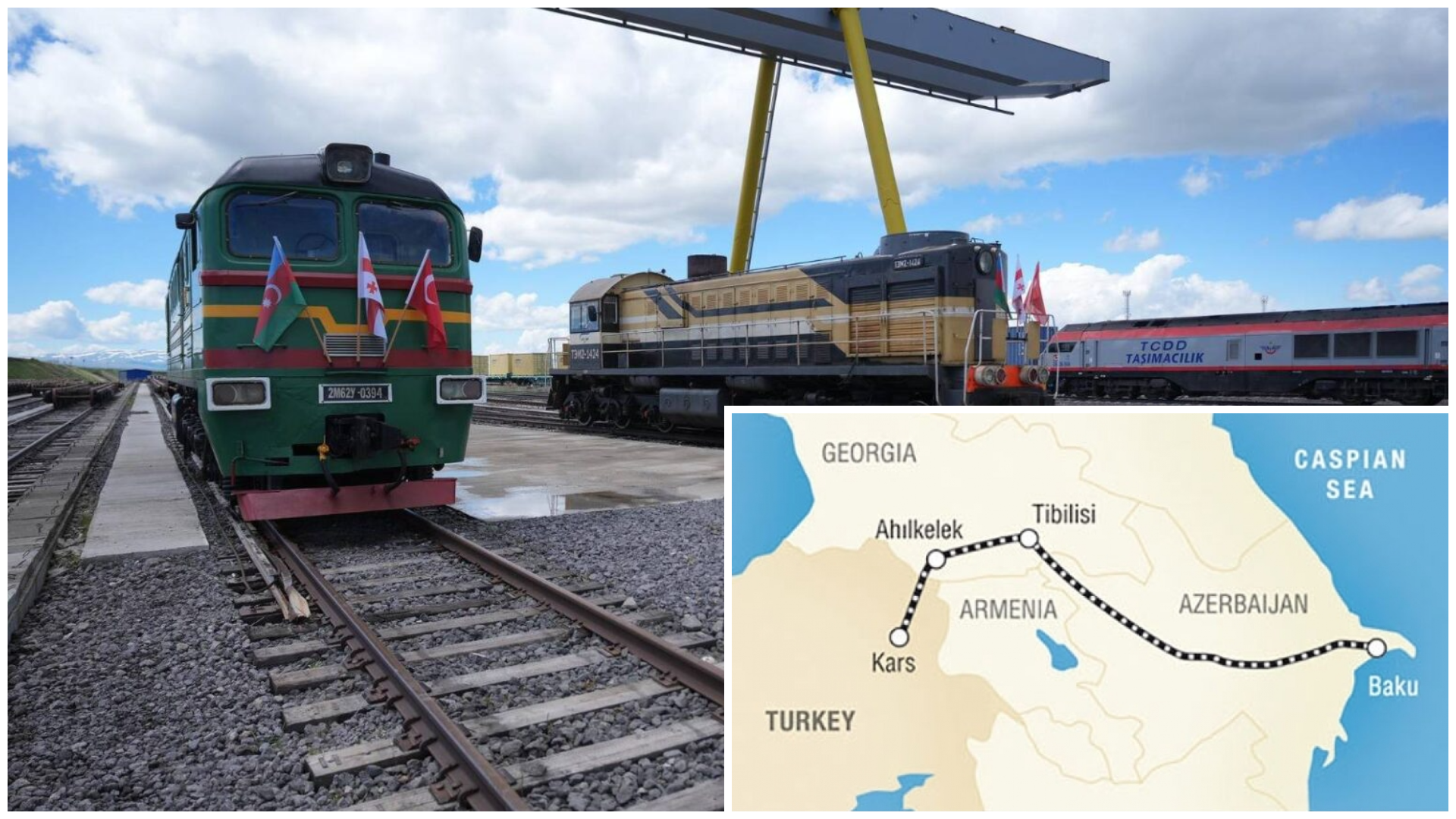
Read moreThe Baku-Tbilisi-Kars railway finally got a full-scale launch after opening in 2017 but only running tests for nine years. When it began operations, it had much lower capacity than what was initially intended. Now, though, annual freight capacity jumped from one million to five million tons thanks to upgrades in the Georgian section. Azerbaijan fully paid for these improvements. To mark the big day, transport ministers from Azerbaijan, Georgia, and Türkiye joined in some symbolic action at the station. They all pushed a button and let a freight train roll through. It was quite a photo-op for Reuters to capture. In a move watched closely by officials in Yerevan, Baku, and Moscow, Georgia’s prime minister Irakli Kobakhidze addressed the press. He mentioned that his country could work more closely with Armenia and might include them in the BTK project in the future.
That sentence, delivered at an infrastructure ceremony, is the most consequential diplomatic signal to emerge from the South Caucasus transport sector this week, and its implications extend well beyond freight timetables. The BTK railway is what Yerevan fought against for ten years, pushing for its veto in European capitals and Brussels. Meanwhile, Azerbaijan bankrolled it, Georgia constructed it, and Türkiye hooked it up to their rail network. Armenia argued the BTK would cut them out of regional connectivity, and boy, were they right. Their exclusion happened exactly as predicted. Now, whether this exclusion can be reversed is the main point raised by Tuesday’s ceremony.
There are specific numbers that needed to be highlighted; perhaps the modernization of the project led to a significant increase in those numbers. That includes:
The capacity increases from 1 million to 5 million tonnes annually after upgrades. The rail is 827 km long, connecting Baku to Kars through Tbilisi. Of that, 213 km runs through Georgia. Azerbaijani funding comes in at $775 million for the Georgian section, which will be repaid through transit revenue. Target freight transit time is 4.5 days from Alat port in Baku to Mersin on Türkiye's Mediterranean coast.
Now the real question - what does it change for Armenia?
The BTK's initial one-million-tonne annual capacity was pretty small in business terms. Sure, it worked as a symbolic link, a way to show that the Middle Corridor could work in theory, but it wasn't enough to handle major freight traffic between China and Europe. When they boosted that to five million tonnes, perhaps, everything changed. The Middle Corridor's overall container traffic shot up by 90% from 2022 to 2025, with 390 China-Europe block trains running each year. This expansion lets the BTK really support that growth instead of just suggesting it. Along with boosting their capacity, they're also setting up a unified tariff system for the Trans-Caspian International Transport Route, turning a theoretical path into an actual profitable venture.
For Armenia, upgrading the railway raises the stakes if they don't join in. A BTK line carrying a million tonnes yearly was tolerable, as being left out didn't hurt too much economically. But with that figure rising to five million tonnes, and possibly growing to fifteen when the Zangezur link comes online, it becomes a bigger issue. Plus, Armenia's exports really need these new routes. Their agricultural products were banned from Russia by Rospotrebnadzor right before the country’s elections on June 7. This ban forces Armenia to reroute through Europe using pricier logistics via Georgia. With the BTK passing through Georgia and Türkiye and connecting to Europe, it's the quickest path west. Each month, being excluded gets more costly.
Now, realistically, as much as it is easy to say this on paper, the implementation nature is much more different.
One being, Armenia's main rail infrastructure, which is operated by a Russian state-linked company under a 30-year concession that restricts Yerevan's ability to unilaterally develop new rail connections without Moscow's consent. For instance, the Russian Southern Railways lease expires in 2038. Pashinyan has threatened to override it ("will not allow railways to turn into scrap metal") but has not yet done so.
Another obstacle is the Armenian section of the Zangezur corridor. The only unbuilt segment of the corridor is the Armenian section. The Turkish side is tendered and under construction; the Azerbaijani side is nearing completion; the Nakhchivan section is planned for 2026.
The Original BTK was a joint project among Azerbaijan, Georgia, and Türkiye. For Armenia to join, all three countries must agree and set commercial terms. Fortunately, Georgia is open to it, Türkiye has no issues, and while Azerbaijan is conditional, they'll probably agree with progress in the peace rotation.
The infrastructure condition of Armenian railways: Armenia's lines toward the Turkish and Azerbaijani borders are in poor condition. The Ijevan–Hrazdan and Vanadzor–Gyumri tracks need major upgrades for the "east-west shortest route" Pashinyan discussed. Luckily, European investors show interest. The ADB CAREC framework might help too. Plus, the costs stack up nicely against the economic benefits.
Last but not least, the elections on June 7. As far as it stands, from the given promises, the rhetoric and ideas, a Pashinyan victory enables the connectivity agenda to continue; a Russia-aligned opposition win would reverse it. The same election shapes whether the Zangezur corridor talks progress or stall. This 'obstacle' resolves within days, but the outcome is genuinely uncertain.
Broader picture
With that said, Kobakhidze's comment in Akhalkalaki fits into a pattern starting since the August 2025 Washington peace declaration. Azerbaijan began exporting fuel and fertilizers to Armenia. In his Baku Energy Week letter, UK Prime Minister Starmer pointed out these energy exports as the first real success of the peace process. At the BTK ceremony, Georgian, Azerbaijani, and Turkish officials gathered at the same table in Georgia. Nine years ago, Armenia was noticeably absent. This event asked whether the setup that left Armenia out is now intentionally being changed to include it. So, Kobakhidze's remarks partly answered this question.
Currently, it depends. Azerbaijan wants economic integration after, not before, political progress on the peace agreement. The key? The Zangezur corridor's Armenian part. An important date is June 7th for elections. A Pashinyan government returning with a mandate is the most plausible path toward the 41-kilometre segment being built, the BTK's doors opening to Armenian freight, and the South Caucasus acquiring the genuinely triangular connectivity architecture that has been described, but not yet delivered, as a "South Caucasus House." However, a Russia-backed leader means no such progress, and the corridor stays undone for another year. That stretch has been incomplete for three decades now, making it one of the region's biggest unfinished projects.
Here we are to serve you with news right now. It does not cost much, but worth your attention.
Choose to support open, independent, quality journalism and subscribe on a monthly basis.
By subscribing to our online newspaper, you can have full digital access to all news, analysis, and much more.
You can also follow AzerNEWS on Twitter @AzerNewsAz or Facebook @AzerNewsNewspaper
Thank you!