
Middle East conflict sends shockwaves across global gas markets

Ulviyya Poladova
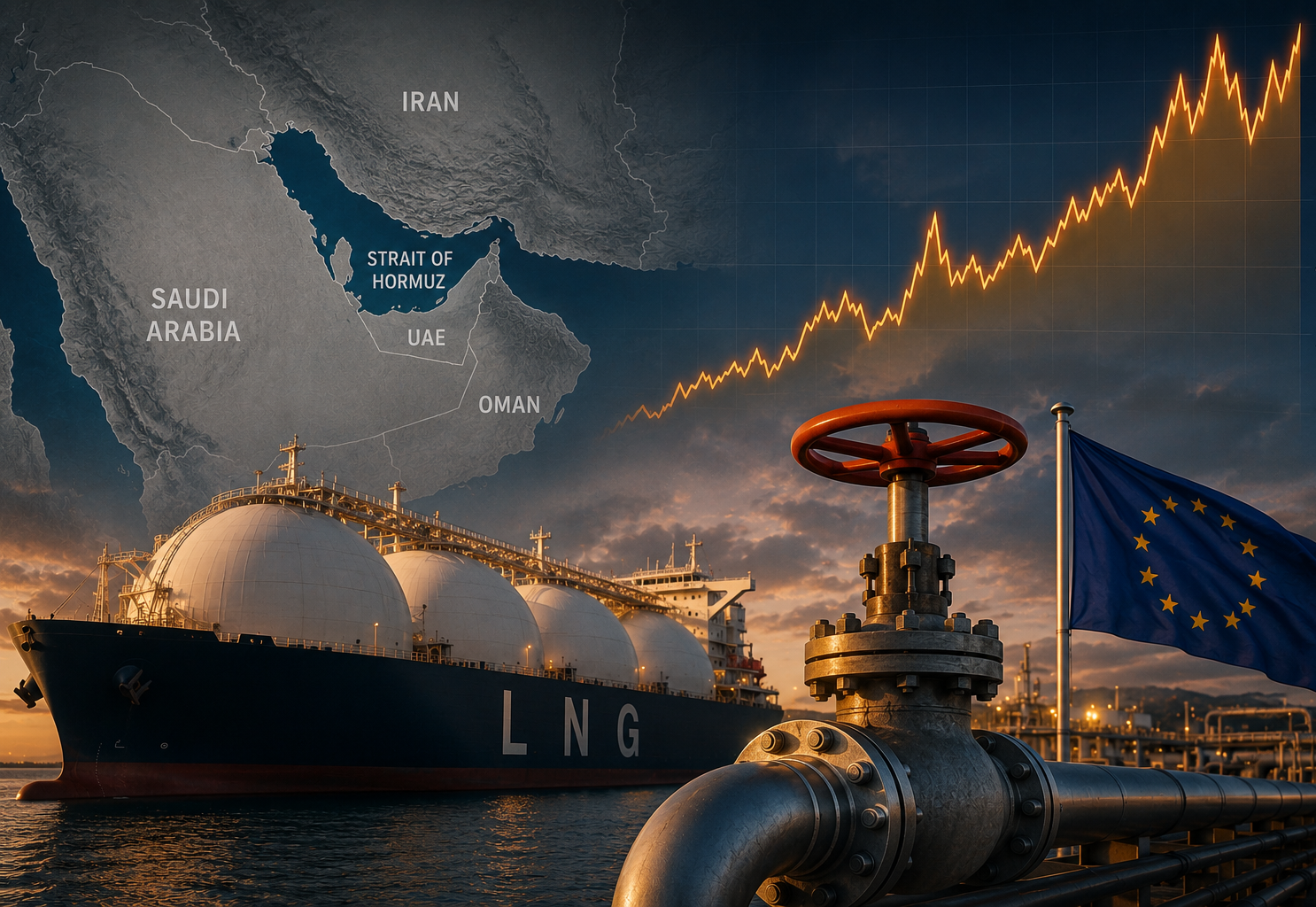
Read moreThe economic shockwaves from the renewed conflict in the Middle East are no longer confined to crude oil. In one of the most striking recalibrations of the year, Goldman Sachs has lifted its European natural gas price forecasts substantially, citing the prolonged disruption to liquefied natural gas (LNG) flows through the Strait of Hormuz. The conflict is reordering the global gas market in ways that could outlast the immediate hostilities and reshape energy trade well into the next decade.
The latest revision by Goldman Sachs of its short-term forecast for European natural gas prices illustrates the scale of this vulnerability. The US investment bank has raised its forecast for prices at the Dutch Title Transfer Facility (TTF), Europe's key gas trading hub, citing the continuing tensions in the Middle East and the possibility that liquefied natural gas (LNG) supplies from the Gulf will recover more slowly than previously expected.
Goldman Sachs now expects TTF gas prices to average €60 per megawatt-hour in the third quarter of the year, up from its previous forecast of €41/MWh. Its forecast for the fourth quarter has also been raised from €40 to €53/MWh. For 2027, the bank increased its projection from €30 to €31/MWh.
At first glance, the increase in the 2027 forecast appears relatively modest. However, the sharp upward revisions for the third and fourth quarters demonstrate how quickly geopolitical risks can affect energy prices. The market is not simply responding to current supply disruptions. It is also pricing in uncertainty over how long those disruptions may last, how quickly LNG infrastructure can return to normal operation and whether alternative suppliers can compensate for lost volumes.
It is worth adding that the Strait of Hormuz, through which roughly 20 percent of global LNG exports pass, cannot be reopened as quickly as analysts assumed when the conflict first erupted.
The consequences of gas disruptions could be particularly serious for Europe. After the energy crisis of 2022-2023, European countries made major efforts to reduce their dependence on pipeline gas from Russia and increase LNG imports. This strategy provided greater flexibility but also made Europe more dependent on global LNG markets.
In other words, Europe has reduced one form of vulnerability while increasing another. Instead of relying primarily on a limited number of pipeline suppliers, European buyers now compete for LNG cargoes in a global market. When supply is disrupted in one major exporting region, the consequences can rapidly spread to Europe and Asia.
This is why a disruption in the Gulf can increase European gas prices even when the physical disruption does not occur directly on European territory. LNG cargoes are redirected toward markets willing to pay the highest prices. If Asian buyers increase their demand to secure alternative supplies, European consumers may face stronger competition for available cargoes.
Goldman now expects Northwest European storage to end October at about 67 percent capacity - down from its earlier forecast of 74 percent - and to fall to as low as 28 percent by the end of winter if temperatures return to seasonal norms.
One of the most concerning scenario outlined by Goldman Sachs is the implicit argument that the repricing of European gas may prove stickier than markets assume. The bank explicitly notes that in a scenario in which Middle East energy exports only gradually normalize through 2027, prices could climb above €100/MWh as Europe is forced to outbid Asian buyers for a shrinking pool of cargoes.
This is not a tail risk to be dismissed. Europe's pivot away from Russian pipeline gas has made it structurally reliant on LNG, and LNG is a globally traded, fungible commodity. Any disruption to major exporters translates almost immediately into upward pressure on European prices.
Just do not miss that high gas prices directly affect energy-intensive sectors such as chemicals, metals, fertilizers, glass and manufacturing. They also influence electricity prices because natural gas-fired power plants often play an important role in balancing electricity systems.
The relationship between gas and electricity is particularly important. Even when renewable energy generation is expanding rapidly, gas-fired power plants remain essential in many markets because they can be dispatched relatively quickly when wind or solar generation falls.
This means that gas prices can affect the wider economy through electricity markets. A rise in gas prices can increase wholesale electricity prices, raise production costs and place additional pressure on households.
According to projections from the International Energy Agency, global electricity demand is expected to grow by 3.6% in 2026 and 3.8% in 2027, exceeding the 3% growth recorded in 2025. Global electricity consumption is projected to increase from approximately 28,600 terawatt-hours in 2025 to 30,700 terawatt-hours in 2027.
The recent increase in gas prices has already encouraged some countries to replace natural gas with coal in electricity generation. This highlights another difficulty in the global energy transition, because when gas becomes too expensive or unavailable, countries may temporarily return to more carbon-intensive fuels. In that case, geopolitical instability can slow progress toward climate objectives even when renewable energy capacity continues to expand.
The Middle East tensions have once again demonstrated that the energy system remains highly interconnected. A disruption in a strategically important maritime corridor can affect gas prices in Europe, electricity costs in Asia and investment decisions around the world.
As electricity demand continues to grow and the global economy becomes increasingly dependent on digital infrastructure and electrification, the importance of energy security will only increase. The countries best positioned to manage future shocks will be those that combine diversified energy supplies with strong infrastructure, flexible electricity systems and a rapid expansion of renewable energy.
For Azerbaijan, these global developments carry particular significance. As a major energy producer and an increasingly important transit country, Azerbaijan is closely connected to the changing dynamics of international energy markets. The country's strategic location between the Caspian Sea, Europe and Central Asia gives it the opportunity to play a greater role in ensuring regional energy security.
Azerbaijan has already established itself as a reliable supplier of natural gas to European markets. Through the Southern Gas Corridor, Azerbaijani gas reaches several European countries, helping diversify energy supplies and reduce dependence on individual suppliers. At the same time, the expansion of gas exports remains an important element of the country's economic and foreign policy.
However, the changing global energy landscape is also creating new challenges for Azerbaijan. The increasing volatility of gas prices, geopolitical risks and the gradual shift toward renewable energy mean that long-term energy security cannot rely solely on hydrocarbon exports.
Here we are to serve you with news right now. It does not cost much, but worth your attention.
Choose to support open, independent, quality journalism and subscribe on a monthly basis.
By subscribing to our online newspaper, you can have full digital access to all news, analysis, and much more.
You can also follow AzerNEWS on Twitter @AzerNewsAz or Facebook @AzerNewsNewspaper
Thank you!