
Missiles over Türkiye, talks in Islamabad: Is this Washington's last exit?
Akbar Novruz
Read moreAs Iranian missiles strike Türkiye for the fourth time and a new regional security order stirs quietly in Riyadh, Pakistan is threading an almost impossible needle, holding Washington's hand while standing beside Tehran's neighbour. The next 72 hours may determine whether diplomacy survives the war.
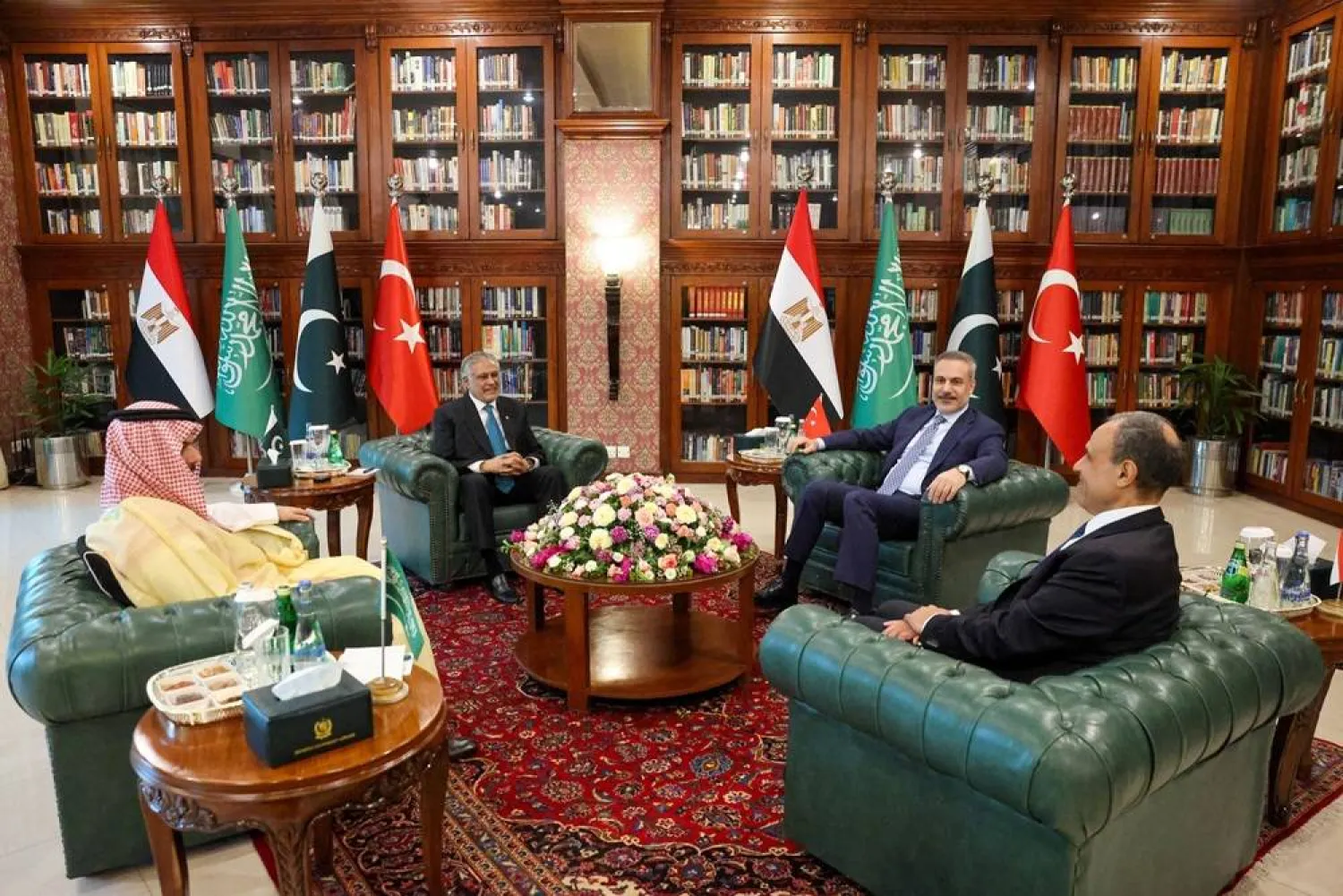
The room in Islamabad on Sunday contained four foreign ministers, a war now in its 30th day, and a question no one in the room seemed quite willing to ask aloud: Is there a way out of this now, or has the window already closed?
The foreign ministers, Pakistan's Ishaq Dar, Türkiye's Hakan Fidan, Saudi Arabia's Faisal bin Farhan, and Egypt's Badr Abdelatty, had assembled in the Pakistani capital for a meeting described in official language as a coordination meeting. In reality, they were seeking to build the last available exit strategy before a decision is made by the United States on whether to send ground troops into Iran.
That Islamabad has emerged as the centre of this effort is, to say the least, surprising. Pakistan is not a great power. It is a country struggling to cope with an energy crisis of its own, guarding a porous 900-kilometre border with Iran, hosting the world's second-largest Shia population, and battling the Taliban in its western territories. It has a defence treaty with Saudi Arabia, which commits it to consider an attack on Riyadh an attack on itself, which Iran has already done. And yet, in some inexplicable manner, it is Pakistan that both Washington and Tehran claim to trust.
"Pakistan is very happy that both Iran and the US have expressed their confidence in Pakistan to facilitate the talks", - Ishaq Dar, Pakistani Deputy Prime Minister and Foreign Minister.
Islamabad acted as a go-between between Washington and Tehran in the early days of the conflict, an activity that US special envoy Steve Witkoff admitted publicly. Then the go-betweens started to make proposals. Pakistan conveyed a 15-point US ceasefire plan to Tehran, which the Iranians examined and then rejected, presenting alternatives of their own. In a small but telling move, the Iranians agreed to allow 20 Pakistan-flagged ships, two daily, to pass through the strait. It was not a ceasefire. It was, however, an indication that Tehran was willing to extend good faith, albeit limited, to Islamabad.
The rationale behind this improbable situation is partly historical. In 1971, Pakistan enabled the confidential visit by Henry Kissinger to China, which opened China to the US. It is said that this single act rearranged the global geopolitical landscape for a generation. It is frequently referred to in the context of Pakistan, and with reason. It is because this event established the identity of the nation as one that can connect the unconnectable. Even the Saudi-Iran détente via China in 2023 has further opened up the room for Islamabad to work with Tehran without offending Riyadh.
While the ministers were holding their meeting in Islamabad, the war was giving its own commentary. In fact, on Monday night, NATO announced that it had intercepted a fourth Iranian ballistic missile over Turkish airspace, the latest in a string of incidents that began on 4 March when debris landed in the southern province of Hatay. The fact that Türkiye, which is a member of NATO, has been extremely careful in what it has said about the incidents is evident in the fact that Ankara has been talking about interceptions, not attacks; deterrence, not retaliation. In fact, Erdogan said to his countrymen, "We are leaving absolutely nothing to chance regarding the security of our borders and airspace." US Defense Secretary Pete Hegseth was quick to point out, however, that none of these incidents had resulted in Article 5 of the NATO treaty, which pertains to collective defense.
Nevertheless, the restraint itself is a diplomatic act. And Türkiye is at the same time a NATO ally, a state that has already declared Iran’s initial strikes legitimate in the context of self-defense, and now a candidate for membership in a new security format in the region, together with Saudi Arabia, Egypt, and Pakistan. It is possible only because the "Islamic NATO" concept that its designers are trying to create is not a military alliance in the first place.
The gathering on the sidelines of the Riyadh OIC summit on 19 March, which included the same four foreign ministers who met in Islamabad ten days later, came up with a phrase that must be closely examined. Turkish Foreign Minister Fidan said to reporters: "We are exploring how, as countries with a certain degree of influence in the region, we can combine our strengths to solve problems." The phrase is almost comically low-key. The real issues under discussion among these four countries include a security alliance that will combine Pakistan's nuclear capabilities, Türkiye's conventional military and defense industry, Saudi Arabia's financial and Islamic credentials, and Egypt's position as the most populous Arab country and the largest military in the Arab world.
What is the "Islamic NATO"?
The Strategic Mutual Defence Agreement (SMDA) between Saudi Arabia and Pakistan was signed in September 2025 and includes a collective defence clause: any aggression against one party is treated as aggression against both. Türkiye has been in advanced talks to join the pact since January 2026, with Egypt also being considered for inclusion.
The framework is explicitly not modelled on NATO; its architects describe it as a "security platform" for defence industry cooperation and coordinated policy. Each member brings complementary assets: Pakistan, a nuclear deterrent; Türkiye, conventional military depth and drone technology; Saudi Arabia, financial resources and religious authority; Egypt, demographic weight and military capability.
The architects of this framework, in their attempt to set it apart from NATO, also want to ensure that it is a space that all four nations can occupy at once, a position that NATO membership would not allow, as it also comes with a set of obligations that would not allow Pakistan to balance its relations with both Washington and Tehran at present. "The pursuit of a pact by Türkiye represents a continuation of a particular foreign policy tradition: not replacing NATO, but making its own position within NATO more secure." Similarly, in terms of its relations with Saudi Arabia, "limited alignment without military entanglement" has been how analysts have characterised Pakistan's stance on not allowing military action against Iran, even as it continues to maintain its defence commitments to Riyadh.
Then there are potential risks as well...
Iran has already rejected the US ceasefire plan, which was mediated by Pakistan. Iran's parliamentary speaker has accused the US of planning a ground invasion. The Pentagon, according to a report in the Washington Post, has been preparing options for weeks of ground operations, although it is still unclear whether President Trump will approve this plan. Yemen's Houthis have now entered this war for the first time, firing on Israel, which has now sparked the spectre of a second blockade at the Bab el-Mandeb Strait. The UAE is seeking reparations from Iran for attacks on its civilians. Major aluminium factories in Bahrain and the UAE were damaged in strikes over the weekend.
Moreover, according to Associated Press, key Gulf powers, including Saudi Arabia and the UAE, are urging Donald Trump to continue military operations against Iran, believing that Tehran hasn't been sufficiently weakened. The UAE is particularly assertive, even discussing a potential ground operation, while Saudi officials warn that ending the conflict now would not achieve a favourable deal.
Both Riyadh and Abu Dhabi seek guarantees to neutralise Iran’s nuclear and missile programs and ensure the Strait of Hormuz remains open. In contrast, Oman and Qatar are calling for diplomacy and dialogue to de-escalate the situation.
Given that, similar to the current NATO, the concept of an "Islamic NATO" could represent a coalition of nations cooperating under a shared agenda. However, this coalition could also be perceived as exerting pressure on MENA countries that aspire to maintain their autonomy and independence from external influence. That means the US influence.
Diplomats say the next 48 to 72 hours will tell if this is the moment it all comes together. They point to the possibility of talks between US Secretary of State Marco Rubio and Iranian Foreign Minister Abbas Araghchi taking place in Islamabad in the coming days. It could be the first direct contact between the two parties since the war started. But what happens next won’t be decided in Pakistan. Yet the world is looking to Islamabad as if it might be.
Here we are to serve you with news right now. It does not cost much, but worth your attention.
Choose to support open, independent, quality journalism and subscribe on a monthly basis.
By subscribing to our online newspaper, you can have full digital access to all news, analysis, and much more.
You can also follow AzerNEWS on Twitter @AzerNewsAz or Facebook @AzerNewsNewspaper
Thank you!