
Corridor of consequence: Armenia, Azerbaijan and politics of transit

Akbar Novruz
Read moreWhen Yerevan's deputy prime minister called the opening of Azerbaijani transit routes "significant", he was understating a seismic shift. Two countries forged in conflict are now exchanging fuel, grain, and, cautiously, trust.
It was, on the surface, a single sentence delivered at an intergovernmental council meeting in Shymkent, Kazakhstan. Mher Grigoryan, Armenia's deputy prime minister, described the lifting of transit restrictions through Azerbaijani territory as a "particularly noteworthy event" that "opens prospects for unlocking the full potential of the region."
Diplomatic boilerplate, perhaps. Except that it wasn't.
Perhaps, Grigoryan was not simply describing a logistical convenience. He was, in the terminology of Caucasus diplomacy, making a declaration of strategic intent. In linking this move to "strengthening mutual trust and advancing the peace agenda," Grigoryan was saying something that would have been considered unthinkable five years ago: namely, that the natural direction of Armenia is no longer around Baku but through it.
"The recent removal of transit restrictions to Armenia through Azerbaijan's territory is a particularly noteworthy event for us, as it opens prospects for unlocking the full potential of the region."
To understand what has changed, you have to comprehend the degree to which Armenia has been defined by its detours. Isolated from two of its four neighbors, Azerbaijan to the east and Turkey to the west, Armenia has built its entire transit structure on the basis of the routes left to it. A full 70% to 80% of Armenia's international trade has passed through Georgian territory, and it is a dependency that left the latter vulnerable to the transit fees, the closure of the Lars crossing in the winter months, and the aftershocks of any political tension en route. Even an overdependency.
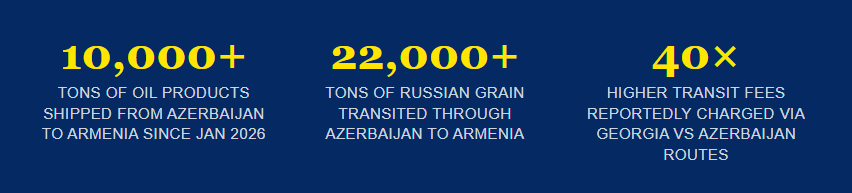
The numbers, when you lay them out, are remarkable. Since January 2026 alone, more than 10,000 tons of oil products, which include diesel fuel and petroleum, have moved from Azerbaijan to Armenia. More than 22,000 tons of Russian grain and 610 tons of fertiliser have transited through Azerbaijani territory on their way to Armenian tables and fields. Two countries that fought two wars within three decades are now exchanging fuel and grain.
This is a really historic moment. And it is also, in a region where nothing is ever simply economic, a shift in the balance of power. The old route through Georgia was expensive: it was reported to be up to 40 times what the equivalent charge would have been in Azerbaijan. And that has already prompted debates in Yerevan about whether a direct rail link with Azerbaijan, which has lain dormant since the first war in the early 1990s, should be rebuilt.
In human terms, the consequences are straightforward: cheaper, faster supply chains translate into lower food and energy prices for ordinary Armenians. That creates opportunity, but it also creates the kind of structural dependence that Armenian opposition figures have begun to raise with increasing urgency. When your rival becomes your fuel source, the nature of rivalry itself changes.
And one more thing, with trade flowing constantly, could technically give the long-stalled peace treaty another view. From Baku's perspective, the formal treaty is indeed a must, given the fact that Armenia's territorial reference in the Constitution does not guarantee finality of anything. But there is a great human and geopolitical factor that adds a different view here.
The human dimension in this case is that both ordinary people on both sides have benefited from the trade, and therefore, there is a new constituency for peace that did not previously exist. The longer the trade continues without a treaty, the more both governments will face pressure to formalise what has already become economically real.
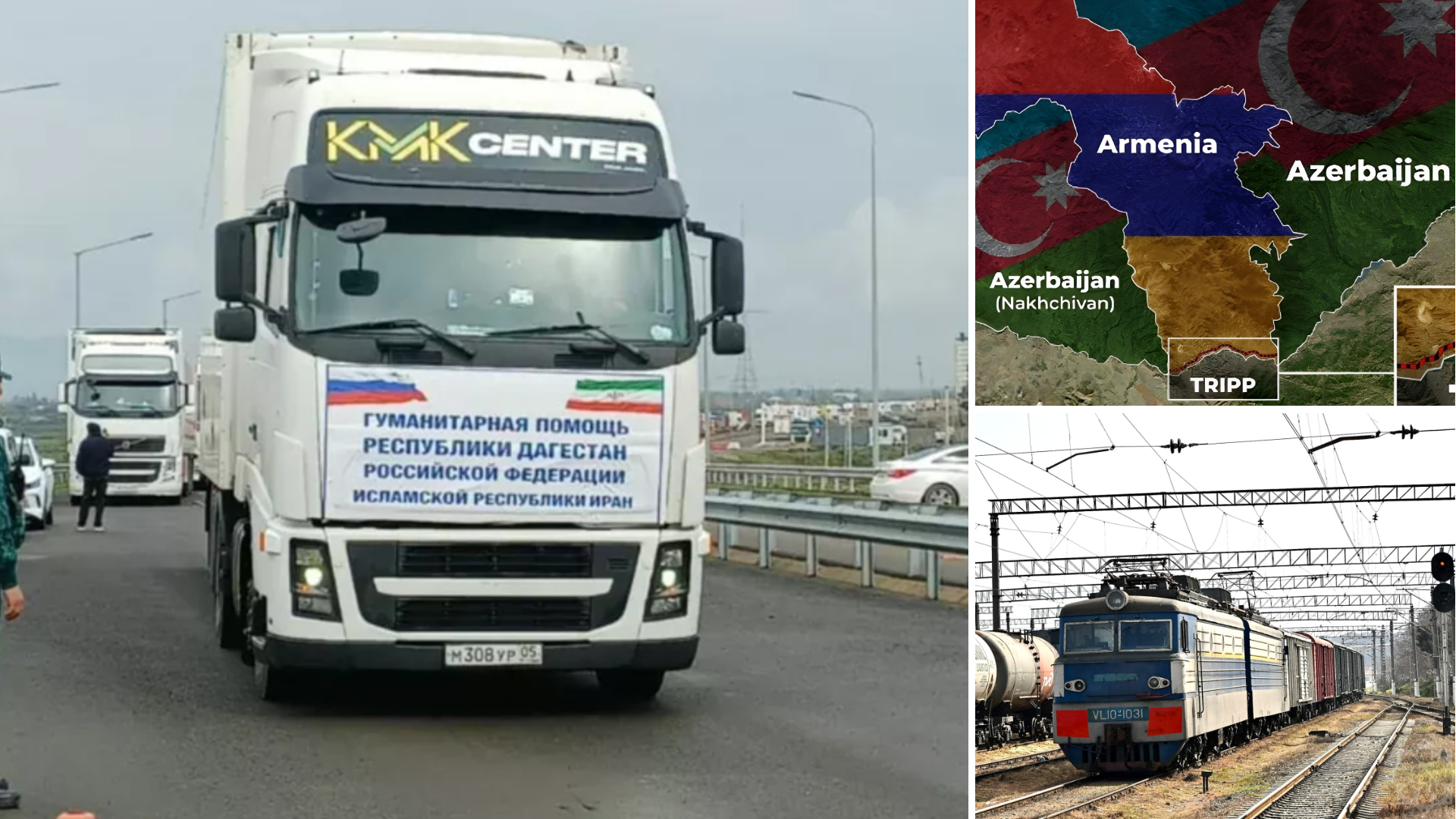
The geopolitical dimension is the current reality. During the ongoing US, Israel-Iran war, we have actually seen a draft of what is yet to come. Both Russia and Iran did not hesitate in giving their ‘protest’ regarding the opening of the TRIPP route, which connects the route between the exclave of Nakhchivan and Azerbaijan through Armenia. Whether at the level of government officials or through media outlets. During the period of war, the reality of the South Caucasus became evident as both Baku and Yerevan played a role in serving as a bridge to transfer humanitarian aid. That really means something. This is called managing interdependencies with extraordinary dexterity, positioning itself as indispensable to every major player in the region simultaneously.
So, every wagon that now travels through Azerbaijani territory is, in this light, a political statement. Yerevan is signalling that it is ready to embed itself in the new South Caucasus architecture, for better or worse.
Here we are to serve you with news right now. It does not cost much, but worth your attention.
Choose to support open, independent, quality journalism and subscribe on a monthly basis.
By subscribing to our online newspaper, you can have full digital access to all news, analysis, and much more.
You can also follow AzerNEWS on Twitter @AzerNewsAz or Facebook @AzerNewsNewspaper
Thank you!