
Iran committed to restore ties with Egypt, but long road ahead
By Sara Rajabova
Since the fall of Hosni Mubarak in February 2011, Iranian officials have worked with Egypt's new government to slowly restore diplomatic ties. However, despite Iran's efforts on normalizing ties between the two powerful countries, the Iran-Egypt relations remain unsatisfactory.
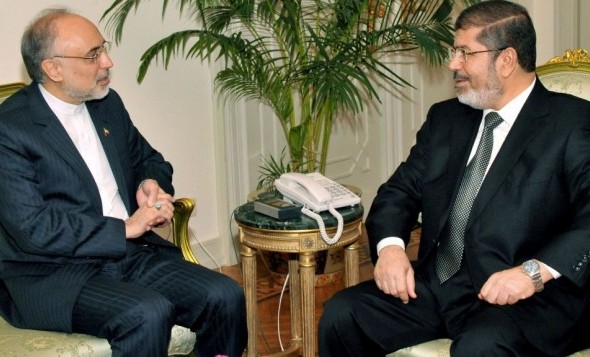
Despite tension Iran is committed to thaw the cold diplomatic relations with Egypt and the recent two-day visit of Iranian Foreign Minister Ali Akbar Salehi to Cairo is evidence of these endeavors.
Within his Africa tour, Salehi held meetings in Cairo last Thursday with Egypt's president and foreign minister. Salehi was in the Egyptian capital to discuss the conflict in Syria and improve relations between Egypt and Iran.
Salehi said in an interview with Egyptian state television that stronger relations could lead to trade deals and that together the two countries could solve regional problems without "international interference," an oblique reference to the United States.
"Rapprochement between Cairo and Tehran does not mean being against the interests of others," Salehi added. "Each side has its own political vision."
Ties between Iran and Egypt -- among the largest and most influential countries in the Middle East -- were severed in 1978 following Iran's Islamic revolution and Egypt's recognition of Israel.
Salehi's visit to Cairo comes amid rising tensions between Sunnis and Shiites across the Middle East. A focal point of those tensions, the conflict in Syria, was at the top of his agenda as he met with top Egyptian and Arab League officials, Voice of America reported.
Despite differences over the Syria issue, the two countries are trying to solve the problem by diplomatic means and propose peace plans on resolution of the conflict, such as Iran's six-point peace plan and Egypt' s four-party diplomatic initiative.
Salehi said Iran would like to see talks between the Syrian government and the opposition start before it's too late and that regional states sit down and talk, so as to find a solution between the two sides and prevent foreign intervention.
Egyptian Foreign Minister Mohamed Kamel al Amr said that a peace proposal by President Mohamed Morsi, calling for Iran, Turkey, Egypt and Saudi Arabia to jointly negotiate an end to the Syrian conflict, was still on the table, adding that Iran has a key role to play.
Also, speaking about the divergence between Iran and Egypt, one should note the sectarian difference of the two countries which also plays some role in the differences between them.
Egypt is predominantly made up of Sunni Muslims, along with other powerful countries in the region, like Turkey and Saudi Arabia, while Iran belongs to the Shiite group of Islam, which has been a source of contention between the two nations in the past.
Salehi said in a meeting with the Grand Sheikh of Al-Azhar Ahmed Al-Tayeb in Cairo that the so-called issue of division between Shia and Sunni Muslims is a plot devised by the enemies of Islam.
He also called on Muslims to avoid conflicts and rely on commonalties instead.
Here we are to serve you with news right now. It does not cost much, but worth your attention.
Choose to support open, independent, quality journalism and subscribe on a monthly basis.
By subscribing to our online newspaper, you can have full digital access to all news, analysis, and much more.
You can also follow AzerNEWS on Twitter @AzerNewsAz or Facebook @AzerNewsNewspaper
Thank you!