
ANCA's Washington playbook and politics of pressure

Akbar Novruz
Read moreAmerican foreign policy is not shaped exclusively in the White House, the State Department, or the corridors of Congress. Beyond the formal machinery of government operates an extensive ecosystem of lobbying organisations, advocacy networks and politically active diaspora communities, each seeking to influence how Washington interprets conflicts far beyond its borders. Their power rarely comes from controlling decisions outright. More often, it lies in making certain decisions politically expensive, rewarding sympathetic lawmakers and ensuring that inconvenient questions remain on the legislative agenda.
For countries seeking closer relations with the 'Uncle Sam', this is an uncomfortable but unavoidable feature of American politics. A diplomatic breakthrough negotiated between governments can encounter resistance in Congress. An ambassadorial appointment can become entangled in domestic electoral calculations. Even a commemorative flag in a municipal park can become the subject of an international political dispute. The distance between local activism and foreign policy is sometimes remarkably short.
Long story short, the Armenian National Committee of America (ANCA) illustrates how this system operates. Frequently dismissed in Azerbaijani political commentary as little more than an outspoken diaspora organisation, ANCA has spent years building a lobbying infrastructure that extends from community mobilisation to congressional offices. Recent developments have brought those mechanisms into sharper focus, once again.
In Manhattan, Armenian-American activists claimed responsibility for the taking down of the flag representing the Azerbaijani victory day. In Washington, ANCA welcomed the Republican Senator Thom Tillis’ decision not to speed up the process of confirming Alexander Alden who was nominated as the US ambassador to Azerbaijan. The two events are quite different in magnitude and importance, but there is no proof of any connection between them. However, both events are good examples of how one can use different agencies to achieve the same goal.
Washington’s report-card politics
Take, for example, its congressional scorecards. In October [not for the first time], ANCA released grades of senators and representatives for their performance on more than 70 items, ranging from Azerbaijan to Armenia’s security and historical recognition. Some legislators earn an A or A+; some do a lot worse. After that, endorsements transform these grades into electoral messages, especially where there is an organized community base willing to volunteer and campaign.
It operates out in the open, by the way, not in the shadows. Following the November 3 midterms, ANCA boasted that 90 percent of its endorsed candidates in races that had been decided were victors. This is an assertion of victory, not evidence that ANCA produced them. Incumbency, partisanship and local conditions frequently play a larger role. The endorsements span party lines as well. To view the organization as just an arm of the Democrats is to miss half the story.
Nor does a report card establish that lawmakers trade votes for donations. Financial influence requires evidence from campaign disclosures, not insinuations about wealthy diaspora patrons. ANCA’s more demonstrable asset is organisational: it knows which committee office to contact, which legislative measure to score and which candidate to oppose.
Diplomatic appointment becomes a pressure point
A clear recent example was Alexander Alden, the nominee of President Donald Trump for the ambassador to Azerbaijan. Republican Senator Thom Tillis announced that he would veto his nomination as part of the group of nominees by the outgoing Congress. Senator Tillis does not rule out a hearing, but his move only makes it difficult for his prompt appointment. The ANCA publicly welcomed the move on November 13 and urged Senate offices to ask questions of Alden regarding the Armenian detainees, Section 907 limits on aid to Azerbaijan and sanctions.
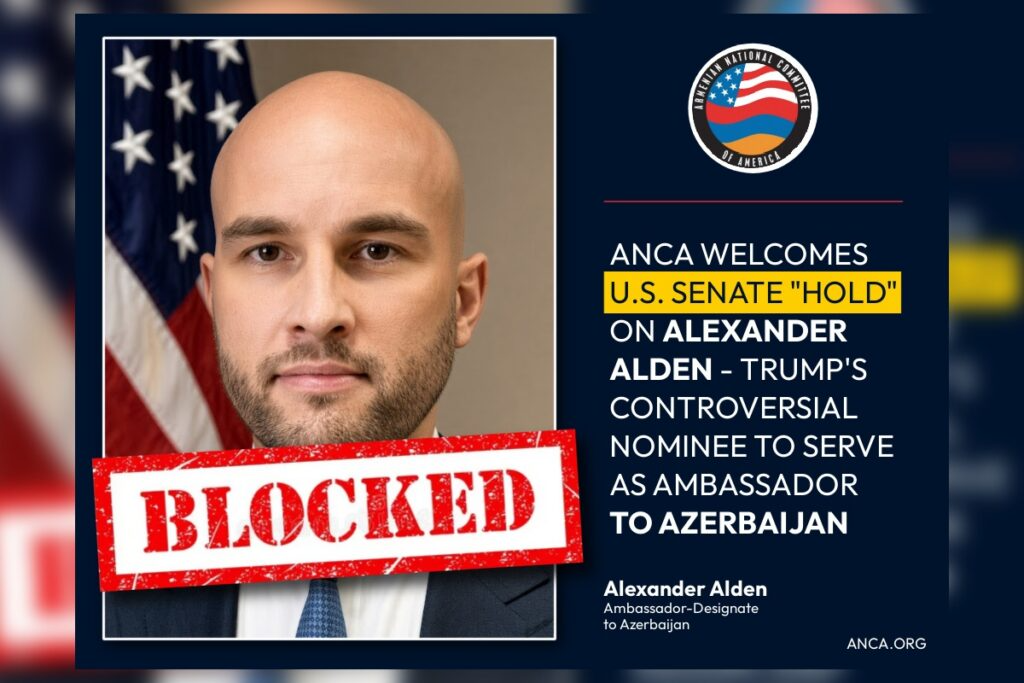
The nominee raises the issue of ethics irrespective of the concerns of ANCA. It should be noted that federal disclosure reveals that Alden, the senior counsel at Palantir, declared the value of the shares ranging from $5mn to $25mn and another $1mn-$5mn in the stock not yet vested. The ANCA claims that the defence-technology firm's future interests in Azerbaijan raise the issue of conflict. It should be noted that Alden agreed to leave Palantir and divest of his interest after confirmation.
Democrats are set to control the Senate when the new Congress convenes in January 2027. A nomination delayed into a different political environment faces fresh scrutiny and potentially different priorities. Even though US President Trump boasts about his recent "Mr.Veto" gimmick, it is unclear what the limits of that idea are. But ANCA’s celebration of Tillis’s decision is not evidence that it instructed the senator to take it. Political influence is not the same thing as authorship.
The limits of a claim and the diaspora gap Baku cannot ignore
Last but not least is the flag at New York’s Bowling Green Park – an Azerbaijani flag raised on November 8 for Victory Day purposes was taken down on November 16, according to reports from Armenian-Americans. ANCA supporters alleged that their demands had achieved the desired outcome. In a response supposedly coming from Mayor Zohran Mamdani’s office, solidarity with the Armenian community and the plight of the displaced people of Karabakh in 2023 were highlighted.
Here lies another gap in the narrative. The above-mentioned statement of the mayor does not explain the reason behind taking down the flag, nor has the actual municipal decision been proven yet. What’s more, the flag had been installed using a temporary permit. Regardless of what caused the takedown of the flag, this case illustrates how the municipal flag can be used as a surrogate battleground of competing memories of the 2020 war – liberation for Azerbaijanis, defeat for Armenians.
There is, however, an uncomfortable question for Azerbaijan itself. If ANCA has become adept at navigating American political institutions, why has the Azerbaijani diaspora struggled to build a comparably visible and sustained presence in Washington?
The problem is not so much a lack of successful Azerbaijanis abroad, nor even a lack of patriotism. The problem is the mismatch between activism and influence. Azerbaijani diasporic activism too often seems to center around ceremonies, culture days and occasionally countering anti-Azerbaijan narratives, not building long-term relationships with congressmen, developing expertise and having a regular presence in the debate over America's policies.
The practices of ANCA may well be criticized, but their organizational consistency poses an unpleasant lesson for Baku. In Washington, it pays off to know how things work there, cultivate connections and stay active long after news stories have faded away. Being influential in American politics does not mean organizing receptions and releasing statements. In order to respond to lobbying efforts complicating Baku's diplomatic agenda, the authorities need not only to criticize such campaigns, but to confront the weaknesses of their own diasporic organization. For Azerbaijan to defend itself successfully, it needs independent and professionally organized networks able to promote Azerbaijan's interests in the venues where American policies are shaped.
Peace process meets American electoral politics
For Baku, the broader issue is the effect of this pressure when it collides with a new diplomatic approach from the US side. The framework of the US policy in its declaration of August 2025 included the idea of Armenian-Azerbaijani rapprochement and a transport link through Armenia. Congressmen’s requirements for accountability may be valid topics for discussion. However, making each nomination a list of maximal demands can turn diplomacy into a political campaign.
Now the issue is not abstract. The pace of development could slow down and be less steady in the first year. Perhaps normalization cannot continue to be based solely on the successes of one summit alone. The diplomacy is real. At their Dublin meeting on November 12, Aliyev and Pashinyan discussed the proposed route’s rail and road design. This is the practical diplomacy an incoming American ambassador would inherit.
It is remarkably easy to speak with confidence about a region one barely understands, particularly from the comfort of America's self-proclaimed “Land of the Free”. Thousands of miles from the South Caucasus, complicated historical realities can be reduced to convenient political slogans, while selective narratives are presented as unquestionable truths. Freedom of expression is among America's greatest democratic strengths, but it does not automatically confer credibility, historical understanding or moral authority. The problem begins when those unfamiliar with the region's complexities turn partisan interpretations into political campaigns capable of influencing the decisions of the world's most powerful government.
Not to fabricate some all-powerful conspiracy, nor to underestimate the Armenian-Americans' voting power, but to challenge ideas with facts: build ties within both camps, emphasize the economic consequences of peace, reveal the contacts with lobbyists, and separate fact-based objections from political theater. ANCA cannot send ambassadors nor manage the parks in New York. What ANCA can do is make the decision-making process very costly for those who decide against its preferences. Enough to take a closer look at.
Here we are to serve you with news right now. It does not cost much, but worth your attention.
Choose to support open, independent, quality journalism and subscribe on a monthly basis.
By subscribing to our online newspaper, you can have full digital access to all news, analysis, and much more.
You can also follow AzerNEWS on Twitter @AzerNewsAz or Facebook @AzerNewsNewspaper
Thank you!