
Caucasian Albania at the centre of new scholarly dispute over historical identity

AzerNEWS Staff
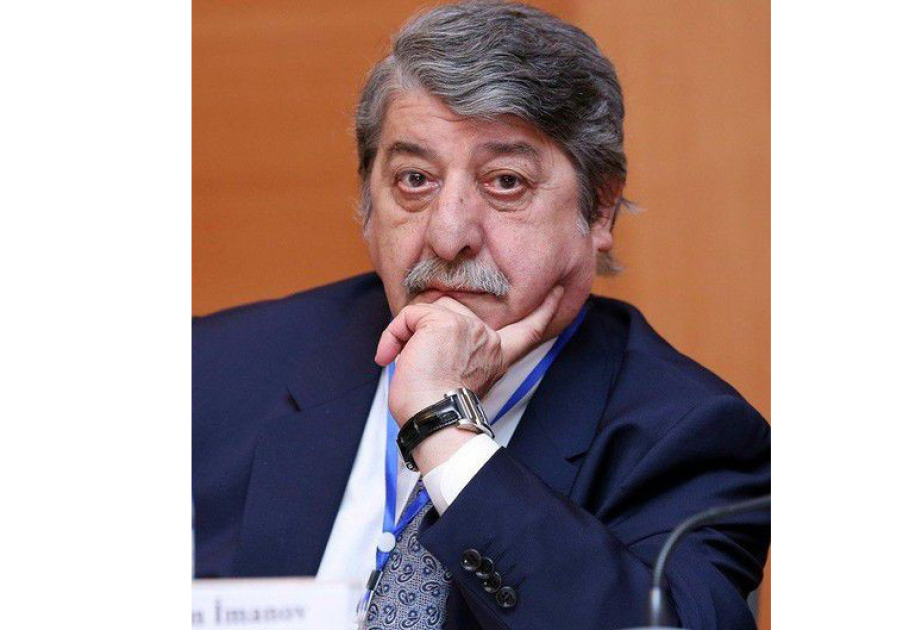
Read moreChairman of the Board of Azerbaijan's Intellectual Property Agency, Professor Kamran Imanov, has presented a new study examining the historical sources, manuscripts and scholarly interpretations surrounding Caucasian Albania and its cultural heritage.
According to AZERTAC, the agency chairman recently completed a book titled Towards the Ethnohistory of the Inhabitants of Caucasian Albania, the first chapter of which is being published by the state news agency.
The study focuses on the historiography of Caucasian Albania, examining historical texts attributed to Agathangelos, Yeghishe, Sebeos and Moses of Khorenatsi, alongside the geographical work Ashkharatsuyts.
We present the article:
Preserving a nation's material and cultural heritage is just as important as protecting state borders and respecting national symbols. One of the primary objectives in this regard, beyond the physical preservation of cultural monuments, archives, and works of art created over centuries, is protecting them from deliberate appropriation by other peoples. In this context, not only specific elements of our people's culture are falsified, but entire layers of history. The goal is the same: to use a fabricated history to proclaim one's own privileged status to the world and appropriate the works and creations of other peoples.
Azerbaijani scholars, in their research based on concrete historical facts, have always rebuffed the attempts of those who chronicle Armenia's fictitious history. The Intellectual Property Agency of Azerbaijan is conducting extensive work in this area. At international conferences, presentations, and in his books on this topic, the Agency's Chairman of the Board, Professor Kamran Imanov, convincingly exposes the activities of Armenian pseudoscholars who are trying in every way to create a history of their country that would fulfill their long-held dream of Armenian autochthony in the Caucasus.
A characteristic feature of Professor Kamran Imanov's research into exposing intellectual theft is, along with legal, linguistic, and etymological justification, a broad examination of ethnohistory and ethnoculture. The scholar devotes particular attention to Armenian mythology, which fills the world with fables.
Speaking to an Azertac correspondent , the professor, speaking about the importance of protecting the material and cultural heritage and the intellectual achievements of the people, said: “Intellectual property is interdisciplinary and is located at the intersection of law, culture, science, and technology, including information technology.
Historical and ethnogeographical events are traces left by a given culture, understood in the broadest sense. This applies to every nation, and certainly to ours, the Azerbaijani people. Traces of culture, the facts, events, narratives, and testimonies of the past that have come down to us are components of cultural traditions—that is, a past without which the present has no future. Everything lived through by our Azerbaijani ancestors belongs to the Azerbaijani people and is their cultural property. It is from these sources, protected as intellectual property, that our epics, folklore, traditional knowledge, and other heritages arose. The uniqueness of various forms of cultural tradition is that they represented progress in the past, just as today's progress will become the tradition of the future.
Regarding the genesis of Hay-Armenian falsifications, i.e., fabrications and conjectures, forgeries and counterfeits, as well as the associated plagiarism of Hay-Armenian intellectual property appropriation, I note that they rely on various, usually false, mythologemes and have given rise to Hay-Armenian mythomania, which closely interacts with intellectual theft. Moreover, if mythologemes, through contrived plots, typically inflate the Hay-Armenians' greatness and replace the non-existent with a false reality from the past, simultaneously facilitating the creation of new mythical "realities," then intellectual and cultural thefts of intangible and tangible objects should serve as "proof" of the "reality" of Hay-Armenian mythologemes. As you understand, "some knowingly and intentionally lie, while others, having been deceived, spread these lies." Thus, the centuries-old pattern of Hay-Armenian plagiarism and intellectual theft of the cultural heritage of neighbors is closely interconnected with historical phantoms and the deliberate distortion of the history of the region, and ultimately they all go back to the “proof” of the non-existent autochthony of the Hay-Armenians in the Caucasus and, as a consequence, to the territorial claims of the “long-suffering” ethnic group in connection with the “lost territories.”
Therefore, our heritage must be protected, is protected and will be protected by the rights and authority of intellectual property and our civic duty."
As President Ilham Aliyev noted, “we must launch an information offensive against Armenia’s false propaganda.”
Following these words, in the fight against Hay-Armenian mythologemes, falsifications, speculations, intellectual thefts, abandoning the defensive, we take an offensive position."
Azertac begins publishing Professor Kamran Imanov’s book “Towards the Ethnohistory of the Inhabitants of Caucasian Albania ,” which he completed recently.
X X X
CHAPTER I
Introduction: Historiography and some sources on Caucasian Albania
The introduction raises the question of the evidence upon which ideas about the population of Caucasian Albania and the identity of its cultural heritage are based. Using the works of Agathangelos, Yeghishe, and Moses of Chorene, as well as the "Armenian Geography" (Ashkharatsuyts), the author examines how the dating of surviving manuscripts, disputed attributions of texts, and discrepancies between translations influence the interpretation of events and the localization of ancient regions. Comparing two editions of A. Hakobyan's work, he challenges the conclusion that Albanian identity in Artsakh and Utik developed among the "local" Hay-Armenian population as a result of the administrative and ecclesiastical isolation of these regions. In Musa (Moses) Kalankatuklu's (Kalankatuksky) account of Bishop Israel's mission to the Huns to Christianize them, the author draws attention to the limits of the authority and independence of the Albanian Catholicos, his lack of subordination to the Armenian Catholicos, and, in the letters of Karabakh meliks to the Russian court, dating from the late Middle Ages, to the continued use of the name "Aghvan." Distinguishing between political, ecclesiastical, and ethnic affiliations, the author defends the independence of the Albanian historical tradition and its significance for the history of Azerbaijan.
The Armenians' territorial claims against their neighbors stem from a desire to prove the autochthony of the Hay-Armenians in the Caucasus and, consequently, the appropriation of their tangible and intangible cultural heritage as "evidence." This denial of the existence of Albanian statehood as such by the Hay-Armenians, and, in extreme cases, the de-ethnicization of the Albanian ethnos itself in the Middle Ages (from the 7th to the 12th centuries) and its reduction to Hay-Armenians, and, finally, as a maximum program, the denial of the existence of this ethnos by replacing it with Hay-Armenians who have acquired an Albanian "worldview" and "worldview." This is the spectrum of ideas within the national historical scholarship of the Armenians. To this end, the Hay-Armenian tradition of appropriating foreign cultural traditions is liberally spiced with false information, the falsification of events and characters, the alteration and distortion of historical facts, and so on.
As one of the leading Armenologists, a renowned scholar of Armenian descent, professor at the University of Michigan and the University of Chicago, Ronald Grigor Suny, said in his study “Looking Toward Ararat. Armenia in Modern History” (Indian University Press, 1993): “Armenians are a special people, first of all, because they are a nation (or at least a people) living within another nation, and, secondly, this people is usually proud of a heritage about which they do not have any clear idea.” Armenian historian Armen Ayvazyan, in his book “Coverage of Armenian History in American Historical Geography (A Critical Review),” notes that Hay-Armenian historians accuse renowned Western Armenologists and Caucasian scholars, including those of Armenian descent, professors Ronald Grigor Suny, Robert Thompson, James Russell, and Richard Hovanisyan of deliberately falsifying Armenian history.
It is emphasized that their main message is to "question the notion, substantiated by modern history and scholarship (read: the works of modern Armenian historians – ed.), that the Armenian Highlands was the area of formation of the Armenian people. Instead, they insistently resuscitate the version, rejected by scholarship, that Armenians were aliens, which corresponds to the approach of scholars in Azerbaijan and Turkey. It is noted that "Armenian culture in the works of the aforementioned Western authors is presented as a continuation and borrowing of Byzantine, Assyrian, Arab, and other cultures. Historical Armenia is presented as a decentralized, weak country, transformed into a manipulated tool by the Iranian and Roman empires." Thus, “the 5,000-year-old Armenian history is belittled, while the Armenian military forces during the period of the kingdoms of Hayas, Urartu and Yervanduni [Orontids] numbered several tens of thousands, and during the era of the Artaxiads, Arshakuni and Bagratunis, they numbered from 100 thousand to 200 thousand warriors.”
In response, at a conference held on October 4-6, 2003 (Harvard, Cambridge, and Massachusetts) on the topic "Rethinking Armenian Studies: Yesterday, Today, and Tomorrow," a number of scholars, primarily from Western countries, offered compelling responses to the chauvinistic and nationalistic Hay-Armenian scholarship. Professors Bardakjian, Russell, and Robert Hyseni noted that in Armenian studies in the Republic of Armenia, "a scholarship imbued with xenophobia and ultra-nationalism, having become the leading trend, is leading to its own destruction."
Professor George Burntian noted that "the basis of Armenian complaints against Western scholars is that 'Armenian-American' researchers, through their research, undermine Armenian claims to Karabakh, Cilicia, Nakhchivan, Ganja, and Turkish Armenia, and cast doubt on sensitive cultural issues, including Armenia's adoption of Christianity. Thus, the conscientious, painstaking scientific findings of Western scholars are dismissed without any basis."
This is why Professor Robert Grigor Suny concludes his remarks with the following thought: "Armenian scholars are mired in the quagmire of nationalist thinking." The reasons for this, as the prominent scholar notes, are "the consequence of the pronounced nationalism that exists among Armenians, the lack of roots, and the substitution of fiction for historical knowledge."
The ancient Armenian texts that Armenians so readily cite, the manuscripts and originals of which are generally missing or presented as multiple later copies, are the root of all this. At the root of all this lies the falsifications of the Armenians. However, as the famous Cervantes said, "The dress both adorns and reveals."
For example, finding manuscripts by ancient Armenian authors in the St. Petersburg Archive, considered one of the richest archives in the world, is a challenging task. In 2003, the book "Treasures of the Academic Collections of St. Petersburg" was published to commemorate the 300th anniversary of St. Petersburg. As Professor Yuri Petrosyan, an ethnic Armenian and the head of the team that compiled this book, noted, among the thousands of Armenian manuscripts stored there, not a single original exists: the majority, approximately 80%, are copies from the 17th and 18th centuries. A few manuscripts are copies from the 14th and 15th centuries, and one of them may date back to the 12th century. According to another Armenian scholar, the number of Turkic originals from the 7th to 11th centuries stored in this archive numbers in the thousands.
As for ancient Armenian texts, the original manuscripts of which are not found, but later, rewritten copies exist, then “instead” in these copies there are traditional, well-established falsifications, forgeries and speculations.
Armenian falsifications and fabrications have a long tradition dating back to ancient times. For example, let's begin with the first Armenian historian, Agathangelos (Agathangelos), and his work "History of the Armenians," dedicated to the events of the 3rd and 4th centuries associated with the adoption of Christianity.

According to Armenian historians, Agathangelos was the personal secretary of the Armenian King Trdat at the time of his conversion to Christianity. An academic publication by Armenian scholars describes this work as follows: "...using genuine historical facts in combination with hagiographic material, ... legends, ... and folk tales, [the author] created a unified and comprehensive work" ("Armenian Medieval Literature," Academy of Sciences of the Armenian SSR, Yerevan, 1986).
Here is the opinion of one of the famous Western scholars, R. Thomson: “This work seems mysterious not only because it is a mixture of vague traditions preserved in memory and fictitious legends. Although the work exists in several languages and in various editions, many of them do not correspond to the existing Armenian version” [RW Thomson, Introduction to Agathangelos: History of the Armenians, London, Harvard University Press, 1978].
It is particularly noteworthy that Agathangelos's work (early 4th century) is the first and primary written source through which modern Armenian historiography has identified the Ayrarat region in the Lake Van area with the Ararat Valley in today's South Caucasus, and the biblical Ararat with today's Mount Aghridagh (Mount Masis). Thus, the territory of Anatolia in the vicinity of the Taurus Mountains, bordering Upper Mesopotamia, was geographically shifted toward the South Caucasus. This falsification and fabrication were subsequently further developed through the efforts and references of the 7th-century Armenian historians Sebeos and Anania Shirakatsi. The obvious and specific purpose of this fabrication was to “substantiate” the autochthony of the Hay-Armenians in the territory of the South Caucasus and, in particular, Western Azerbaijan, as well as to “prove” that Echmiadzin, considered the first Armenian church, was located not in the area of Lake Van, but in the territory of the modern Ayrarat region.
This "historical work" asserts that the founder of the Gregorian Church, Gregory the Illuminator, founded the first Armenian Christian centers—Etchmiadzin—in the vicinity of modern-day Erevan (Yerevan), where the graves of the first Christian martyrs were supposedly located. However, this historical lie is refuted by another ancient Armenian historian, Faustus of Byzantium (Buzand Faustos). According to Faustus of Byzantium, the graves of the first Christian martyrs were not located in the Erivan Khanate, but in the region of Korduk-Korduene, that is, in the Ashtishat area of the Taron Province, located south and west of Lake Van. Moreover, according to Christian rite, those converting to this religion were required to undergo baptism, which took place in the Euphrates River. As we have repeatedly noted, if Etchmiadzin had been founded on its current site, what would have been the point of traveling several weeks to the banks of the Euphrates in Asia Minor instead of being baptized in the nearby Araxes River? Furthermore, how could it have happened that, with the main church located in the South Caucasus, the church dioceses were located exclusively in Asia Minor?
Taron region

Source:

Moving on to the next historical falsification, let us turn to the work of the Armenian historian Yeghishe (Elisha), dating back to the 5th–6th centuries, “About Vardan and the Armenian War.”
This work tells the story of the events of the 5th century - the uprising against the Sassanids led by Vardan Mamikonyan.

First of all, let us turn to the assessment of this work presented in Armenian institutional sources: “Yegishe’s work is a convincing historical source, created by a contemporary who was an eyewitness to the events that took place; the events in it are presented logically, in a consistent cause-and-effect relationship...” (“Armenian Medieval Literature”, Academy of Sciences of the Armenian SSR, Yerevan, 1986).

The position of Western scholars, however, is as follows: "Eghishe claims that his narrative is a record of an eyewitness's observations of events in Armenia... However, this assertion cannot be accepted in itself. The fact is that historical works by other authors, who also presented themselves as eyewitnesses, are recognized as later works... The assumption that Yeghishe's history was written earlier than the sixth century is unconvincing..." (Elishe. History of Vardan and the Armenian War. Translated by Robert W. Thomson. Cambridge: Harvard University Press, 1982).
It should be noted that there are two Russian-language versions of this book: the first translation by P. Shanshiev was published in 1853, and the second by Orbeli was published in 1957. However, a comparison of these editions reveals that these are not different translations of a single original, but two significantly different works. Under these circumstances, any discussion of the authenticity of the information presented is pointless: it is all fabrication, falsified in the late Middle Ages.
The next “ancient Armenian source” is “Armenian Geography”, or “Ashkharatsuyts”.

Source:
http://www.bvahan.com/armenianway/great_armenia/main_rus/maps_rus/map_rus.htm
In reality, this is an anonymous work, presumably written in the 7th century. Initially, the renowned Armenian historian Patkanov and other researchers attributed this work to M. Khorenatsi. Currently, Armenian scholars are considering the possibility that this work was written by Anania Shirakatsi.
For several reasons, this work, a compilation, cannot be dated to a period earlier than the 14th century. First and foremost, its earliest manuscripts date from the second half of the 17th century. The falsification consists of presenting territories not part of Armenia as Armenian, resulting in the territory of historical Armenia being depicted as even larger than that of Sassanid Iran.

The main reason for this fiction is to locate the ancient region of Ayrarat in the area of today's Ararat Valley. The insidious goal remains unchanged—an attempt to portray the Hay-Armenians as an indigenous population of the South Caucasus.
In all likelihood, the falsification originated during the Mkhitarist era—the 17th–18th centuries—and the territory depicted in this work coincides with the hypothetical borders of the Ararat Republic, whose creation at the beginning of the last century was among the Armenian side's goals. Such forged "historical documents" were created to substantiate Armenian territorial claims against Azerbaijan and Turkey. Once again, the ultimate goal remains the same—an attempt to portray the Hay-Armenians as a people who had long inhabited the South Caucasus.
The next “ancient Armenian historian” whose works we will turn to is Sebeos.
In Armenian historiography, Sebeos is recognized as a 7th-century author. In his work, the author recounts the arrival of the Mamikonian clan (actually the Mamgunlu) to Armenia from eastern Turkestan (Chenestan), but presents this story in a version that differs from M. Khorenatsi's version. Without dwelling on this difference, let us turn our attention to another issue, which seems more important to us.
The book contains two fictitious narratives. The first concerns the city of Tigranakert in Karabakh, and the second is a reference to Yerevan during the Arab Caliphate. Given the references to these falsified events by medieval historians in a later compilation, we would like to share our thoughts on the unexpected publication of this book.
First of all, the only manuscript of this work was unexpectedly discovered in 1840 by the Armenian bishop O. Shakhatuni. The manuscript itself contains no indication that it was written by Sebeos. After examining the manuscript, Shakhatuni concluded that this "work" was one of Sebeos's lost manuscripts. The attribution of this work to Sebeos raises numerous doubts. First of all, its content does not correspond to the works of either M. Khorenatsi or Faustus of Byzantium. Most importantly, the ancestors of the Mamikon (Mamgun) clan did not wage war against the king of Chen. This is confirmed by M. Khorenatsi. Faustus, in turn, explains Mamikonian's departure from the land of Chen by the fact that he sought to avoid a fratricidal war with the Arsacid king. Thus, Sebeos's story about Mamik and Konak, as well as about the war that took place in Chenistan, is a later fiction.

Armenian scholars have also reached the same conclusion. For example, the Armenian specialist G. Abgaryan questioned Sebeos's authorship, pointing out that significant fragments of the anonymous work were compiled in the 11th century through compilations from other works (G.V. Abgaryan. "The History of Sebeos" and the Problem of the Anonymous Author. Publishing House of the Academy of Sciences of the Armenian SSR, Yerevan, 1965).
This false work, moreover, was put forward by those who lack sufficient historical knowledge. Thus, in the text, the toponym "Armenia" is used as "Hayastan," whereas the designation "Armenia" in this form only came into use in Armenian-language literature beginning in the 17th-18th centuries. It is also known that earlier authors used the toponym "Hayk" to refer to this territory. Leaving aside other falsifications and chronological inconsistencies, we will examine in more detail two cases of deliberate misrepresentation.
In connection with the Arab invasion of 646, the text asserts that the Ayrarat region was supposedly located near the city of Irevan. However, according to the author's version, the Azerbaijani city of Irevan was founded in 1520, and its name is associated with Revan Khan. Prior to this time, the city is not mentioned in any historical source. Moreover, this is confirmed by other ancient Armenian written sources. For example, in the work of Levond (8th century), considered a more reliable Armenian source, when describing the Arab campaign, there is no mention of either the Ayrarat region or Irevan; it only refers to the Arab conquest of Nakhchivan.
Another case of misrepresentation concerns Karabakh's Tigranakert, with the falsified text presenting this Tigranakert as "another Tigranakert." The hype surrounding today's Karabakh Tigranakert originates precisely from this false source.
However, in the extensive Byzantine sources recording events related to the Arabs, there is no mention of Tigranakert in Gardman (Girdiman). Moreover, not a single ancient Armenian source contains any information about a city called "Karabakh Tigrankert." The most notable is the phrase "another Tigranakert." The fact is that Tigranakert, actually located near the Euphrates River, had already been wiped off the face of the earth by the time of Sebeos. This city existed for a short time and belonged to the era of Tigranes BC. After several centuries, knowledge of it disappeared from the memory of the Hay-Armenians, and therefore no information about this city survives in the Grabar texts of the Common Era.
In short, the fabrications contained in the work of the pseudo-Sebeos, an anonymous author, are a falsification created in later years. Ultimately, its goal is once again to present the Hay-Armenians as an indigenous population of the Caucasus.
And in conclusion, a few words about Moses of Khorenatsi (Movses Khorenatsi).
As we have repeatedly noted in our presentations and publications, M. Khorenatsi's "History of the Hays," which has become a textbook of Armenian history, is accepted by Armenian historiography as an indisputable truth and dates back to the 5th century CE. Its author, considered the "father of Armenian history," has a rather interesting history in terms of the fictitious nature of this work. The frauds and falsifications associated with this work concern its title, time of writing, authorship, and even translation. The original text is missing, and it is unknown whether it was written in Syro-Aramaic, Greek, or Grabar. References to this work are primarily made by modern Armenian authors; however, Khorenatsi's name is not mentioned in Armenian historiography until the 10th century.
According to some scholars, Khorenatsi's name refers to an anonymous priest-historian, as his biography is unknown and was compiled by the Armenian translator N. Emin for the 1858 Russian edition based on unreliable sources. In the 1809 Russian translation (the Latin edition was published in London in 1736), the title of the work, "History of the Armenians," was changed to "History of Armenia" in the 1858 edition. Thus, the story of the Hays—Armenians—was transformed into a history of the country of Armenia, whose historical past, it is claimed, was fictitious.
M. Khorenatsi's main falsification, however, is his alteration of the Bible, thereby presenting an Armenian version. The insidious design of this falsification was to, through the fictional characters of Hayk and Armenak, introduced into the "Table of Nations," as well as the filling in of genealogical branches missing from this table, present the Hays as the ancestors of the Armenians and, furthermore, to establish their "kinship" with the Sakas—ancient Turks. To make this forgery more convincing, stories preserved in the memory of the Sakas, the proto-Turks, were plagiarized (for example, about Tomiris) with fictitious Hay-Armenian names, as we have repeatedly noted in our speeches and in the press. Ultimately, the goal was to appropriate the history of other peoples in favor of the Hay-Armenians, thereby appropriating their territories.
It is no coincidence that one of the most outstanding historians of the 18th century, Gibbon, wrote: “One can only borrow from Khorenatsi what is also found in other ancient historians…”
Thus, the most “fundamental” historical work of Armenianism, acting as a source with obvious signs of falsification, thereby gave the “green light” to other fictitious works.
The tradition of intellectual theft continues, and Armenians, who display a particular mastery of myth-making—a form of folklore—continue to encroach on the tangible and intangible heritage, lands, and culture of other peoples, especially us Azerbaijanis, "enriching" their arsenal with attempts at appropriation, seizing possessions, intellectual theft, falsifications, and fabrications. All of this applies to both our real political life and the past, to historical events.
The mythologically based stereotype of "great lands," territorial claims against neighbors, and cultural appropriations stemming from various myths, such as "great Armenian culture" and "the first Armenian cradle of civilization," have acquired a "natural" and "legitimacy" character in Armenian thinking. Consequently, neither our demands nor UN resolutions on the need to liberate the occupied territories of Azerbaijan, nor the need to comply with international norms, have been taken into account. Consequently, the tradition of Armenian appropriation of Azerbaijan's tangible and intangible heritage, as well as its cultural traditions, continues. Moreover, stereotypes generated by fictions about the "exceptionality" of Armenians, their "martyrdom," and their "special mission" shape modern Armenian identity. These myths influence the moral and ethical attitudes of Armenian politicians, public figures, scholars, and the general public, creating obstacles to the recognition of international law, the cornerstone of the modern world order.
Every nation, including the Armenians, has its own unique history. Events and phenomena that occurred in the nation's past, its achievements, failures, and sorrows, are an integral part of historical reality. We do not oppose the Armenian people, but rather books and other publications filled with lies, fabrications, and slander, written by nationalist-minded authors from our neighbors who espouse an unhealthy worldview, as well as by hired foreign mercenaries. We particularly oppose the underlying theme of such historical works, according to which Armenians are not aliens but an indigenous people of the South Caucasus, and the territorial claims made on this basis, allegedly related to lost lands.
If we look at Armenian history, as we have repeatedly noted, it is no coincidence that nationalist Hay-Armenians substitute the history of the country for the history of an ethnic group. This is not only because a stable political concept of "Armenia" did not exist in the past. A stable geographical concept of "Armenia" in no way satisfies the appetites of Armenians. After all, this geographical region was home to many peoples, including Turkic ethnic groups. While M. Khorenatsi's references to the concept of "Armenia" were few and far between, modern Armenian historians have cited dozens of such "Armenias." This includes the so-called "Eastern Armenia," which they insistently refer to as the "Echmiadzin period of Armenian statehood." Clearly, they are referring to the historical lands of Azerbaijan—Western Azerbaijan—which became the site of the formation of Armenian statehood. The works of nationalist Armenian authors assert that Armenian migrants were the autochthonous, aboriginal population in all the territories they inhabited. Therefore, the authors are forced to describe the history of the territories through which the Hay-Armenians' migration routes passed, including in this history all the geographic areas where they subsequently settled as a result of their migration. This is why their history is presented not as a "History of Armenia," but as a "History of the Armenian People."
However, Armenianism overlooks one fact. The history of such an alien ethnic group is written by its descendants—the allochthones—while the indigenous inhabitants of the territory—the autochthones—describe it as their historical homeland, the land of their ancestors, and write it as the history of the country.
According to Edouard Herriot, "tradition signifies the achievements and progress of the past, and the progress of today, over time, becomes the tradition of tomorrow, the tradition of the future." While this is true, this well-known statement has nothing to do with the Armenian side's appropriation of Azerbaijani cultural traditions.
Beginning with M. Khorenatsi, myths about the "lost territories of a long-suffering people" form the revanchist basis for Armenians' territorial claims to neighboring lands. Nationalist fantasies about a fictitious "Greater Armenia" constantly contribute to the formation of their own falsified history and the distortion of the histories of neighboring peoples. The myths we are examining, in addition to the pragmatic function of spreading lies, also serve a more important purpose within Armenian circles: creating the preconditions for the emergence of yet another mythological narrative.
Let us pay attention to one feature of ancient Armenian texts.
It is well known that a certain "template" is used here: "an ancient people with a heroic Christian past" and "an ancient people surrounded by enemies and subjected to oppression." Through textbooks and academic publications, this template is transformed from written Armenian narratives into institutionalized history, entrenched in the collective memory of the Armenian ethnic group, and thus defines the modern way of thinking of Hay-Armenians when perceiving the global ethnic landscape.
The opinion of renowned American specialist and Harvard University professor R. Thomson is noteworthy. As this scholar, who has extensively researched Armenian narratives, writes: "First, the authors of Armenian historical narratives are, as a rule, members of the church clergy, and their works were commissioned by the church and preserved thanks to the church. Second, Armenian historical works present not so much a description of events as a special, selective arrangement of them. Third, these works arose significantly later than the stated time of their creation and, over the centuries, right up until the 19th century, were subject to additions and changes favorable to the Hay-Armenians."
As the famous Russian ethnologist V. Shnirelman notes in his study “Wars of Memory”: “Modern Hay-Armenian historiography is based on written templates and images of the “glorious past.”
Another well-known Russian political scientist, S. Lurye, in his work "Armenian Political Mythology and Its Influence on the Formation of the Foreign Policy of Armenia and Nagorno-Karabakh," writes that the political mythology of Armenians "is part of the ethnic picture of the world, and, I emphasize, an unconscious picture of the world, and determines the ethnic group's perception of reality, reality, as well as models of behavior in relation to this reality."
However, unlike the Armenian ethnic worldview, which is a product of the unconscious, the legends created about the history of the Armenian people, both past and present, are consciously composed and attributed to specific authors, including Grigor Artsruni, Raffi, Leo, and Mkrtich Khrimyan. Lacking deep historical knowledge, these writers and publicists in the late 19th century created a series of historical myths and legends, highlighting fictional heroism.
Therefore, as the renowned Russian writer Yuri Pompeyev aptly notes, such works include opuses about the divine origins of the Armenian nobility, publications by authors like Artashes Artsruni, whose fabrications are published in thousands of copies, and the false historical works of Suren Ayvazyan. As a result, "the collective memory of the ethnic group finds itself captive to an artificially created illusory past, and the future is imagined not for the sake of the future itself, but, on the contrary, in the name of the past."
Yes, as the famous writer Flaubert said: “…the past holds us and does not let go, and for this reason the present passes us by.”
It should be especially noted that the assessments of ancient texts by Armenian authors, as well as numerous modern historical works, provided by Armenian and Western, including foreign, historiographers differ radically. And we will return to this issue repeatedly.
For now, we will limit ourselves to two statements about M. Khorenatsi, considered the "father of Armenian history." This quote is taken from the Russian-language publication "Armenian Medieval Literature" (1986), published by the Armenian Academy of Sciences: "...Khorenatsi's work is the first critical history of Armenians and a gem, a masterpiece of national scientific and historical thought..."
And these, in turn, are the words of the renowned historian August Carriere, spoken in 1896: "To believe the information he [Khorensky] provides is to show ignorance. Most of the information he provides is fiction."
In conclusion, I'd like to recall the remarkable words of the great ethnologist Lev Gumilev: "...Ethnic history is not a boundless collection of information 'without beginning or end' (A. Blok) or simply 'anecdotes from bygone days (Pushkin),' but a complex chain of cause-and-effect relationships..." "At the individual level, lying is not only an asymmetrical behavioral stereotype but also a means of influencing the environment, both ethnic and landscape. At the population level, it is already massive disinformation in anti-systems that influence the social and cultural environment."
I am convinced that Armenian myths built on lies and other falsifications and fabrications are being debunked and will continue to be debunked. And let us remind you once again: "For clothes," as the great Spaniard Cervantes said, "both clothe and unveil."
It is quite obvious that the Albanians, who were one of our ancestors, and Caucasian Albania, being a state entity on the lands of modern Azerbaijan, were at the center of attention of Armenian historical circles.
In contrast to the accepted scholarly and professional view of the existence of Albanian statehood, Hay-Armenian historians typically rely on their own coined term, "Albania – the eastern outskirts of Armenia," thereby denying Albanian statehood. However, all of them, including those who acknowledge the existence of Albania, rely on the same thesis: the population of Albania was completely Gregorianized and Armenized from the 7th century CE until the 11th century CE, or the advent of the Seljuk Turks. They emphasize that the Albanian ethnic group was completely de-ethnicized, becoming part of the Hay-Armenian ethnic group by the time of the collapse of the Hasan Jalal principality, by the 14th century CE. As an example, we can cite the “research” of Professor, historian Henrik Svazyan from the Institute of History of the Academy of Sciences of Armenia and his monograph “The History of the Country of Aluank” (from ancient times to the 8th century AD), the Russian-language edition of which was published in Irevan (Yerevan) in 2009, and subsequent works, which, among other things, far-fetchedly assert the historical belonging of Utik and Artsakh to Armenia, as well as the significance of the name “Aluank” in the heritage of the population of Caucasian Albania.
However, now works are appearing that completely deny the existence of the Albanian ethnic group, “originally” replacing it with the Hay-Armenian ethnic group, which began to be called Albanian.
Claiming the territory of Caucasian Albania, including the lands of Western Azerbaijan and Kars in Eastern Anatolia and calling the latter Eastern Armenia, the Hay Armenians continue to "develop" the myth of their "ancient" settlement in these lands. This is despite the fact that many researchers have convincingly demonstrated the nature of such a falsification.
Let's start with this myth, and from the period when the Hay-Armenian ethnic group had not yet been formed, namely from the era of the existence of the powerful state of Urartu.
It is generally accepted today that the Urartian language, also called the language of the Alarods, had no relation to the Indo-European language of the Hay-Armenians and was an agglutinative language, very close to the language of the Hurrians (the Horeans according to the Bible) and, possibly, the language of the ancient Hittites (Hatti).

Let's examine how Armenian academic circles interpret the ethnopolitical situation of that time, using recent research as an example. This article is based on the second, revised edition of "Albania-Aluank in Greco-Latin and Ancient Armenian Sources" by Aleksan A. Hakobyan, Doctor of Historical Sciences at the Institute of Oriental Studies of the National Academy of Sciences of the Republic of Armenia (NAS RA).
The aforementioned author argues for three aspects of the "Albanian worldview." Leaving aside two of them, we, following the author, will highlight the third, as he writes: "the juxtaposition in several episodes of 'Albanian' and 'Armenian' for the sake of extolling the former."
However, by praising the “Albanian”, A. Hakobyan understands the “Albanian worldview” not of the Albanians of Albania, but of the Armenians of Albania, and seeks to “prove” this absurd transformation of the Hay-Armenians into Albanians.
As “proof” of the “Albanian worldview” of Armenians, the author is critical of the information of M. Kalankatuklu (M. Dashurantsi) about the earlier, in comparison with the Armenian, beginning of Albanian Christianity in Albania and his assertion that only Albania has an apostolic throne and therefore M. Kalankatuklu (M. Dashurantsi) is accused of distorting sources and making unlawful additions.
This also includes information from M. Kalankatuk (M. Daskhurantsi) about the struggle of the Albanian Sahak Sevada, who was of Subarean (Sabir) Turkic origin, against the Armenian king Smbat Bagratuni, as well as the writing of the “History of Albania”, where, according to A. Akopyan, the ancient Albanian author “seeks to become like Movses Khorenatsi, who wrote the “History of Armenia”.
The author notes that M. Kalankatuklu (Dashkhurantsi) (indicates the origin of the Albanians and gives the following commentary to the phrase “those living in the northern countries are the tribesmen of the Keturians [in another translation the Kittians (K. Imanov)], from where the Albanians also [come]” [p. 238]. ... According to the “Genealogy of Hippolytus of Rome, on which Pilon Tiracatsi is based, “the Armenians are traced back to the grandson of Japheth, Torgom (Togarmah in Hippolytus). To determine the degree of development of the “Albanian worldview” of the Armenian population of the right bank of the Kura (or already “self-awareness”, at least for some groups from the ruling classes), it is very important to state that Movses Dasxurantsi traces the “Albanians” back to another grandson of Japheth, Kittiya (in the “History of Albania” - Ketur- (ed.). The reason for choosing this candidate for the ancestor is apparently that the phrase about him mentions the "northern countries". Perhaps the presence of the reading "Ketureans" in the manuscript of the Chronicle of Pilon Tiracatsi, which the author of the History of Albania had at hand, also played a role. As one of the important sources of this work, Movses Khorenatsi cites information from the Bible that the sons of the prophet Ibrahim (Abraham) from the wife of Keturah (i.e., the "Ketureans", according to Christian genealogical tradition, the ancestors of the Parthians) migrated to the "eastern country" (Khorenatsi, II, 68, p. 203) ... Dasxurantsi calls his country "northeastern" several times. It is easy to see that the candidate for the biblical ancestor was not entirely successful, for Kition is the traditional ancestor of the Cypriots and some northern islanders. And this fact is very important, since it shows how seriously thought out (and in the modern scientific understanding – justified) was the tendency of the Armenian ruling circles of Albania to reincarnate Armenians - “Albanians” as a separate people.”

Source: Prof. Farida Mamedova

Source: http://axc.preslib.az/az/maps
Urartu IX-VI centuries. BC

Source: https://az.wikipedia.org/wiki/Urartu#/media/File:13-Urartu-9-
It is no coincidence that we are citing such a lengthy quote from A. Hakobyan. Hakobyan uses the term "Albanian worldview" and even "Albanian self-awareness" to support his arguments against Armenians. We will examine the political, historical, and confessional aspects of this quote, despite the absurdity of the passage we have highlighted, which, according to the author's position, substantiates the transformation of Armenians into Albanians as a separate people by the Armenian ruling circles of Albania. This quote should be considered in light of the ultimate political goal oriented by this author's research. The political imperative pursued by A. Hakobyan essentially boils down to convincing the reader of the absence of an Albanian ethnic group in the original provinces of Albania—Artsakh and Utik—and its replacement by the Hay-Armenians, who have supposedly lived there since time immemorial. According to A. Akopyan, this is achieved through a semantic analysis of the terms "Albania" and "Albanians" in sources from the 4th century BC to the 10th century AD. Here, the author seeks to show that "as a result of well-known political and administrative changes, the ethnic content of these terms has undergone several stages of evolution," according to the author of this opus.
(to be continued)
Here we are to serve you with news right now. It does not cost much, but worth your attention.
Choose to support open, independent, quality journalism and subscribe on a monthly basis.
By subscribing to our online newspaper, you can have full digital access to all news, analysis, and much more.
You can also follow AzerNEWS on Twitter @AzerNewsAz or Facebook @AzerNewsNewspaper
Thank you!