
Construction credit boom reveals shift towards state-led investment


Qabil Ashirov
Read moreAzerbaijan’s construction sector is entering a new phase of financial expansion, with a dramatic increase in bank lending revealing a deeper transformation in the country’s investment landscape. The sector’s outstanding credit portfolio reached ₼2.382 billion (US$1.401 billion) at the end of September 2026, representing an 82.3% increase compared with the end of 2025. Beyond the impressive headline figure, the composition of this expansion offers an important insight into the evolving relationship between public investment, banking institutions and Azerbaijan’s economic diversification agenda.
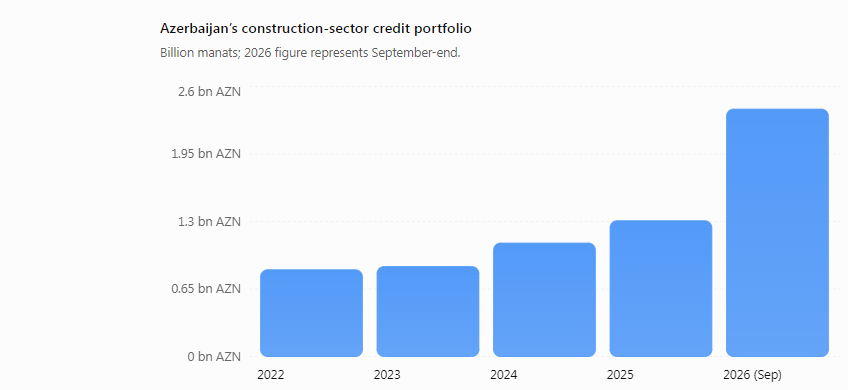
The historical trajectory illustrates the scale of this acceleration. Construction-sector lending stood at ₼834.8 million ( US$491.1 million) at the end of 2022, increased to ₼865.5 million US$509.1 million) in 2023, reached ₼1.092 billion ( US$642.4 million) in 2024 and advanced to ₼1.307 billion (US$768.8 million) in 2025. The subsequent expansion during the first nine months of 2026 represents a substantial departure from the sector’s previous growth pattern. The additional ₼1.075 billion (US$632.4 million) accumulated during this period alone highlights the increasing importance of construction-related investment in the country's financial system.
The most striking development, however, concerns the changing ownership structure of construction-sector borrowing. State-owned enterprises accounted for ₼1.029 billion (US$605.3 million) of the total portfolio in September, compared with just ₼26.8 million (US$15.8 million) at the end of 2025. This represents an almost 38-fold expansion in nine months. Meanwhile, private enterprises held ₼1.353 billion (US$795.9 million), equivalent to 56.8% of the overall portfolio, while state-owned companies accounted for the remaining 43.2%.
This shift suggests that public-sector investment priorities are becoming an increasingly influential component of Azerbaijan’s construction financing model. State-owned enterprises frequently operate in areas closely connected with national infrastructure, utilities, transportation, engineering and large-scale development programmes. Their expanding access to bank financing can therefore be interpreted as an indication of the growing financial requirements associated with Azerbaijan’s long-term infrastructure ambitions. The scale of lending also points to a closer relationship between commercial banking activity and the implementation of public investment priorities.
The timing of this expansion is particularly significant. Azerbaijan continues to pursue extensive reconstruction and development programmes across Karabakh and East Zangezur, alongside investments in transportation connectivity, residential construction, energy infrastructure and urban development. These activities generate demand across multiple industries, including cement production, metallurgy, construction materials, logistics, engineering services and electrical equipment manufacturing. Consequently, the expansion of construction financing can create a multiplier effect throughout the domestic economy, supporting industrial production and generating additional business opportunities for local suppliers.
The maturity structure of lending provides another important indication of the sector’s investment orientation. Long-term loans reached ₼2.0478 billion (US$1.2046 billion) in September, accounting for approximately 86% of the entire construction credit portfolio. Their monthly increase amounted to ₼236.2 million (US$138.9 million), or 13%. This composition demonstrates the growing importance of financing arrangements associated with longer investment horizons, capital expenditure and infrastructure development. For an economy seeking to expand its non-oil productive capacity, the availability of long-term financing represents an important institutional mechanism connecting banking resources with physical capital formation.
The currency composition reveals an additional dimension of this transformation. Long-term foreign-currency loans increased from ₼972.1 million ( US$571.8 million) in August to ₼1.2033 billion (US$707.8 million) in September, marking a monthly expansion of 23.8%. State-owned enterprises accounted for a particularly substantial portion of this movement, with their long-term foreign-currency borrowing rising from ₼773.5 million (US$455 million) to ₼1.0081 billion (US$593 million). This development highlights the growing importance of foreign-currency financing in supporting major construction-related investment requirements, including projects involving imported equipment, engineering solutions and internationally sourced technologies.
Another important consideration is the relationship between public and private capital. Although state-owned enterprises generated the overwhelming majority of the September increase in lending, private businesses continued to represent the largest overall borrower category. Their ₼1.353 billion (US$795.9 million) credit portfolio demonstrates the considerable role of private companies in the sector. This creates an economic structure in which public investment programmes and private entrepreneurial activity can operate as complementary sources of construction demand. Public infrastructure expenditure establishes the foundations for economic activity, while private enterprises contribute through commercial construction, industrial facilities, housing and supporting services.
From a broader macroeconomic perspective, the expansion of construction lending should also be examined through its contribution to Azerbaijan’s economic diversification strategy. The construction industry connects financial intermediation with tangible economic assets, while its supply chains extend into manufacturing, transportation, trade and professional services. Every major infrastructure project can stimulate demand across several domestic industries, strengthening economic linkages and expanding opportunities for local production. The banking sector consequently becomes an important channel through which accumulated financial resources are transformed into productive capacity.
Azerbaijan’s construction-credit expansion in 2026 therefore represents more than a statistical increase in outstanding loans. The almost 38-fold growth in state-owned enterprises’ borrowing, the 86% share of long-term financing and the expansion of the overall portfolio to ₼2.382 billion (US$1.401 billion) collectively illustrate an evolving investment environment. The central economic story is the increasing integration of banking finance, public infrastructure priorities and private-sector participation. As Azerbaijan advances its reconstruction, connectivity and industrial development programmes, construction financing is emerging as one of the important mechanisms shaping the country's next stage of economic transformation.
Here we are to serve you with news right now. It does not cost much, but worth your attention.
Choose to support open, independent, quality journalism and subscribe on a monthly basis.
By subscribing to our online newspaper, you can have full digital access to all news, analysis, and much more.
You can also follow AzerNEWS on Twitter @AzerNewsAz or Facebook @AzerNewsNewspaper
Thank you!