
War risks transform maritime insurance into barrier to global trade

Ulviyya Poladova
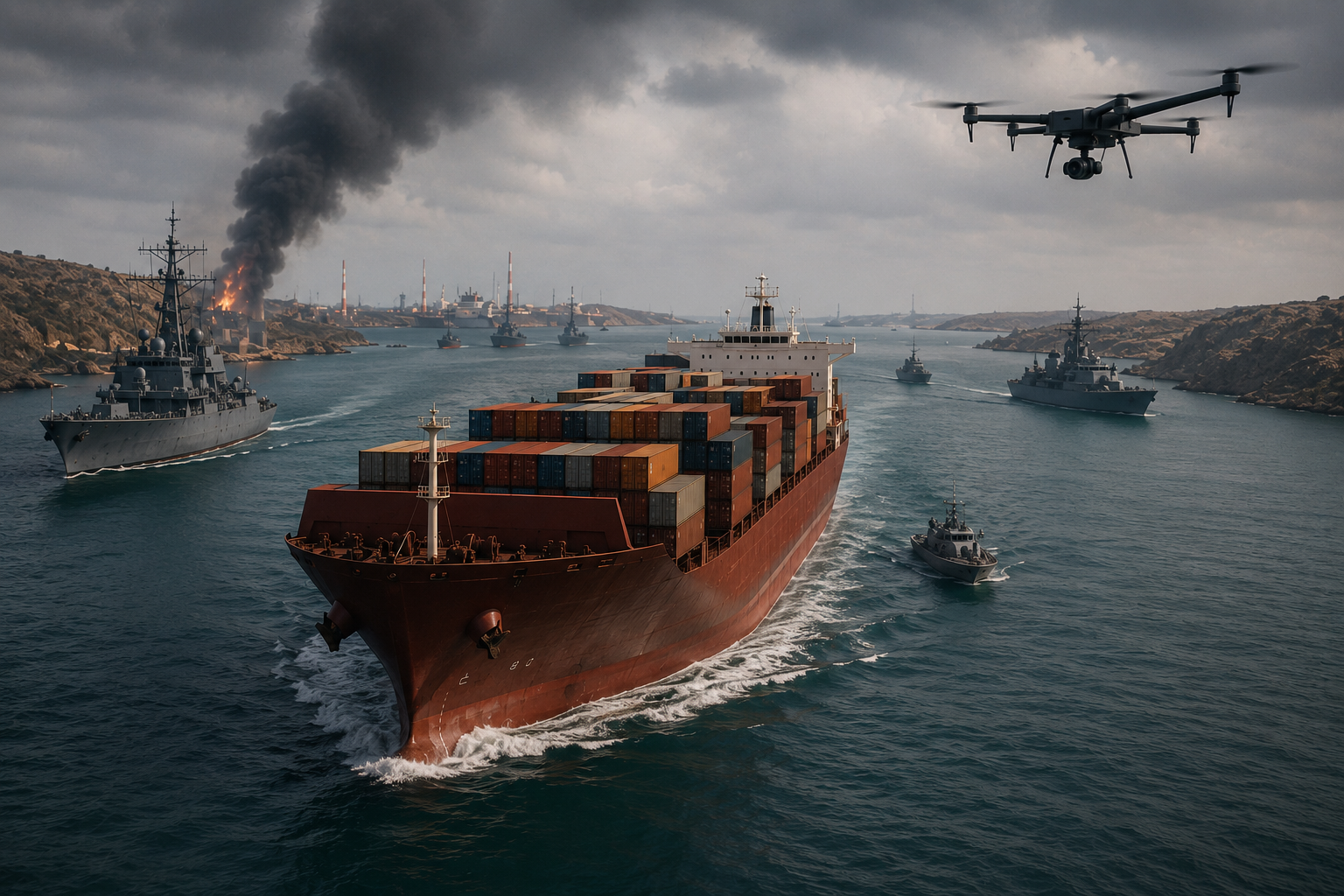
Read moreHistorically, maritime insurance operated quietly in the background lika a modest line item ensuring that if a storm hit or a rare misfortune occurred, trade kept moving. Today, however, escalating geopolitical tensions, targeted drone strikes, and state-backed blockades are fundamentally transforming maritime insurance from a routine business overhead into a defining, cost-prohibitive barrier to global commerce.
Across the Red Sea, the Strait of Hormuz, the Gulf of Aden, and the Black Sea, military risk is no longer an exotic clause buried in a policy. It is, increasingly, the dominant variable determining whether a voyage is economically viable at all.
The consequences are cascading through global supply chains in ways that are still poorly understood by the broader public. Insurance, after all, is an invisible infrastructure, because it works in spreadsheets and back-office risk models, until it suddenly stops working. When underwriters refuse to cover a route, or quote a premium that effectively prices a voyage out of the market, the effect is the same as a physical blockade.
The most vivid illustration of this dynamic is the southern Red Sea. Following the escalation of attacks by Yemen's Houthi movement (Ansar Allah), on civilian shipping in the region, premiums for cargo insurance on routes passing through the southern Red Sea roughly doubled. What had been a marginal surcharge became, within days, a decisive cost factor for any operator contemplating the Bab-el-Mandeb Strait - the narrow southern gateway connecting the Red Sea to the Gulf of Aden and, beyond it, the Indian Ocean.
According to Reuters, changes in war-risk insurance rates alone are adding hundreds of thousands of dollars in additional costs per voyage. To put that in concrete terms as indicative premiums for war risk rose to approximately 0.75% of a vessel's insured value, up from roughly 0.3% only days earlier, before the Houthis announced a maritime blockade of Saudi Arabia. A seemingly small percentage point shift translates, on a typical seven-day voyage, into expenditures that can erase the thin margins on which bulk shipping operates.
The Houthis' declaration of a maritime blockade of Saudi Arabia, announced after their claimed attacks on the oil tankers "Encelia" and "Layla" pushed the risk calculus further. The attack on Encelia reportedly caused a fire in the vessel's bow section, a reminder that these are not merely rhetorical threats. The Saudi-led Arab coalition's announcement, on July 21, of new measures to protect commercial shipping signaled an attempt to re-establish deterrence. But deterrence, in maritime insurance markets, is judged by outcomes, not intentions. Until the frequency of attacks demonstrably falls, underwriters will continue to price the risk as if every transit is a potential incident.
The strategic stakes are enormous. A full closure of the Bab-el-Mandeb Strait would halt Saudi oil exports to Asia and could remove roughly 7% of global oil supply from the market. Saudi Aramco, the world's largest oil exporter, had already increased its use of the Yanbu terminal on the Red Sea since the beginning of the US-Israeli conflict with Iran in late February. That shift now sits in tension with the rising threat from Houthi forces operating along the same coastline. Ambrey, the UK-based maritime security firm, has classified vessels flying the Saudi flag, owned or operated by Saudi entities, or bound to and from Saudi Red Sea ports as belonging to a high-risk category for Houthi attack. The classification matters not because it changes the physical danger, but because it formalizes that danger in the language underwriters use to set premiums.
Shipping traffic through the Red Sea has never fully recovered since Houthi attacks began off the Yemeni coast in November 2023, actions the group framed as an act of solidarity with Palestinians in Gaza. Some attacks continued into mid-2025, ceasing only with the Gaza ceasefire concluded in October of that year. The cessation, however, has proven fragile.
The Gulf of Aden also remains one of the world's most challenging maritime regions, particularly because of the continuing threat of piracy. Although international naval patrols have significantly reduced pirate activity compared with its peak in the late 2000s and early 2010s, attacks and attempted hijackings have re-emerged in recent years.
If the Red Sea shows how quickly risk premiums can double, then the Strait of Hormuz demonstrates something more alarming, since the state's ability to insure large-scale military risks is limited. Approximately 20% of the world's oil supplies pass through Hormuz under normal conditions. It has long been the most strategically important and most expensive offshore energy corridor on the planet.
Following exchanges of strikes between Iran and the United States, commercial operators have grown increasingly unwilling to assume the risk of transiting the strait. Insurance is either prohibitively expensive or, in some cases, simply unavailable. According to Financial Times reporting, the United States government attempted to bridge this gap through a $40 billion insurance program administered via the newly established US Development Finance Corporation, with underwriting capacity contracted through Chubb and AIG. The stated objective was to restore shipping flows through the strait and, by extension, apply downward pressure on global oil prices.
The program, however, has gone effectively unused. Two sources familiar with the matter told the FT that the $40 billion facility was never drawn upon in any meaningful way. The US military managed to escort two vessels through the strait in May, but no broader flow followed.
The vast majority of the world's marine insurance still flows through Lloyd's of London, a centuries-old market whose syndicates specialize in pricing exactly the kind of idiosyncratic, high-severity risks that standard insurers avoid. Some observers have suggested that the US initiative was, in part, an attempt to weaken British dominance over this sector. If so, the attempt has not succeeded. The absence of uptake suggests that operators either did not trust the US-backed mechanism to pay out in a genuine conflict scenario, or judged that participating in it would expose them to other forms of legal and political risk.
FT further reports that Western insurers are covering only a limited number of vessels transiting Hormuz, and that information about these operations is deliberately concealed to avoid sanctions complications. In practice, the majority of vessels obtain passage through the strait either through bilateral negotiations between Tehran and the flag state, or through the payment of fees to Iran's Islamic Revolutionary Guard Corps. The "insurance" that actually enables transit through Hormuz, in many cases, is not a financial product issued by a Western underwriter - it is a political and financial arrangement with the very actor whose behavior was supposed to be deterred.
The International Maritime Organization reports that at least 38 vessels have been attacked since the broader Middle East conflict reignited in late February 2026. Insurance costs across the region have multiplied.
One of the most directly intersects with the insurance markets of the former Soviet space is the Black and Azov Sea region. Here, the risk environment is shaped by ongoing military operations, mine hazards, and the continued exchange of strikes between Russian and Ukrainian forces. Unlike the Red Sea or Hormuz, the Black Sea is not a global chokepoint of comparable strategic weight, but it is a critical corridor for grain, energy, and bulk cargo moving between the Black Sea littoral and global markets.
According to Kommersant, citing Dmitry Grushin, head of cargo insurance at the broker "Remind", Russian insurance companies have in recent weeks begun refusing to underwrite war-risk coverage for shipments through the Black and Azov Seas.
Tariffs in the marine cargo segment rose two- to fourfold in the second quarter of 2026, but as Grushin notes, raising rates is no longer sufficient to restore market equilibrium. When the probability of a total loss approaches a threshold where even a high premium cannot credibly cover expected payouts, insurers withdraw.
The sums at stake are substantial. Insurance coverage for a single container runs between $30,000 and $50,000, while high-value cargo such as energy resources can require policies exceeding $150 million per shipment. When insurers refuse to write war-risk coverage at any price, the burden shifts either to the cargo owner.
Here we are to serve you with news right now. It does not cost much, but worth your attention.
Choose to support open, independent, quality journalism and subscribe on a monthly basis.
By subscribing to our online newspaper, you can have full digital access to all news, analysis, and much more.
You can also follow AzerNEWS on Twitter @AzerNewsAz or Facebook @AzerNewsNewspaper
Thank you!