
Azerbaijan's transit boom entering its industrial phase

Akbar Novruz
Read moreExcess capacity at the logistics center is often challenging. It involves meeting demand, managing inventory capacity, and addressing all infrastructure-related issues. With respect to the present development trends of the Middle Corridor, the 25-30% load of the 11 million tons annual capacity of the Absheron Logistics Center serves as more of a strategic reserve. The center, which became Azerbaijan's first internationally certified private logistics center established in 2018 in the Garadagh region of Baku on more than 100 hectares, processes 85% of all rail cargos arriving in Azerbaijan. But the combined imports and transit cargos carried by rail annually in Azerbaijan amount to merely a tiny part of the capacity of the center, which is 2.4-2.7 million tons a year. It is only through the prism of this information, together with the growth of the corridor, that one can see the meaning of this imbalance: demand for container transportation increased by 450-500% in just a week of March 2026 compared to the corresponding period in 2025. At such growth rates, the shortage of processing capacity cannot be afforded by any corridor.
Middle Corridor developments in 2025 and 2026 have consistently surpassed all projections for it. The Alat container terminal in Azerbaijan handled 105,000 TEU at the end of 2025, marking a 37% year-on-year rise and becoming the first time that it has handled more than 100,000 TEU since the facility began operations in 2018. For the first eleven months of 2025, Azerbaijan Railways transported 350 block trains from China, representing a 34% year-on-year growth, handling 123,992 TEU, about 18% more than 2024. The Baku-Tbilisi-Kars railway, which received upgrades to handle 5 million tonnes per annum of cargo in its Georgian leg last month, saw an impressive 35% rise in weekly freight traffic in a single week in March 2026 due to the Iran war detouring trade to the route.
Cargo throughput within the corridor expanded from 0.6 – 0.8 million tonnes during 2019-2021 to more than 4.5 million tonnes in 2024, that is, a sixfold expansion in just three years, and the projections of both the World Bank and ADB foresee a tripling of that volume to reach 2030. Every one of those tonnes that travels across the Caspian Sea from Kazakhstan to Azerbaijan must be processed through Baku before it continues its journey by rail to Georgia. And that's precisely the point where the development of the corridor will eventually come to rest.
What does the numbers say?
The Middle Corridor's development over 2025-26 has outstripped all forecasts made about it. Container throughput of the Alat port of Azerbaijan amounted to 105,000 TEU by the end of 2025, which is an increase of 37% year-over-year and the first time that the port passed 100,000 TEU after commissioning in 2018. In the first eleven months of 2025, Azerbaijan Railways transported 350 block trains from China, a rise of 34% over the same period of 2024, and this amounted to 123,992 TEU, which is nearly 18% more than the previous year. Weekly traffic via the Baku-Tbilisi-Kars railway, the Georgian part of which was recently increased in its capacity up to 5 million tons per year, surged 35% in one week in March 2026 due to the Iran conflict rerouting cargo from the Hormuz route.
The geography behind all these figures is straightforward and unchanging. Freight traffic on the route increased from 0.6-0.8 million tons during 2019-2021 up to more than 4.5 million tons in 2024, an increase of almost six times in just three years, and the World Bank and ADB are forecasting an additional tripling of the 2024 figure by 2030. Each of those tons of freight, traveling across the Caspian Sea from Kazakhstan to Azerbaijan, needs to be handled in or around Baku before being shipped west by rail through Georgia.
The level of operational integration achieved by the Absheron hub after eight years is more advanced than what the figures for spare capacity imply. The software used by the Absheron center is mutually integrated with both the Azerbaijan Railways and the State Customs Committee, allowing for a kind of data exchange that the digitalisation plan for the Middle Corridor, launched during the April 2026 TITR Board, had been aiming to implement across the entire corridor. The "one-stop" customisation concept, where import-export and transit customs operations are performed in one place, helps cut down on processing times, as being the biggest problem after port capacity in the Middle Corridor.
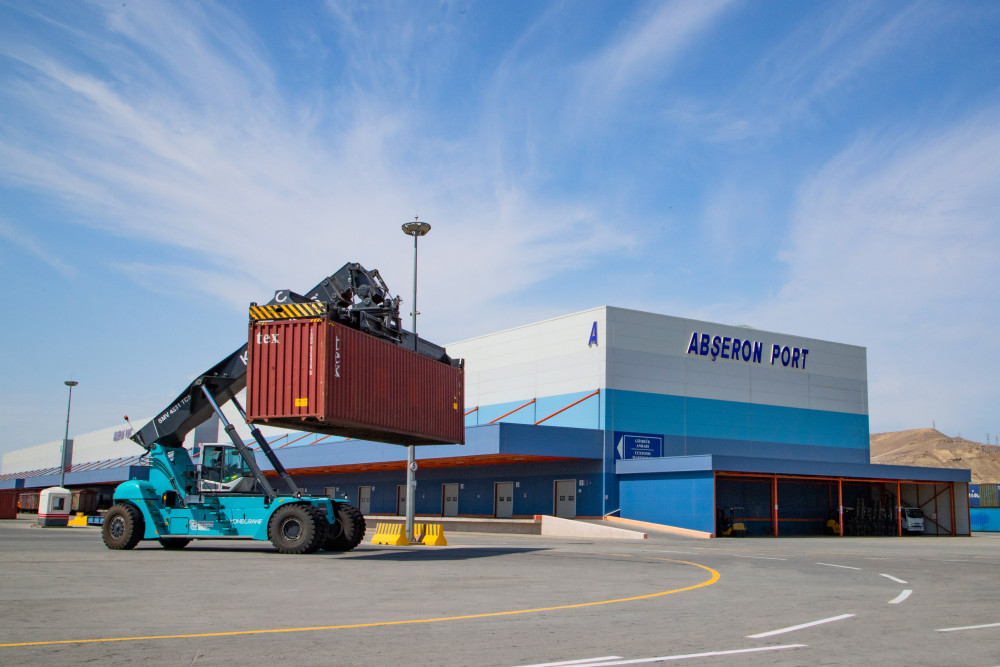
It is worth mentioning that even the history of the shifting geographical distribution of the centre’s cargoes reflects the corridor's history in general terms. Traditionally, a significant portion of inbound cargoes originated in the northern regions, Russia specifically. However, over the last couple of years, this geographical pattern changed dramatically as a rising proportion of containers and wagons came to the centre from the eastern countries, mainly from Kazakhstan. Institutionally, the centre has also been adapting to these changes as, for instance, an office in Xi’an, the Chinese city where Europe-bound block trains are primarily loaded from central China, allows the centre to be located right at the point of origin of currently growing freight traffic in the Middle Corridor. The centre that has offices in Xi'an, partners in Georgia and Türkiye, as well as an integrated railway and customs system in Azerbaijan. Perhaps, it is a key link of the international supply chain reaching from central China to European railways.
Business park, from transit to production
The most strategically intriguing part of the development of the Absheron center at present is not the functioning of its logistic services but rather the creation of the Business Park Absheron industrial zone, which is being built on 20 out of its 158 hectares of territory, an 80,000 sqm complex of light and heavy industries, warehousing and storage, which will start functioning in stages in Q1 2027. This represents a fundamental change in perception of the project: from a logistics center that sorts goods of other countries to a manufacturing facility that makes products for domestic and foreign consumption.
It is the same logic driving the entire strategy of Azerbaijan for economic diversification beyond oil – that the country which finds itself right at the crossroads of the most strategically significant east-west transportation corridor in Eurasia should be taking advantage of more than simply the transit revenues but the industrial value addition as well. The reality is, Baku has moved towards connectivity diplomacy, positioning itself as the indispensable transit point of a trans-Eurasian corridor. It was the Business Park Absheron that was to become the next stage in this evolution from connectivity as the means of earning transit revenues to connectivity as the industrial location advantage. The Xi'an office, Georgian-Turkish cooperation, single-customs facility and 80,000 square meters of industrial space all together made up the rationale of why a company deciding to locate its business within Azerbaijan's logistic facilities would have access to a unique corridor.
Elchin Adiyev, the Director of the Business Department at Absheron Logistics Center, recently stated in an interview with local media that "85 percent of the cargo imported into the country by rail arrives here. The center has significant potential for further development, as its capacity could be increased by 3 to 4 times."
The honest qualification is the one the centre's own management implies in its figures: 25–30% utilisation in a facility commissioned in 2018 means eight years of below-capacity operation. While the rise in activity in the Middle Corridor has altered the course, the consistent business success of Business Park Absheron, whose competition for clients will be from Alat Free Economic Zone, the Sumgait Chemical Industrial Park, and industrial areas in the liberated territories, depends on whether the industrial park model will be able to gather enough anchor producers to make the rest of the investment worthwhile. Traffic on the corridor is very real and increasing. The issue is whether the aspirations of Absheron will materialize as quickly as its logistical potential is realized.
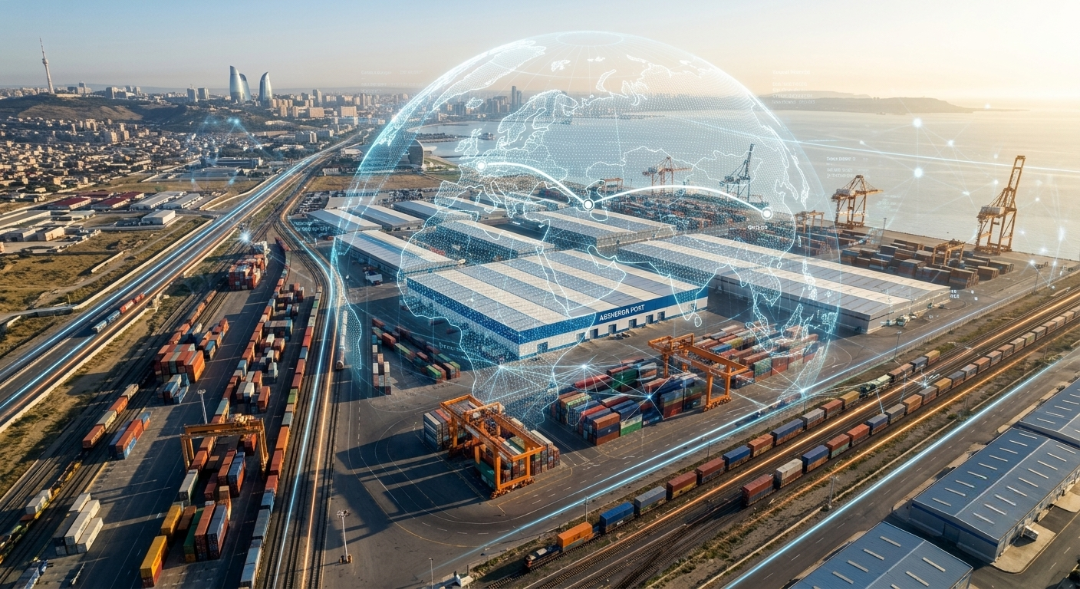
*image is generated by AI and does not represent an actual on-site photograph.
Here we are to serve you with news right now. It does not cost much, but worth your attention.
Choose to support open, independent, quality journalism and subscribe on a monthly basis.
By subscribing to our online newspaper, you can have full digital access to all news, analysis, and much more.
You can also follow AzerNEWS on Twitter @AzerNewsAz or Facebook @AzerNewsNewspaper
Thank you!