
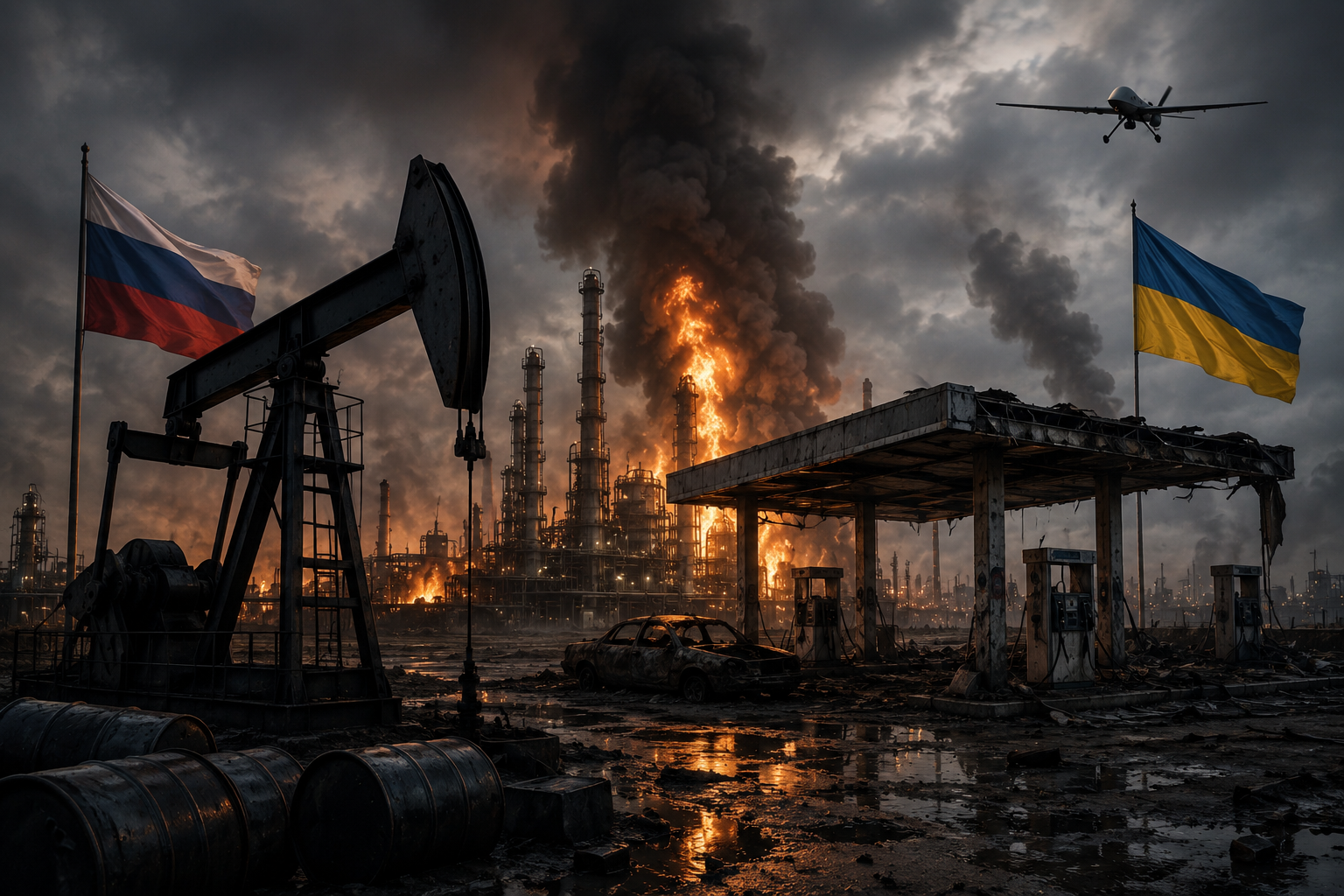
Ukraine's drone campaign turning Russia's oil system into new frontline

Qabil Ashirov
Read moreThe escalation of the conflict between Russia and Ukraine has taken a highly destructive turn along the frontlines and border zones, shifting the focus of tactical strikes heavily onto retail energy networks. In recent months, Russian forces have initiated a systematic campaign targeting civilian petrol stations within a 30 to 50-kilometer radius of the Ukrainian border. Utilizing a combination of kamikaze drones, heavy artillery, and precision guided missiles, these strikes have left hundreds of local distribution points in ruins across regions like Kharkiv, Sumy, and Chernihiv. On paper, official military narratives justify these attacks as preemptive operations designed to cripple the immediate logistics and mobility of the Ukrainian Armed Forces. In reality, however, the destruction of these retail networks hits the local population hardest. By wiping out local fuel nodes, the strikes effectively cut off civilian emergency services, medical transports, and humanitarian volunteers. This systematic dismantling of everyday energy infrastructure serves a broader strategic purpose: forcing an artificial evacuation of border settlements through resource starvation.
Yet, analyzing this battlefield dynamic requires understanding a critical geographic and strategic reality that dictates Ukraine's asymmetric response. Russia possesses an immense territory, spanning eleven time zones with thousands of scattered civilian fuel stations. For the Ukrainian military, attempting to track and destroy individual retail pumps across such vast expanses would require an extraordinary, inefficient amount of effort, time, and financial expense. The tactical return on investment simply does not justify the resource expenditure. Therefore, Ukraine has chosen an entirely different, centralized approach, completely bypassing individual retail nodes to strike directly at the source: Russia’s major oil refineries.
Currently, it is evident that Russian air defense systems are struggling to protect these massive industrial complexes. Despite layers of highly sophisticated anti-aircraft protection, long-range Ukrainian precision drones have repeatedly penetrated thousands of kilometers into Russian territory. The culmination of this campaign was vividly demonstrated when upgraded Ukrainian long-range drones traveled a record-breaking distance to strike the Omsk oil refinery deep in Western Siberia. By hitting the Omsk facility, Ukraine completed a strategic sweep, having now successfully struck every single one of Russia’s 11 largest oil refineries. Thus, Ukraine knocked out more than 30% of Russia's total refining capacity, causing domestic fuel production to plummet.
Faced with an eroding domestic production base, the Kremlin will likely find itself forced to replicate the exact strategy Ukraine used to survive its own energy challenges in the opening years of the war. Early in the full-scale invasion, Russian missile strikes effectively knocked out Ukraine’s sole operating oil refinery in Kremenchuk, and Moscow continues to periodically bomb that same area to ensure it can never be brought back online. Ukraine successfully solved its resulting domestic fuel crisis by abandoning domestic refining altogether and shifting completely to fuel imports from Europe, utilizing a highly flexible, decentralized network of foreign rail and road supply.
Russia is now standing at the precipice of a mirror image of that dilemma. The domestic press and international energy forums are already actively discussing Moscow's urgent negotiations to import fuel from alternative partners. Belarus has already delivered record-breaking volumes of gasoline to the Russian market, while parallel discussions and initial shipments involving India and Kazakhstan are rapidly gaining momentum. This represents a historic and profoundly ironic economic shift: one of the world's largest oil-producing empires is now forced to export raw crude because it can no longer process it at home, effectively buying back finished gasoline from foreign nations just to keep its domestic market afloat.
However, this transition to foreign dependency will almost certainly trigger the next tactical evolution on the battlefield. Once Russia fully shifts to relying on these highly concentrated foreign fuel imports to supply its border garrisons and regional economies, the vulnerability of its domestic distribution network will skyrocket. It is highly probable that once these import supply lines are established, we will begin to observe a familiar phenomenon emerge on Russian soil: the systematic and targeted destruction of fuel stations and transport hubs within Russia's own border regions, precisely matching the scorched-earth energy tactics currently being executed inside Ukraine.
Ultimately, the war between Russia and Ukraine has shed its remaining illusions and entered a grueling new phase: a pure war of attrition. By shifting the primary focus of the conflict directly into the fuel tanks, processing towers, and distribution lines that power both advanced military machinery and daily civilian life, both nations are testing the absolute limits of each other's structural and economic resilience. The degradation of the adversary's energy and logistics systems is no longer a secondary byproduct of territory grabs; it has become the primary objective of the war. In this relentless and exhausting test of endurance, the message written across the burning infrastructure of both nations is stark: the side that suffers systemic structural attrition first will be the absolute loser of this war.
Here we are to serve you with news right now. It does not cost much, but worth your attention.
Choose to support open, independent, quality journalism and subscribe on a monthly basis.
By subscribing to our online newspaper, you can have full digital access to all news, analysis, and much more.
You can also follow AzerNEWS on Twitter @AzerNewsAz or Facebook @AzerNewsNewspaper
Thank you!