
Georgia's Anaklia shift opens door to new investment and stronger Middle Corridor
Akbar Novruz
Read moreIt took a decade, three administrations, two tender cancellations, a lost arbitration case before the World Bank, and the subtle withdrawal of a Chinese state-owned enterprise to finally reach a port model that port economists would have advocated from the very beginning. On Monday, Economy Minister Mariam Kvrivishvili declared that Anaklia will operate as a landlord model, the state holding a 100% stake in core maritime assets, while international businesses could construct and operate certain facilities under long-term contracts, signalling an end to plans of a single private lead investor and validating what several months of speculation had revealed: Beijing has exited the project. The declaration may be important not in its implications for Georgian politics, although there are many of them, but in its implications for one of the most serious structural challenges that exist in the Middle Corridor.
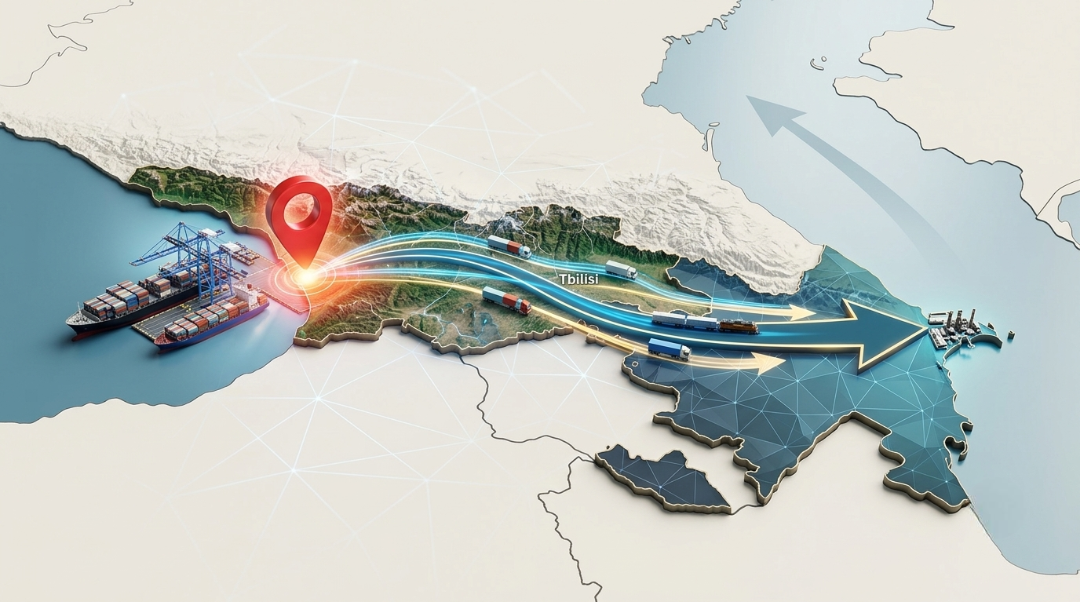
The bottleneck exists, and it becomes more evident each day. In the first four months of 2026, cargo transit through Georgia increased 21% year on year and 46% over four years, all due to the growth of cargo transit through the Middle Corridor as a result of rerouting China-Europe overland transport from the sanctioned Northern Corridor to the Middle Corridor and from the ocean route disrupted at the same time because of disturbances in the Hormuz and Red Seas. Cargo transit currently passes from the Caspian Sea to the Black Sea via Alat Port in Azerbaijan, via the Baku-Tbilisi-Kars railway route, and ends up in Poti or Batumi, both shallow-draft ports close to their operational capacity. Poti and Batumi ports do not have the capability to accept Panamax-class vessels, the most common container ships in international commerce. Anaklia, built with a depth of 16-17 metres, is the only port on the Georgian Black Sea coast that can handle such a class of vessels. Without Anaklia, a maximum of 5 million tonnes of transit through the Middle Corridor would be limited.
Why did China leave?
The CCCC exit, officially unconfirmed but confirmed by omission, given that the government did not refer whatsoever to the Chinese-Singaporean consortium in Monday's announcement, resolves a problem that had been accumulating for two years. CCCC is currently under US Treasury sanctions imposed since 2021 for involvement in the military-industrial complex of China. It was excluded from World Bank projects for eight years starting from 2009 due to corruption charges in the Philippines. A technology center built by CCCC in Ecuador turned out to be mainly structurally deficient after a few years of operation. The US embassy in Tbilisi and the State Department warned repeatedly and publicly that Georgia going forward with CCCC will negatively affect the country's Euro-Atlantic integration process, becoming even more important given the deterioration of the relationship with the EU. The removal of CCCC removes a major hindrance preventing Western and Middle Corridor investments from entering the project.
The landlord concept itself has been thoroughly tested. Both Rotterdam, Hamburg, and Singapore have versions of it in place, public ownership of infrastructure assets, along with private terminal operators with long-term leases. Port Consultants Rotterdam, the firm retained in April 2026 to review possible alternatives to the previous master plan, was the firm that suggested the state implementation concept chosen by the government. The concept provides for sovereignty for Georgia while also providing each Middle Corridor nation, as well as every container terminal operator, with an economically viable point of entry.
And now, what this means for Azerbaijan, specifically
The BTK railway's recent capacity increase to 5 million tonnes, driven by over $775 million of Azerbaijani investment in its Georgian section, is currently hindered by bottlenecks at the ports of Poti and Batumi. To alleviate this issue, developing a terminal at Anaklia, directly linked to the BTK network, would unlock the railway's full potential for commercial returns. Azerbaijan could utilize a landlord model to lease and operate this terminal, thus extending its logistics management from Alat Port on the Caspian to the Black Sea. Importantly, Anaklia complements rather than competes with Alat since it provides a viable onward route for goods arriving from Kazakhstan and Uzbekistan, thereby increasing Alat's utilization and transit revenue. Moreover, Azerbaijan and Georgia are the only two countries through which any Middle Corridor freight must pass between the Caspian and the Black Sea. Co-investing in Anaklia solidifies their joint significance in a manner that European institutions, as well as the Asian Development Bank (ADB) and the Asian Infrastructure Investment Bank (AIIB), can support. This partnership also enhances Azerbaijan's influence in any future EU-Middle Corridor investment framework.
The landlord model addresses ownership and partner issues, but it does not solve the financing problem. The government of Georgia has made a pledge to finance its maritime infrastructure, roads and railway links on its own, a pledge which will cost a considerable portion of the $7 billion transport and logistics investment program until 2032. The government of Georgia has not announced any allocation for the infrastructure of Anaklia from the total amount mentioned above, nor a financing program. The US International Development Finance Corporation recently signed an agreement to lend $25 million to Poti's PACE Group to expand another port facility.
However, the crucial sequence from the declaration of the landlord model to the selection of the terminal operator and the arrival of the first ship within 36 months is a challenge. The timing of whether the Alat-BTK-Anaklia route can become a functioning integrated system before the next round of Middle Corridor investments arrives is an issue of mutual interest to Azerbaijan, Georgia, and their Middle Corridor partners.
Here we are to serve you with news right now. It does not cost much, but worth your attention.
Choose to support open, independent, quality journalism and subscribe on a monthly basis.
By subscribing to our online newspaper, you can have full digital access to all news, analysis, and much more.
You can also follow AzerNEWS on Twitter @AzerNewsAz or Facebook @AzerNewsNewspaper
Thank you!