
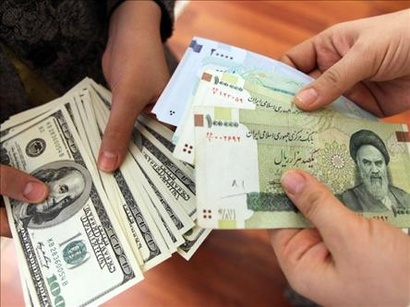
Iran currency drop linked to compensation of budget deficit by dollar sales
Mohammad-Reza Sabzalipour, the head of Iran's comprehensive
exports center, told Trend news agency on May 27 that the main
reason of dropping Iran national currency in value was compensation
of budget deficit in Iran by selling expensive dollars by
government.
The Iranian administration says it anticipates 300 trillion rials
(about $24.5 billion) deficit in the current year's budget, but MP
Ahmad Tavakkoli believes that the real budget deficit is 860
trillion rials, Mehr news agency reported on April 26.
Last year, Iran faced budget deficit, as well.
Another MP, Gholamreza Mesbahi-Moqaddam, said last November that
the government is anticipated to face 540 trillion rials budget
deficit.
However, economy minister Shamseddin Hosseini said last December
that total incomes had been projected to reach 1440 trillion rials,
but oil export bans decreased the figure to 950 trillion rials.
Oil incomes fell by 50 percent as a result of the sanctions, he
said, adding that oil incomes account for 60 percent of government
revenues and 80 percent of total exports.
Oil exports had been envisaged to hit 2.7 million barrels per day,
but it stood at 1.5 mpbd (including gas condensates) due to the
western sanctions, he noted.
Ahmadinejad's administration earned $800 billion during the past
eight years, which is more than half of the country's oil sector
total income during its 103 years of history.
Sabzalipour said that the value of the Iranian national currency
fell to one third since the past eight years, the U.S. dollar price
has increased three times against the Iranian rial, and the runaway
inflation has crippled normal life of people.
According to his statement, the main reason for the devaluation of
the national currency against the dollar was the mismanagement of
the government toward compensating its budget deficit.
Sabzalipour said that government for compensating its 400 trillion
rial deficit and paying cash subsidies, took measures which led
gradually to a reduction in the amount of dollar in the free market
and then a sharp rise in the dollar price. "Unfortunately, the
government took a high risk and fueled the inflation
unprecedentedly."
While the official rate of the U.S. dollar was 12,260 rials last
year, it was dealt at 25,000 rial at the Forex Center and 39,000
rials in the free market.
The administration of president Ahmadinejad pays 450,000 rials to
every Iranian in exchange for removing a portion of subsidies. It
is estimated that the value of the cash subsidies is amounted to
34,000 billion rials per month.
According to Sabzalipour, the fastest way to curb the runaway
inflation and control the foreign currency free market is to win
confidence of economic enterprises, remove production obstacles,
resolve financial problems of companies, support exporters,
stabilize the dollar price at about 20,000 rials (between the
official rate of 12,260 rials and the Forex Center rate of 25,000
rials), and allocate dollar to importers without red tape, monitor
prices by supervising bodies, attain an agreement with the 5+1
group to lift sanctions and banking transaction restrictions, and
facilitating the transfer of dollar into the country.
Hamid Safdel, the Iranian deputy industry minister has said that
Iran has some $100 billion overseas, but the capital cannot be
transferred into the country due to the sanctions.
Here we are to serve you with news right now. It does not cost much, but worth your attention.
Choose to support open, independent, quality journalism and subscribe on a monthly basis.
By subscribing to our online newspaper, you can have full digital access to all news, analysis, and much more.
You can also follow AzerNEWS on Twitter @AzerNewsAz or Facebook @AzerNewsNewspaper
Thank you!