
Drone strike puts Kazakhstan’s oil exports at risk: Astana seeks sustainable plan

Akbar Novruz
Read moreA few days ago, the Caspian Pipeline Consortium announced the resumption of the loading process at the Novorossiysk Terminal following an interruption which caused, at its peak, the daily crude oil production of Kazakhstan to be reduced by half from 2.16 million barrels a day to just over one million due to the inability to export the crude oil. The interruption was caused by Ukrainian drone attacks, which have become a 'customary phenomenon' for a while. Within hours of the resumption process, two ships, Seamajesty and Milos, were docked and loading Tengizchevroil volumes. Chevron, which produces the oil in the Tengiz field that goes through the CPC pipeline, indicated that it is keeping an eye on the development. Astana felt relieved.
What is not over and what has in fact been rendered impossible by the recent events is the conversation about the future of the country’s oil export policy. Over 80% of all crude oil shipped abroad via pipeline from Kazakhstan passes through the CPC Pipeline, which runs 1,510 kilometers from the Tengiz field through Russia to Novorossiysk – the oil port on the Black Sea, where tankers load the product and distribute it to Europe and Asia. This arrangement worked for almost three decades. It was economical, cost-effective, and the geopolitical framework underlying it, which included a predictable but demanding transit partner in Russia, had stayed largely stable until February 2022. These premises ceased to be valid in February 2022. Russians did not conduct the recent strikes against the port. They were the Ukrainian attack on a Russian oil port in wartime.
The alternative that needs an upgrade
The Baku-Tbilisi-Ceyhan pipeline stretches 1,768 kilometers, runs only within the territory of Azerbaijan, Georgia, and Türkiye, and ends in the port of Ceyhan located in the Mediterranean Sea, thus avoiding transit through Russia and connecting the pipeline to a different range of buyers than those who can be accessed from Novorossiysk. The BTC pipeline has been transporting Azerbaijani oil since 2006. Besides, it has also, increasingly, been transporting Kazakh oil – which has been loaded from tankers in the Caspian seaport of Aktau, shipped across the sea to the Sangachal terminal of Baku, and transported further on through the BTC pipeline to the Mediterranean Sea. The volume of transportation of Kazakh oil via the BTC amounted to 1.2 million tons in 2025 and for 2026 is planned between 1.5 and 2.2 million tons based on a five-year agreement of transportation concluded between KazMunayGas and SOCAR. Up until June 2026, Kazakhstan had already shipped 704,000 tons of oil via the BTC, thus exceeding the planned pace of delivery.
The figures are on the rise, but still small in relation to the magnitude of the problem they aim to resolve. Even at its highest estimate for 2026, Kazakhstan's volumes of transport via BTC would amount to only 3 per cent of the total crude exports of the country. However, the aspiration is much greater, as the energy minister of Kazakhstan has outlined a vision of increasing BTC throughput up to 20 million tonnes per year, which is thirteen times more than it currently is, although no deadlines have been set yet. The difference between the two is explained by the lack of necessary infrastructure. The capacity of the BTC pipeline amounts to 60 million tonnes per year, and it is already operating at close to maximum capacity with Azerbaijani crude.
Head-to-head comparisons
| Feature | CPC (Tengiz–Novorossiysk) | Trans-Caspian › BTC (Aktau–Ceyhan) |
| Length | 1,510 km | 1,768 km (BTC leg alone) |
| Destination | Black Sea, Russia | Mediterranean, Türkiye |
| Kazakh Export Share | ~80% | ~3% and rising |
| Russian Stake / Territory | Russia equity stake: ~10% | No Russian territory or equity |
| Key Operators | Chevron, Shell, ExxonMobil, KMG | SOCAR, bp (operator handover to SOCAR, July 2026), KMG |
| Risk / Constraint | Risk: wartime disruption, geopolitical leverage | Constraint: tanker capacity, port infrastructure, BTC headroom |
Azerbaijan's strategic opportunity and the problem that won't solve itself
Perhaps, for Azerbaijan, the CPC disruption is an opportunity. The BTC pipeline, which was handed over from its operator bp to SOCAR in July 2026, is the only viable alternative for Kazakh crude that does not go through Russian territory. Each tonne of Kazakh oil shipped via Baku as opposed to Novorossiysk brings in money for SOCAR, strengthens the energy ties between Astana and Baku, and solidifies Azerbaijan's role as an essential point of contact between Central Asia and the outside world. As President Aliyev emphasized in his address at Baku Energy Week recently, the East-West Corridor is already shipping increasing amounts of cargo from Central Asia via Azerbaijani territory, with oil being the most valuable part of it.
Kazakhstan's Energy Minister Akkenzhenov, speaking to AnewZ in Baku, confirmed that Kazakhstan is actively assessing multiple options for expanding Caspian transit through Azerbaijan, including both the BTC route and the Baku-Supsa pipeline, a smaller Black Sea outlet that has been dormant for several years but whose revival is now under active discussion following the recent handover of its Georgian section to Azerbaijani state entities. KazMunayGas and Chevron have also held direct discussions about expanding BTC use as an additional export route, bringing the international oil majors that operate the Tengiz field into what has until now been primarily a government-to-government conversation.
Infrastructure bottleneck. While the political situation is favorable for BTC shipments from Kazakhstan, since both governments are willing to transport oil via BTC, the most critical factor preventing increased volumes is infrastructure. The port of Aktau, which serves as the main loading point of Kazakhstan into the BTC system, needs to be dredged because the Caspian Sea water level has decreased by about two meters in the past two decades. Furthermore, there is a lack of tanker capacity on the Caspian, and the BTC pipeline itself, which is transporting almost all of its capacity from Azerbaijan, does not have much available room without investing in compression and expansion.
The CPC pipeline is up and running again. There is no further threat to Kazakh oil output now. Prices of oil were already high due to the impact of the conflict between the United States and Iran on Middle Eastern supply lines and managed to take the hit without causing a jump that could have spurred political action from the Kazakh government. That means that the crisis has been resolved at just the right time, when the economic impact had been felt but not in such a way as to bring about disaster. However, that convenience may not last forever.
The attack on Russia’s Black Sea infrastructure by drones is continuing. The Ukrainian war has already entered its fourth year with no indication of a near-term resolution that would allow CPC’s Russian route to once again become politically viable. Perhaps it should not be a coincidence to hear Kazakhstan pointing out the possibilities of negotiating the idea of freezing the war in Ukraine for a while.
Oil production plans in Kazakhstan, with the country aiming to produce 100 million tons of oil per year, will eventually need export infrastructure that cannot be satisfied solely by the Novorossiysk port despite any disruptions. BTC is not a substitute for CPC; rather, it complements CPC and becomes an insurance policy against it and ultimately becomes a structural shift in the one key energy dependency that Central Asia continues to have. That shift, made possible by this week’s shutdown of CPC, has become a matter of immediate action. The question now is whether Astana and Baku take advantage of the window before the next drone strikes on Novorossiysk.
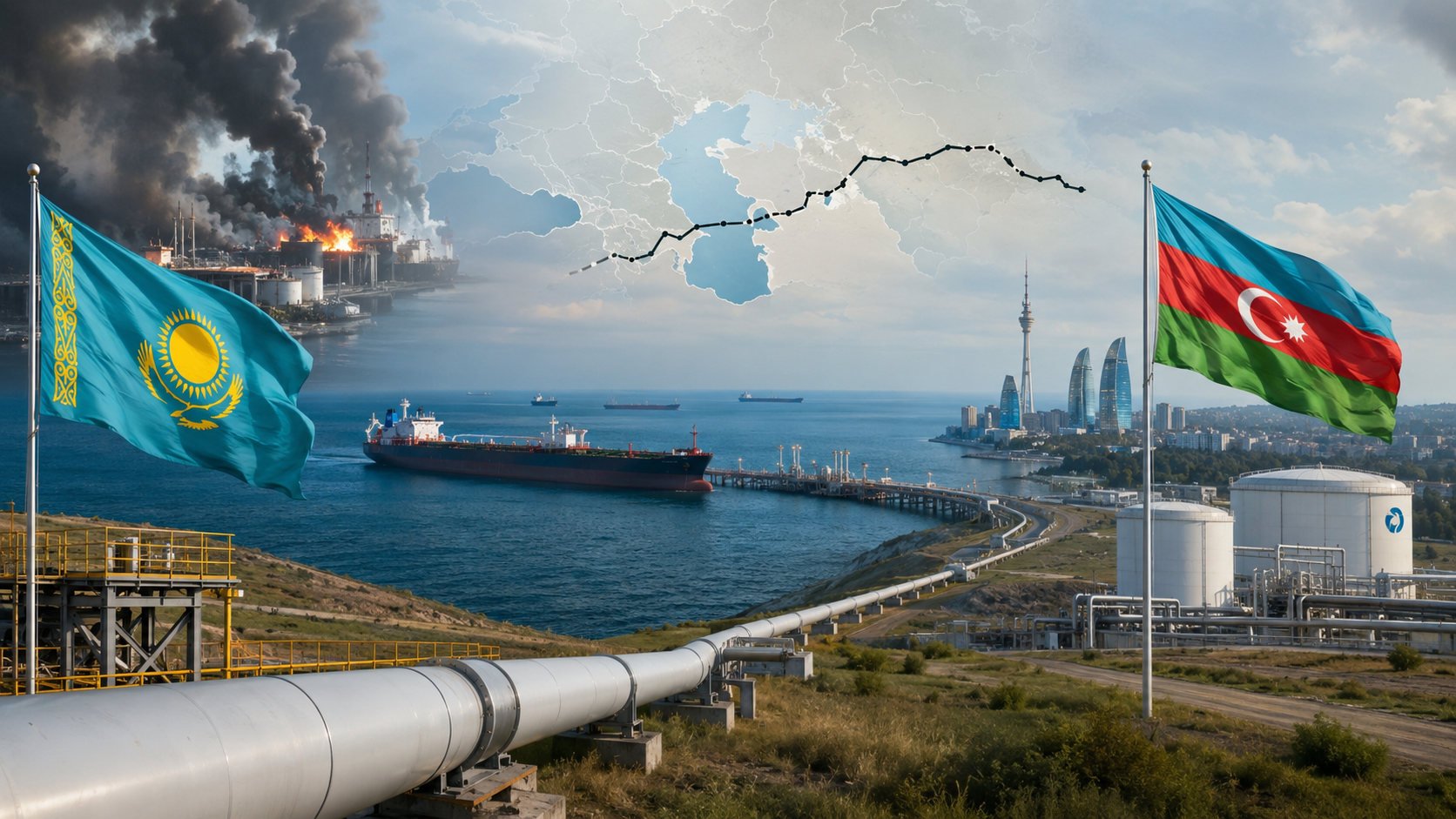
*image is generated by AI
Here we are to serve you with news right now. It does not cost much, but worth your attention.
Choose to support open, independent, quality journalism and subscribe on a monthly basis.
By subscribing to our online newspaper, you can have full digital access to all news, analysis, and much more.
You can also follow AzerNEWS on Twitter @AzerNewsAz or Facebook @AzerNewsNewspaper
Thank you!