
US-Saudi nuclear deal puts Iran, Israel in new strategic equation
Akbar Novruz
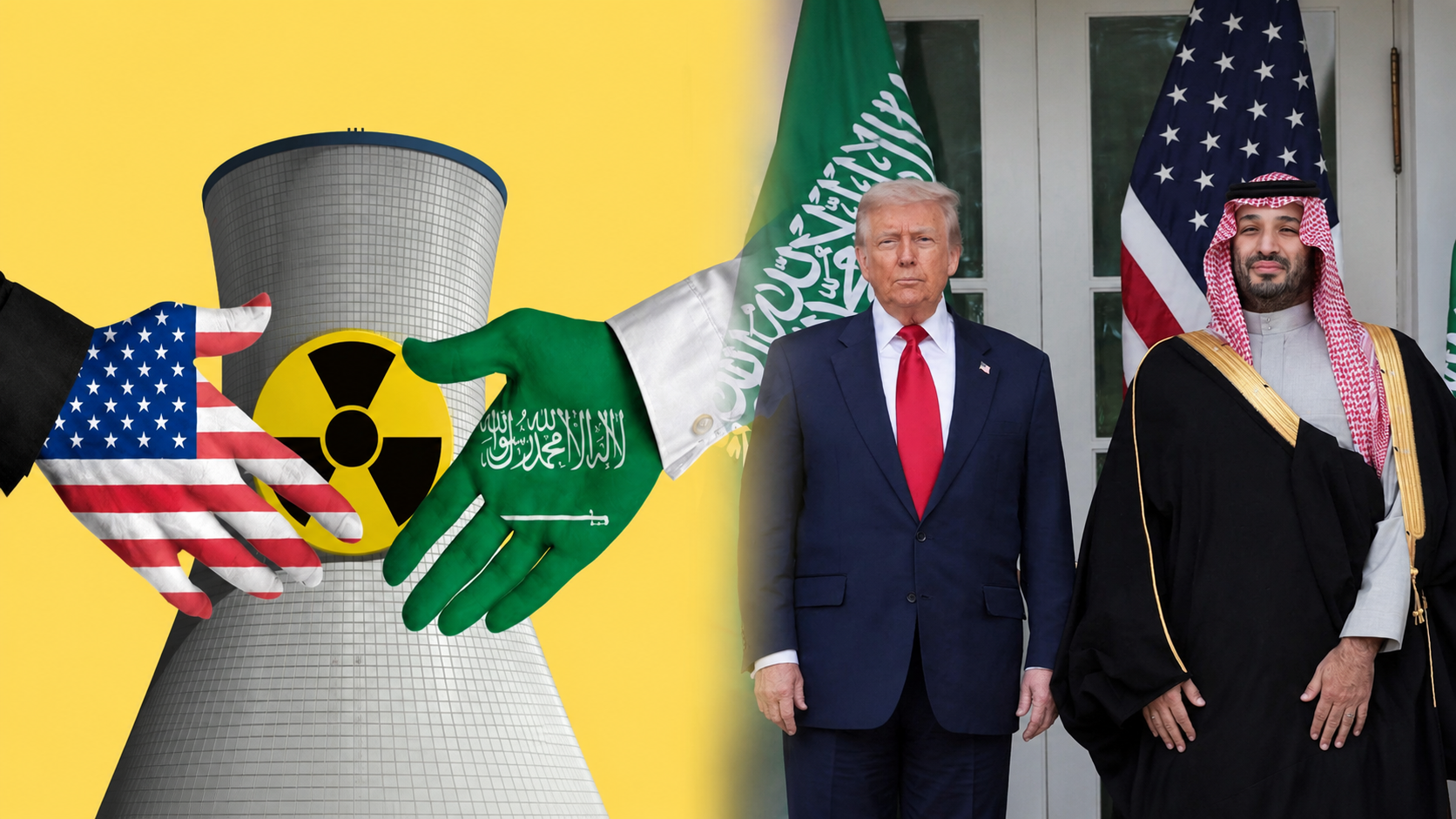
Read moreThe U.S. Department of Energy announced a signed Section 123
civil nuclear cooperation agreement between Washington and Saudi
Arabia. The 30-year agreement aims to open multibillion-dollar
commercial opportunities for U.S. nuclear firms (such as
Westinghouse) and help Saudi Arabia transition its domestic grid
toward nuclear energy.
The pact has sparked intense debate for several reasons, of
course.
Congress has not yet approved the arrangement, and few details about it have been made public. But former officials and members of the nuclear community said it is a major shift in U.S. policy and risks accelerating a nuclear arms race in an already volatile region.
The agreement may allow U.S. companies to build uranium enrichment facilities in Saudi Arabia to supply its nuclear reactors. U.S. companies would also provide additional technical expertise. The deal could mean Saudi Arabia would not have to import its nuclear fuel, and it could provide a pathway for it to enrich uranium on its own at a later date.
Unlike the landmark 2009 U.S. - UAE agreement, which explicitly barred domestic uranium enrichment (the "gold standard" of non-proliferation), the framework with Saudi Arabia includes a joint feasibility study on building a uranium enrichment facility in the kingdom. Enrichment technology can generate fuel for peaceful power plants, but if refined to higher purity levels, it can be used to produce weapons-grade material.
Speaking to AzerNEWS, geopolitical risk analyst Victor Bruno argued that the agreement reflects a much broader transformation in global politics rather than simply a shift in U.S.-Saudi relations. According to him, the Middle East is entering a new era of strategic autonomy and nuclear proliferation, and that the decline of US dominance is pushing regional powers to seek their own means of deterrence.
"Very probably, but it is increasingly evident that we are walking down a path of increased national self-determination. Surprisingly, countries that are economically dominant in the region have not tried to develop their own nuclear arsenal. But on the other hand, this goes to show how much power and leverage the U.S. had over the region. One should not be deceived that this apparent act of mutual respect between the Kingdom and America is, deep down, Washington washing its hands. The fact of the matter is that Western Asia is increasingly a region with bigger and bigger Great Powers, and such actions are bound to happen. It hardly can under these provisions. And with everything that has transpired over the last 12 to 18 months in Iran, any power with hegemonic aspirations should learn the lesson and try to develop its nuclear arsenal."
Lebanon-based analyst Hazem Al-Tawil, on the other hand, noted that Saudi Arabia's pursuit of nuclear technology should be viewed within the broader context of its changing security environment rather than as an isolated energy project.
"Saudi Arabia has long argued that nuclear energy is part of its economic diversification strategy under Vision 2030. That objective is legitimate in itself. The question is whether domestic uranium enrichment becomes merely an energy capability or gradually evolves into a strategic hedge. Unlike purchasing nuclear fuel abroad, domestic uranium enrichment creates indigenous technical expertise, industrial infrastructure and trained personnel. While enrichment for civilian reactors typically requires uranium enriched to around 3–5 percent, the same centrifuge technology can, if political decisions change, eventually be used to produce weapons-grade uranium above 90 percent."
The expert firmly believes that this does not trigger any regional arms race, as this is more of a 'muscle show' over Tehran:
"Now, this [referring to his prior quote] is what nuclear experts commonly describe as a "latent" or "breakout capability." It does not mean a country intends to build nuclear weapons, but rather that it possesses much of the technological foundation necessary to do so within a relatively short timeframe if circumstances dramatically change. Countries such as Türkiye, Egypt and the United Arab Emirates have all expressed varying degrees of interest in expanding civilian nuclear energy over the past decade. In a 2018 interview with CBS News, Crown Prince Mohammed bin Salman declared that "without a doubt, if Iran developed a nuclear bomb, we will follow suit as soon as possible." That statement has remained one of the most frequently cited arguments among arms control experts questioning whether Saudi enrichment should receive the same safeguards applied elsewhere. So, as a reference, we can surely say that Trump is making sure to help build 'muscle' near Iran that it can flex over its ambitions."
However, he also thinks it certainly changes strategic calculations:
"Now, as much as I believe that Saudi Arabia does not intend to trigger any arms race or confrontation in the region, this also adds a bigger complexity to the latter. In a Middle East already balancing Iranian nuclear advances, Israel's undeclared deterrent and growing geopolitical uncertainty, perception often shapes security calculations as much as capability itself. From my observation, the Israeli side does not directly welcome the initiative. The opinions are rather mixed or quite hostile, at least from a public perspective.
The US president cast doubt on the Saudi deal just hours after announcing that it hinged on Riyadh's recognition of Israel. While this recognition had always been a precondition for an agreement, the ongoing conflict in Gaza has strengthened Saudi Arabia's position, asserting that such recognition can only occur alongside the establishment of a Palestinian state. Even if no nuclear reactors are constructed, the mere announcement legitimizes and encourages other nations' ambitions for nuclear capabilities. Previous negotiations led to an Obama-era nuclear agreement that Tehran adhered to until Mr. Trump abandoned it. His actions seem to have resulted in a more aggressive and risk-taking Tehran, as anticipated; further military interventions are likely to exacerbate rather than resolve the nuclear threat. The possibility of Riyadh seeking a nuclear bomb still could serve as additional motivation - at least in a longer perspective."
Here we are to serve you with news right now. It does not cost much, but worth your attention.
Choose to support open, independent, quality journalism and subscribe on a monthly basis.
By subscribing to our online newspaper, you can have full digital access to all news, analysis, and much more.
You can also follow AzerNEWS on Twitter @AzerNewsAz or Facebook @AzerNewsNewspaper
Thank you!