
Turkiye prepares major energy policy shift as electrification takes center stage
By News Centre
At a time when geopolitical risks are intensifying across global energy markets, Turkiye is preparing for a fundamental transformation in its energy policy. In an interview with Yeni Şafak, Energy and Natural Resources Minister Alparslan Bayraktar emphasized that electrification will form the core of the country’s new energy roadmap, set to be unveiled in 2026. The strategy aims to reduce energy costs while decreasing dependence on foreign resources.
Bayraktar highlighted ongoing efforts to reshape Türkiye’s long-term energy planning, noting that the current strategy is undergoing revision. He recalled that five years have passed since the launch of the 30-year energy plan prepared in 2021 with a 2050 perspective. In light of shifting global conditions and technological advancements, the plan will now be updated. The minister stated that the new roadmap is expected to be announced this year, potentially ahead of the Conference of the Parties (COP) process, and will include revised renewable energy targets.
Placing electrification at the heart of the new strategy, Bayraktar explained that the vision to “electrify Türkiye” extends beyond electricity generation to encompass widespread adoption of electricity across all sectors. From transportation and housing to heating and industry, the government aims to drive a comprehensive transition toward electricity-based systems. He stressed that such a transformation will require robust infrastructure.
Bayraktar warned that prolonged tensions in the Middle East could have lasting consequences for the global economy. He noted that attacks on energy infrastructure in the region directly affect supply security, adding, “If similar developments occur in Saudi Arabia or Kuwait, the impact would be far greater.” Commenting on oil prices, Bayraktar pointed to forward market pricing, saying, “If you want to buy oil today, you are paying $140. The levels you see at $107–110 for Brent correspond to June contracts. The market is essentially signaling that if this situation persists, prices will rise further.”
Despite global uncertainties, Bayraktar said Türkiye remains relatively well-positioned in terms of supply security, noting limited dependence on the Strait of Hormuz. “Roughly 10% of Türkiye’s oil imports pass through Hormuz, and we have no dependence on it for natural gas. Therefore, we do not face significant vulnerability in supply security,” he said. He added that mechanisms such as the sliding-scale fuel pricing system and tax adjustments are being used to shield consumers from rising fuel prices, noting that without such measures, prices would be significantly higher.
Highlighting a transformation in energy supply routes, Bayraktar pointed to the strategic importance of the TurkStream pipeline. “Türkiye previously received its natural gas through the Western pipeline via Ukraine, Moldova, Romania and Bulgaria. This structure has now changed. Thanks to TurkStream, we have reduced transit risks and gained the ability to export gas to Europe,” he said.
He also underlined the importance of projects such as the Trans-Anatolian Natural Gas Pipeline (TANAP), Blue Stream pipeline, and floating storage and regasification units (FSRUs), particularly during times of crisis. Risks surrounding the Strait of Hormuz, he added, have accelerated the search for new pipeline routes. Potential lines extending from Saudi Arabia through Jordan and Syria to Türkiye are being evaluated. “If these projects materialize, they could reshape not only Türkiye’s energy landscape but also Europe’s energy balance,” he said.
Bayraktar also addressed energy cooperation proposals with Iraq. He noted that a pipeline extending from Basra to Türkiye has long been on the agenda. “There is a 650-kilometer pipeline reaching Silopi with a capacity of 1.5 million barrels per day. We have maintained this line operational for 50 years,” he said, adding that its completion would provide revenue for Iraq and establish a strategic energy corridor for Türkiye.
Touching on the long-discussed project to transport Turkmenistan gas across the Caspian Sea to Azerbaijan and Türkiye, Bayraktar said the idea has been under consideration for decades. “This project was discussed 30 years ago during the time of the late Süleyman Demirel. Now, a new window of opportunity may be emerging,” he noted.
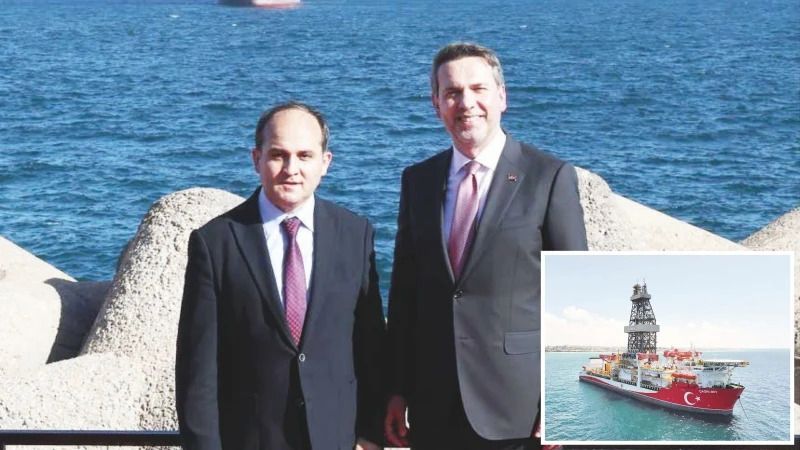
The minister also revealed that planned operations off the coast of Pakistan have been postponed due to security concerns. “We had planned to deploy the Oruç Reis for seismic surveys, but the region has effectively turned into a war zone. There are jammers everywhere, making it extremely difficult to receive signals,” he said. He added that exploration activities continue in two offshore fields in Libya, with seismic operations expected to be rescheduled later this year.
Regarding Black Sea gas production, Bayraktar said the offshore platform has reached a critical stage. “On August 30, we will move the platform from Filyos. This will be followed by a sail-out operation, testing phases, and the completion of riser connections,” he explained.
Bayraktar also provided an update on the Akkuyu Nuclear Power Plant, noting that testing is ongoing and that commissioning is targeted toward the end of the year if all proceeds as planned. He confirmed that negotiations with Japan over the Sinop Nuclear Power Plant were terminated due to cost concerns.
On small modular reactor (SMR) technologies, Bayraktar said discussions are continuing with countries such as Canada and South Korea, though he cautioned that expecting large-scale outcomes before 2030 would not be realistic.
Finally, Bayraktar addressed Türkiye’s energy exploration efforts in Somalia, expressing optimism about potential discoveries. “Expectations among Somalis are high. Based on seismic data, we decided to proceed with deep-sea drilling for oil and natural gas. We are more hopeful about offshore prospects and are currently drilling. I believe we will be able to share good news of a discovery within a few months,” he said. He added that while other international companies hold exploration licenses in multiple blocks, many have yet to begin active operations.
Here we are to serve you with news right now. It does not cost much, but worth your attention.
Choose to support open, independent, quality journalism and subscribe on a monthly basis.
By subscribing to our online newspaper, you can have full digital access to all news, analysis, and much more.
You can also follow AzerNEWS on Twitter @AzerNewsAz or Facebook @AzerNewsNewspaper
Thank you!