
Beijing–Baku agreement unlocks new era for Azerbaijan’s agribusiness exports

Qabil Ashirov
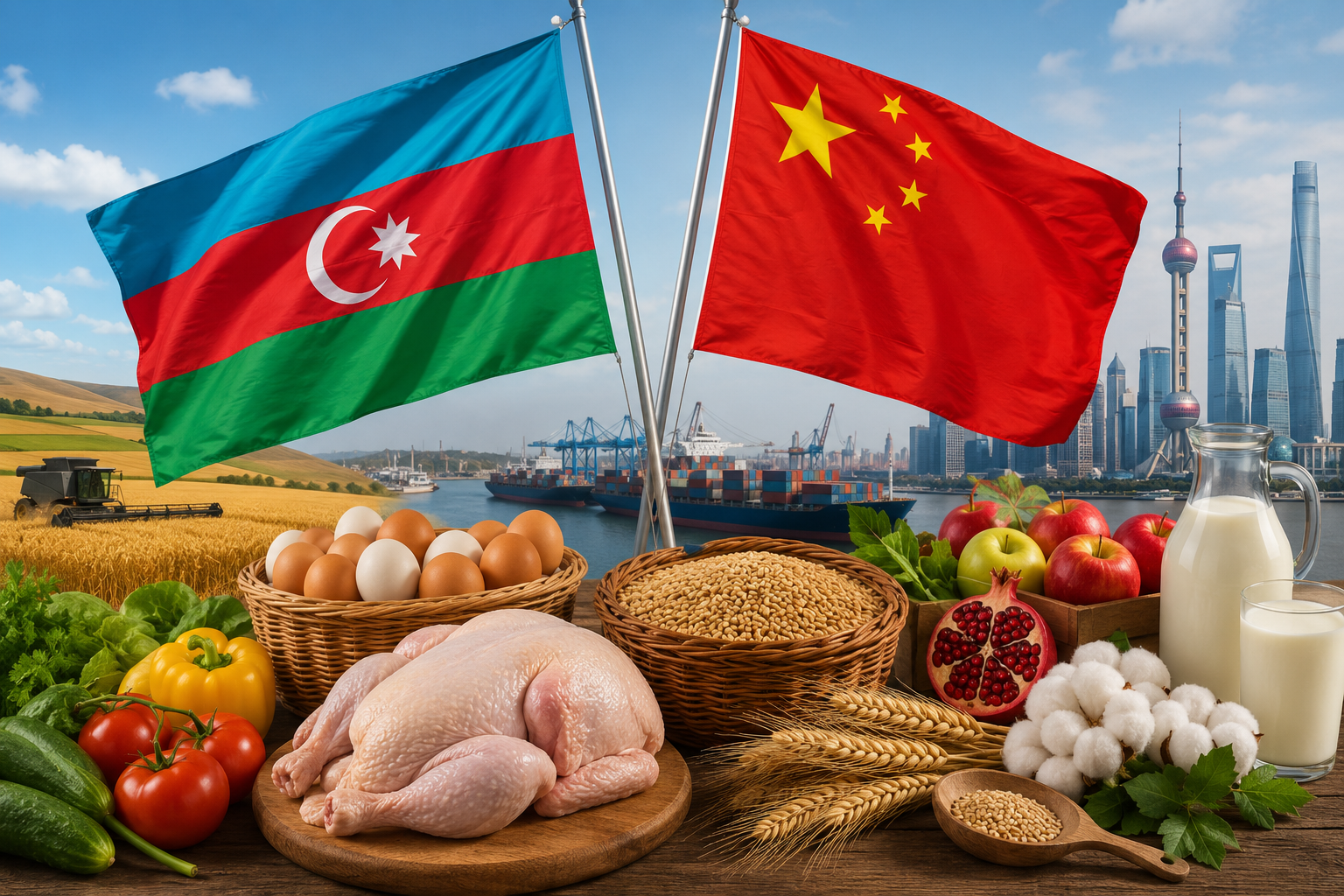
Read moreThe intersection of strategic state planning and high-stakes economic diplomacy has just handed Azerbaijan’s agricultural sector its most transformative blueprint of the decade. Agriculture has historically formed the bedrock of the Azerbaijani rural economy, acting as a vital cushion and a cultural cornerstone long before hydrocarbons reshaped the Caspian shoreline. While the nation’s vast fisheries and aquaculture potential have historically underperformed relative to their natural endowments, the poultry sector has quietly emerged as an economic powerhouse, consistently punching above its weight. The recent simultaneous convergence of a robust domestic production framework and unprecedented market access to the world’s most voracious consumer base marks the beginning of a hyper-growth phase for Azerbaijani agribusiness.
The scale of Azerbaijan’s domestic ambitions is laid bare in the newly unveiled State Program for the Production and Processing of Agricultural, Fishery, and Aquaculture Products for 2026–2030. Public deliberations within the Milli Majlis Agriculture Policy Committee reveal a calculated push to transition from a position of comfortable domestic reliance to total supply security and aggressive export expansion. Currently, Azerbaijan satisfies 82% of its domestic poultry meat demand through local production, leaving an 18% gap heavily reliant on foreign imports. The state’s targeted response is an aggressive 30% surge in poultry meat production by 2030, scaling output up from the 2025 benchmark of 147,000 tons to over 191,000 tons. Concurrently, commercial egg production is slated to expand by 27%, climbing from an annual yield of 2.343 billion eggs to nearly 3 billion units. This is not a modest incremental adjustment; it is a structural overhaul designed to cross the 100% self-sufficiency threshold while engineering a massive structural surplus designated solely for foreign markets.
Export diversification is no longer a theoretical policy goal for Baku; it is an active logistical reality. Azerbaijani poultry and egg producers have already broken ground in competitive foreign territories, successfully navigating complex phytosanitary and trade corridors to establish consistent export channels. Local agribusinesses currently ship premium commercial eggs to Afghanistan, several high-value Gulf countries, and even the heavily regulated market of the United States. However, while these footprints demonstrate the technical compliance and commercial viability of Azerbaijani poultry products on the global stage, their aggregate volume remains constrained by the niche nature of these initial partner economies. To unlock genuine economies of scale, Azerbaijan required an anchor market capable of absorbing infinite output capacity.
Enter Beijing. The signing of three critical protocols covering wild-caught aquatic products, aquaculture derivatives, and poultry meat between Goshgar Tahmazli, chairman of the Azerbaijan Food Safety Agency, and China’s Customs Minister Sun Meijun, represents an economic masterstroke. China remains one of the world’s two largest population centers and possesses a rapidly urbanizing middle class with an insatiable, income-elastic demand for high-quality animal and marine proteins. By establishing a formalized, ironclad legal and regulatory framework with China’s General Administration of Customs, Baku has effectively integrated its domestic production surplus into a multi-billion-dollar consumer ecosystem. The strategic brilliance of this timing cannot be overstated: just as the 2026–2030 State Program begins injecting capital, technological subsidies, and modernizing grants into domestic poultry farms to boost yields, the gates to the Chinese market have been flung wide open to capture the oncoming supply wave.
The macroeconomic synergy between these two developments creates a powerful compounding effect that will reshape Azerbaijan’s non-oil GDP trajectory. For decades, the primary inhibitor to massive private capital investment in Azerbaijani poultry and aquaculture was the "glass ceiling" of a relatively small domestic market of ten million consumers; overproduction risked depressing localized prices and destroying corporate margins. The Chinese protocols instantly shatter this ceiling. With a guaranteed external outlet, local large-scale enterprises and regional agricultural producers can aggressively deploy capital into scaling up operations without fear of local market saturation. Furthermore, the strict risk-based inspection systems and digital transformation metrics discussed during the bilateral meetings with China’s State Administration for Market Regulation will pave the road for a rapid, mandatory modernization of Azerbaijani laboratory and veterinary infrastructure. The capital subsidies promised under the 2026–2030 State Program will facilitate this transition, ensuring that local factories conform to elite global biosecurity standards.
Ultimately, this dual-track strategy offers a textbook case study in how a middle-income state can leverage institutional cooperation to achieve genuine economic diversification. By linking a 30% domestic supply expansion to the world’s most dynamic importing superpower, Azerbaijan is successfully transitioning its agricultural sector from a reactive, import-substituting industry into an offensive, high-yield export engine. The financial inflows generated from selling poultry and revived marine products to Beijing will not only yield vital foreign currency reserves but will also stimulate profound job creation across rural industrial zones. Azerbaijan has laid the infrastructure, secured the diplomatic keys, and unlocked the capital; the upcoming five years will see the nation’s poultry sector fly far beyond its traditional borders.
Here we are to serve you with news right now. It does not cost much, but worth your attention.
Choose to support open, independent, quality journalism and subscribe on a monthly basis.
By subscribing to our online newspaper, you can have full digital access to all news, analysis, and much more.
You can also follow AzerNEWS on Twitter @AzerNewsAz or Facebook @AzerNewsNewspaper
Thank you!