
Aghdam’s $574 million sales herald new economic era for Karabakh

Qabil Ashirov
Read moreWhen Azerbaijan regained control of Karabakh in 2020, the immediate priority was clear. Roads had to be rebuilt, electricity restored, water systems repaired and entire towns reconstructed after decades of destruction. Airports, highways and residential districts became the most visible symbols of the country's post-conflict recovery.
However, reconstruction alone was never likely to determine whether the region could truly recover.
The more important challenge has always been economic: creating the conditions that encourage businesses to invest, industries to develop and people to build their futures in the region. Without sustainable employment and private-sector growth, even the most ambitious reconstruction program risks becoming little more than an infrastructure project.
That is why the latest figures from Aghdam Industrial Park deserve far more attention than they have received.
During the first half of 2026, companies operating in the park generated AZN 976 million (USD 574.12 million) in product sales, including AZN 42 million (USD 24.71 million) in exports. Investors have committed more than AZN 177 million (USD 104.12 million), while the park has already created 1,230 permanent jobs. Today, 12 enterprises are operating, another 12 are under construction, and 10 more are in the planning stage. Notably, only around 60% of the park's territory has so far been allocated to investors, suggesting that significant room for expansion remains.
Viewed in isolation, these figures may appear to be routine economic statistics. In reality, they represent something much larger.
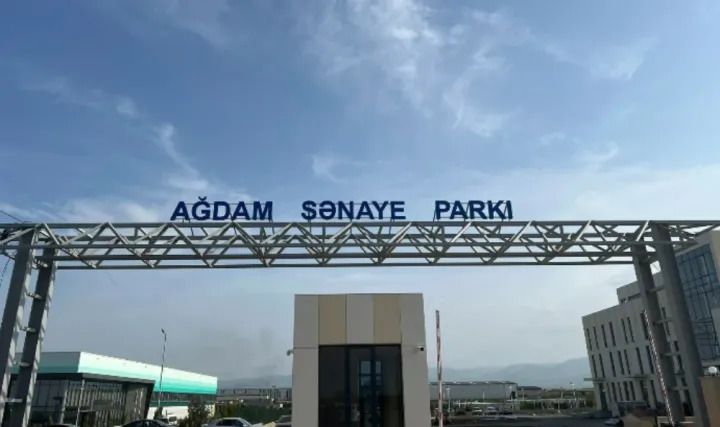
Aghdam Industrial Park is not simply another manufacturing zone. Established in 2021 in territory liberated during the 2020 conflict, it represents one of Azerbaijan's most ambitious attempts to transform post-war reconstruction into long-term economic development. The objective extends well beyond rebuilding damaged infrastructure. It is about integrating Karabakh into the country's broader economy through industrial production, private investment, exports and employment.
This distinction matters.
History shows that people rarely relocate permanently because new roads have been built or new apartment blocks have appeared. They move because they can find stable jobs, establish businesses and provide better opportunities for their families. Economic opportunity—not physical infrastructure alone—is what ultimately determines whether a region becomes vibrant or remains dependent on government support.
Industrial parks are designed to create exactly that foundation.
Aghdam's progress therefore should be viewed as more than a regional development project. It represents an attempt to build an economic ecosystem capable of sustaining long-term population growth. As businesses expand, suppliers emerge, logistics networks develop and supporting services grow alongside manufacturing. Over time, these effects reinforce one another, creating a cycle of investment and economic activity that extends well beyond the boundaries of the industrial park itself.
The project has already reached an important milestone. By the number of resident companies, Aghdam Industrial Park has become Azerbaijan's second-largest industrial park, behind only Sumgait Chemical Industrial Park, which remains the largest industrial park in the South Caucasus. Considering that Aghdam's industrial ecosystem is only a few years old, its pace of development is noteworthy.
More importantly, the project is still far from complete.
With only about 60% of its land allocated and dozens of additional industrial projects either under construction or in development, today's production levels are unlikely to represent the park's full economic potential. If investor interest continues and supporting infrastructure expands as planned, manufacturing capacity, exports and employment could increase substantially over the coming years.
The broader implications extend beyond economics.
A successful industrial base can encourage not only the return of former internally displaced persons but also attract workers, engineers, entrepreneurs and professionals from other regions of Azerbaijan. In time, international manufacturers, foreign investors and specialized service providers may also find opportunities in a region that only a few years ago was associated primarily with conflict rather than commerce.
For many countries emerging from conflict, reconstruction is often measured by the number of houses rebuilt or the kilometers of highways completed. Those achievements are undoubtedly important, but they are only the first phase of recovery.
The more meaningful test comes later: whether private businesses choose to invest, whether factories begin producing, whether exports grow and whether economic activity becomes self-sustaining without continuous government intervention.
By that standard, Aghdam Industrial Park may represent one of the clearest indicators yet that Azerbaijan's strategy for Karabakh is entering a new phase. The story is no longer only about rebuilding what was lost. It is increasingly about creating an economy capable of supporting future generations.
That may ultimately prove to be the most enduring achievement of all.
Here we are to serve you with news right now. It does not cost much, but worth your attention.
Choose to support open, independent, quality journalism and subscribe on a monthly basis.
By subscribing to our online newspaper, you can have full digital access to all news, analysis, and much more.
You can also follow AzerNEWS on Twitter @AzerNewsAz or Facebook @AzerNewsNewspaper
Thank you!