
SOCAR’s Italian investments point beyond traditional oil business

Qabil Ashirov
Read moreThere are moments when the future of the energy industry is announced not with a dramatic discovery or a record-breaking oil field, but with a quiet corporate statement. Hidden between routine updates and investment plans are the first signs of a much larger transformation. For decades, oil companies measured success by the number of barrels they produced. Today, the defining question is becoming something else entirely: who will remain relevant in a continent determined to consume less fossil fuel? SOCAR's latest moves in Italy suggest that Azerbaijan's state energy company may already be preparing its answer.
SOCAR's response to questions about potential new investments in Italy was deliberately cautious. The company confirmed that additional acquisitions and investment opportunities are currently being evaluated as part of a broader investment strategy, with any decisions to be announced only after they are finalized. At first glance, the statement appears uneventful. Yet when viewed alongside the company's recent activities in Italy, it paints a picture of a business that is steadily expanding its footprint rather than making isolated investments.
The most significant milestone came with the completion of SOCAR's acquisition of a 99.82% stake in Italiana Petroli, one of Italy's leading fuel distribution companies. The deal transformed SOCAR from a supplier of crude oil into a direct participant in one of Europe's largest retail fuel markets. Instead of simply exporting hydrocarbons to Europe, the Azerbaijani company now owns part of the infrastructure that delivers refined products to millions of consumers. This is a fundamental shift in strategy. Companies that control downstream assets—from storage terminals to filling stations—capture value far beyond the sale of crude oil and become more deeply integrated into local energy markets.
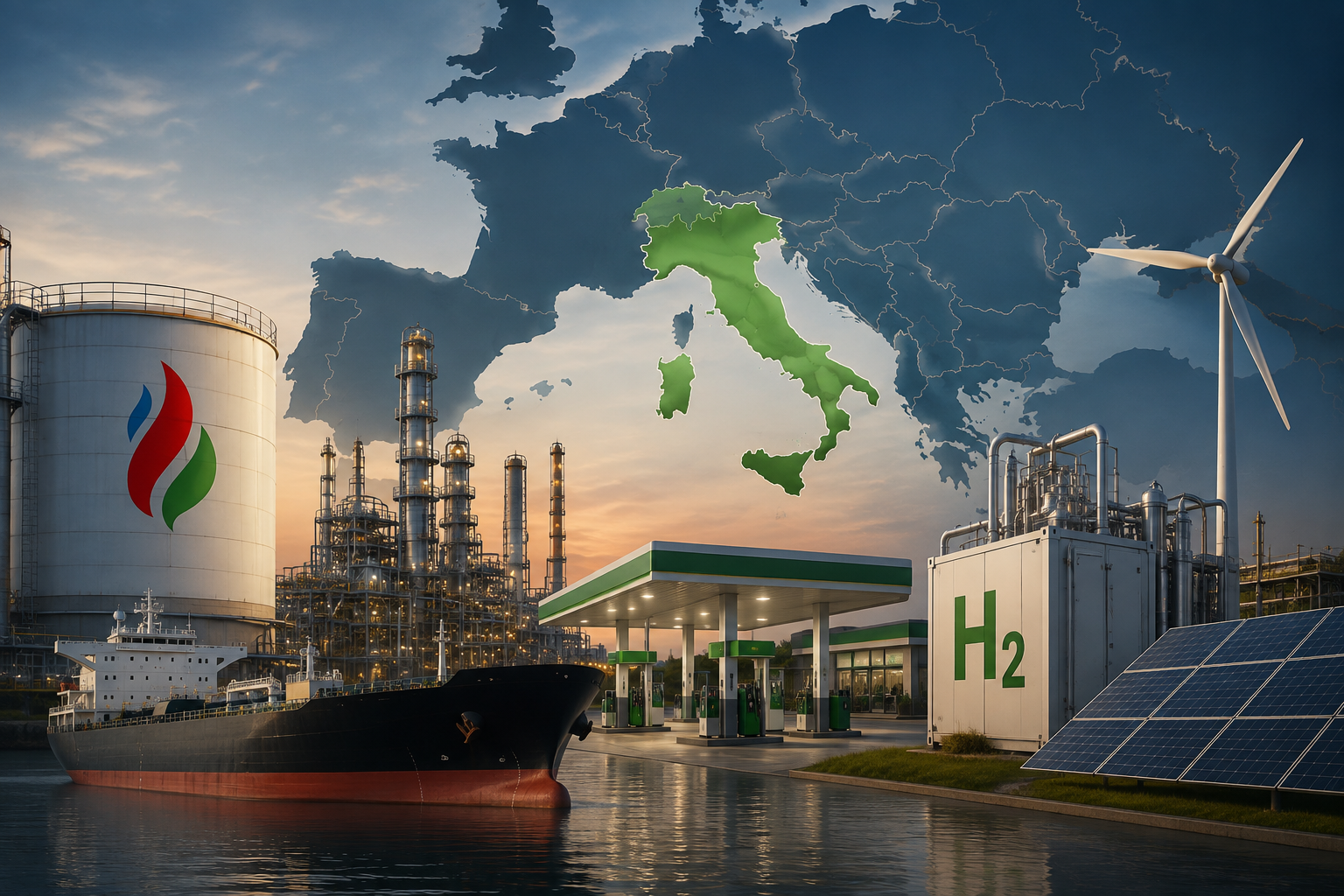
Equally noteworthy is SOCAR's growing involvement in projects linked to the energy transition. The company's participation in Italy's first Hydrogen Valley initiative at the SARPOM refinery in Trecate demonstrates that its ambitions extend beyond traditional refining. Green hydrogen has emerged as one of Europe's preferred solutions for decarbonizing industries where electrification remains difficult, including refining, steel production and heavy transport. While such projects are still at an early stage and their commercial viability remains uncertain, participation offers something equally valuable: experience. As governments across Europe channel billions of euros into hydrogen infrastructure, companies that establish an early presence are likely to enjoy significant strategic advantages in the coming decade.
Taken together, these developments reveal a broader pattern. SOCAR appears to be pursuing diversification not only across business segments but also across technological pathways. The combination of conventional fuel retail, refining partnerships and emerging clean-energy initiatives mirrors the approach adopted by several of Europe's largest energy companies. Firms that once focused exclusively on oil production are increasingly investing in hydrogen, renewable fuels and carbon-reduction technologies—not because oil is disappearing tomorrow, but because the energy market of 2040 will look fundamentally different from that of 2020.
Italy is an especially logical destination for this strategy. It already occupies a central position in Azerbaijan's energy relationship with Europe. Through the Trans Adriatic Pipeline (TAP), Azerbaijani natural gas reaches Southern Europe, while Italian companies have long been among Azerbaijan's most important energy partners. Expanding into Italy's domestic fuel market allows SOCAR to strengthen an existing relationship rather than build one from scratch. The acquisition of Italiana Petroli therefore represents more than a commercial transaction; it reinforces Azerbaijan's long-term economic presence in one of the European Union's largest economies.
Perhaps the most interesting aspect of SOCAR's latest statement is not what it confirms but what it leaves unsaid. The company neither disclosed the nature of the investment opportunities under consideration nor indicated whether additional acquisitions are imminent. Such restraint is typical in corporate communications, particularly when negotiations may still be underway. Nevertheless, the reference to an active investment pipeline suggests that Italy remains a strategic priority rather than a completed chapter.
The transformation taking place at SOCAR should not be interpreted as an abandonment of oil. Hydrocarbons will remain central to the company's revenues for many years, just as they will continue to play an important role in global energy markets. Instead, the company appears to be following a more pragmatic course: using today's fossil-fuel income to secure tomorrow's position in an increasingly diversified energy system. That approach reflects a growing consensus across the industry. The world's major energy companies are no longer choosing between oil and clean energy—they are investing in both.
Whether SOCAR ultimately acquires additional assets in Italy matters less than the direction in which it is moving. The company's recent decisions suggest that it is evolving from a national oil producer into a broader European energy investor. If that trajectory continues, Italy may prove to be not merely another foreign market, but the foundation upon which SOCAR builds its next chapter—one where pipelines, refineries, filling stations and hydrogen projects become parts of the same long-term strategy.
Here we are to serve you with news right now. It does not cost much, but worth your attention.
Choose to support open, independent, quality journalism and subscribe on a monthly basis.
By subscribing to our online newspaper, you can have full digital access to all news, analysis, and much more.
You can also follow AzerNEWS on Twitter @AzerNewsAz or Facebook @AzerNewsNewspaper
Thank you!