
France moves into Armenia as Russia’s influence fades

Ulviyya Poladova
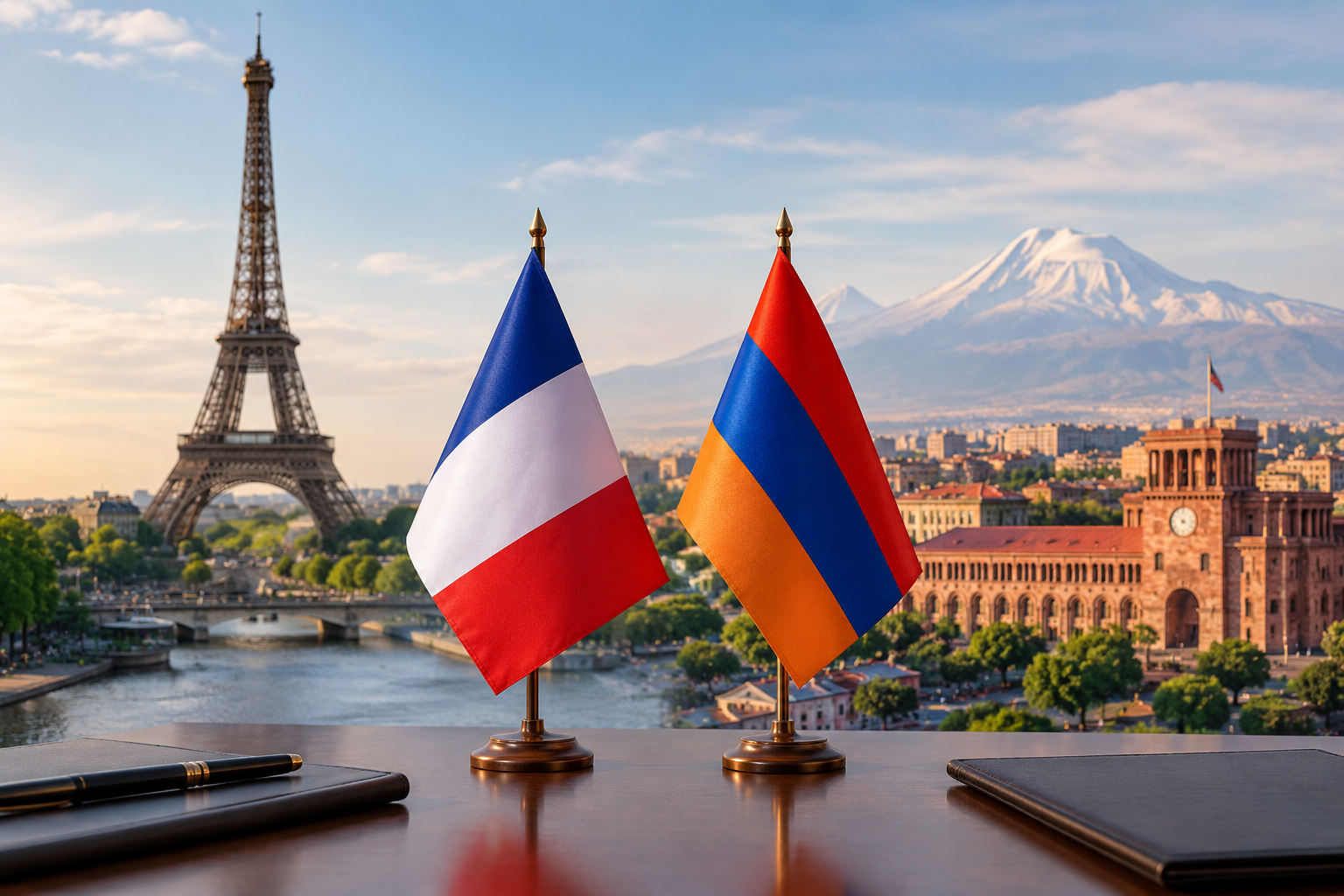
Read moreArmenian Prime Minister Nikol Pashinyan concluded his visit to France, which was the first one since his party’s victory in the June parliamentary elections and the worsening of relations with Russia over the unresolved question of Yerevan’s choice between the EU and the EAEU. His meeting with President Emmanuel Macron, who paid a state visit to Armenia in May and took part in the 8th summit of the European Political Community, demonstrated the strengthening alliance between Yerevan and Paris and Armenia’s pro-European course. The talks in Paris showed that the French leader remains Armenia’s main lobbyist within the European Union.
The formal reason for Armenian Prime Minister Nikol Pashinyan’s latest visit to Paris was an invitation to attend the International Space Summit, held in the French capital on September 9-10. But the real story goes much deeper than space. The worse relations between Russia and Armenia become, the more Armenia’s attention turns toward Europe. France remains one of the EU countries supporting Armenia’s integration into the union, as Yerevan seeks to reduce its dependence on the Russian market, logistics and energy system.
It is also interesting that literally on the eve of Pashinyan’s trip to Paris, France changed its ambassador in Yerevan. On September 5, Florian Escudier took up his post, replacing Olivier Decottignies, during whose tenure French-Armenian military cooperation became particularly active. The choice of his successor was also quite telling. Escudier had previously worked, among other things, on strategic security and cybersecurity issues. The new ambassador himself quickly explained what he intended to focus on in Yerevan. On September 7, he said he wanted to bring relations between the two countries to an "unprecedented level," specifically naming economic diplomacy and defense cooperation among his priorities. So, after the declarations made in May, Paris appears ready to move toward more practical cooperation.
One of the first such projects is expected to be the Bargushat Tunnel. It will become part of the Sisian-Kajaran section of the North-South corridor and will significantly improve connections between central Armenia, Syunik and, further south, Iran. Yerevan hopes this will allow it to maintain a reliable route to the south and reduce its dependence on future transport links through Azerbaijan.
The strengthening of relations with France, with which Armenia has historically maintained close ties, takes on particular importance in the context of the Armenian government’s broader pro-European course. Much of this process is focused on political steps and ambitious plans for the distant future, such as visa liberalization. Europe’s economic contribution, particularly that of France, remains modest, although during the first half of 2026, trade between Armenia and the EU almost doubled and exceeded $516 million.
At the same time, French involvement in the TRIPP (Zangezur Corridor) project cannot be ruled out. In the future, Armenia could, in exchange for certain services, as French support for joining the EU and provide access to this project, which is already being developed with U.S. involvement. The TRIPP project itself envisages the creation of a joint venture in which the United States would receive rights to develop and manage the transport corridor for 49 years. This is taking place against the backdrop of growing tensions between the United States and France in recent times.
This raises the question of whether Armenia can sit on several chairs at the same time. On the one hand, there is the United States, which will be involved in the Zangezur Corridor, and France, which is both an ally and Armenia’s potential gateway to the European Union. On the other hand, there is Iran, which is at war with the United States, and Russia, which remains under EU sanctions, including those imposed by Paris. And will Moscow be pleased to see a NATO country operating right next door, even if only as a contractor or project partner?
In the defense sector, France has helped Armenia diversify its sources of military equipment after Armenia moved away from the CSTO and Russia. Paris has signed agreements on the supply of French equipment and the training of Armenian military personnel. Purchases have included armored vehicles, night-vision equipment, Thales radars and Caesar artillery systems. Back in May, France and Armenia agreed to expand cooperation in military technologies and defense systems. Now space is being added to this cooperation. Modern space technologies have long been about much more than satellites for scientific purposes. They include communications, navigation, surveillance, intelligence and a wide range of dual-use technologies.
France is willing to open this door for Armenia as well. It is in Paris’s interest to tie Yerevan more closely to its own and European technological projects, complementing the growing French presence in Armenian defense and infrastructure with cooperation in advanced technologies.
Nikol Pashinyan is not simply a passive beneficiary of France’s growing interest in Armenia. The relationship between Yerevan and Paris is increasingly based on a convergence of interests, in which both sides see strategic value in a deeper partnership. The more actively France becomes involved in Armenia’s defense, infrastructure, economy and technology, the more alternatives to Russia Yerevan gains. However, this partnership is not without limits. Armenia’s attempt to diversify away from Russia inevitably intersects with the interests of other regional and global powers. France therefore has to balance its growing engagement with Armenia against its wider relationships and commitments.
Here we are to serve you with news right now. It does not cost much, but worth your attention.
Choose to support open, independent, quality journalism and subscribe on a monthly basis.
By subscribing to our online newspaper, you can have full digital access to all news, analysis, and much more.
You can also follow AzerNEWS on Twitter @AzerNewsAz or Facebook @AzerNewsNewspaper
Thank you!