
Romania turns to Caspian and Black Sea in Europe's energy shift

Ulviyya Poladova
Read moreEurope is entering a period in which energy security is once again becoming one of the continent’s most serious strategic challenges. After years of efforts to diversify energy supplies and reduce dependence on Russia, European countries have succeeded in changing the structure of their energy imports. Yet diversification has not eliminated vulnerability. Instead, it has exposed Europe to a wider range of geopolitical risks.
Romania is a particularly important example of this new reality. The country is not currently experiencing a fuel shortage, but its energy infrastructure and supply chains remain vulnerable to disruptions in the Black Sea, fluctuations in global oil and liquefied natural gas markets, and instability along major transportation routes. At the same time, Europe as a whole is approaching the autumn-winter period with energy markets under pressure, relatively low gas storage levels and growing competition for LNG and refined petroleum products.
According to Reuters, European underground gas storage facilities are around 55% full, the lowest level for this period since 2021. LNG imports have also weakened, while Asian buyers have returned to the global LNG market with greater strength. This competition is important because Europe increasingly relies on LNG to compensate for the reduction of Russian pipeline gas. Any additional disruption in the Middle East, global shipping or LNG production can therefore quickly translate into higher European energy prices.
Energy security is no longer determined solely by the amount of oil or gas a country possesses. It increasingly depends on whether those resources can reach consumers safely, reliably and at an affordable cost.
Romanian refineries cover only about a quarter of their feedstock needs from domestic production. The remainder is imported, principally from Kazakhstan, Azerbaijan, and a handful of other suppliers. Roughly half of imported crude originates in Kazakhstan and moves through the Caspian Pipeline Consortium (CPC) to Russia's Novorossiysk port on the Black Sea, then by tanker to the Port of Constanța.
Drone attacks and other threats affecting energy infrastructure around Novorossiysk have highlighted the vulnerability of the existing logistics system.
As Money.ro portal mentioned, for Romania, the most sensitive product may not necessarily be gasoline but diesel fuel. Trucking, agriculture, construction and much of the industrial sector depend heavily on diesel. If supplies become more expensive or deliveries are interrupted for several weeks, the consequences could spread throughout the Romanian economy.
Higher diesel prices would not remain limited to fuel stations. They would raise transportation costs, increase the cost of agricultural production and construction, and potentially contribute to broader inflation. In this sense, energy security is directly connected to economic security.
Romania’s experience demonstrates that Europe needs to move beyond the traditional concept of diversification. It is no longer enough to say that Europe has diversified away from Russian energy. The continent must also diversify the routes through which energy reaches its markets. This is where Azerbaijan becomes increasingly important.
Azerbaijan has established itself as an important energy partner for Europe, particularly through the Southern Gas Corridor and its broader role in the transportation of Caspian energy resources.
Romanian political and military analyst Alexandru Grumaz in an article published by Romania’s National newspaper, noted that the current geopolitical environment is increasing Azerbaijan’s importance for European energy security.
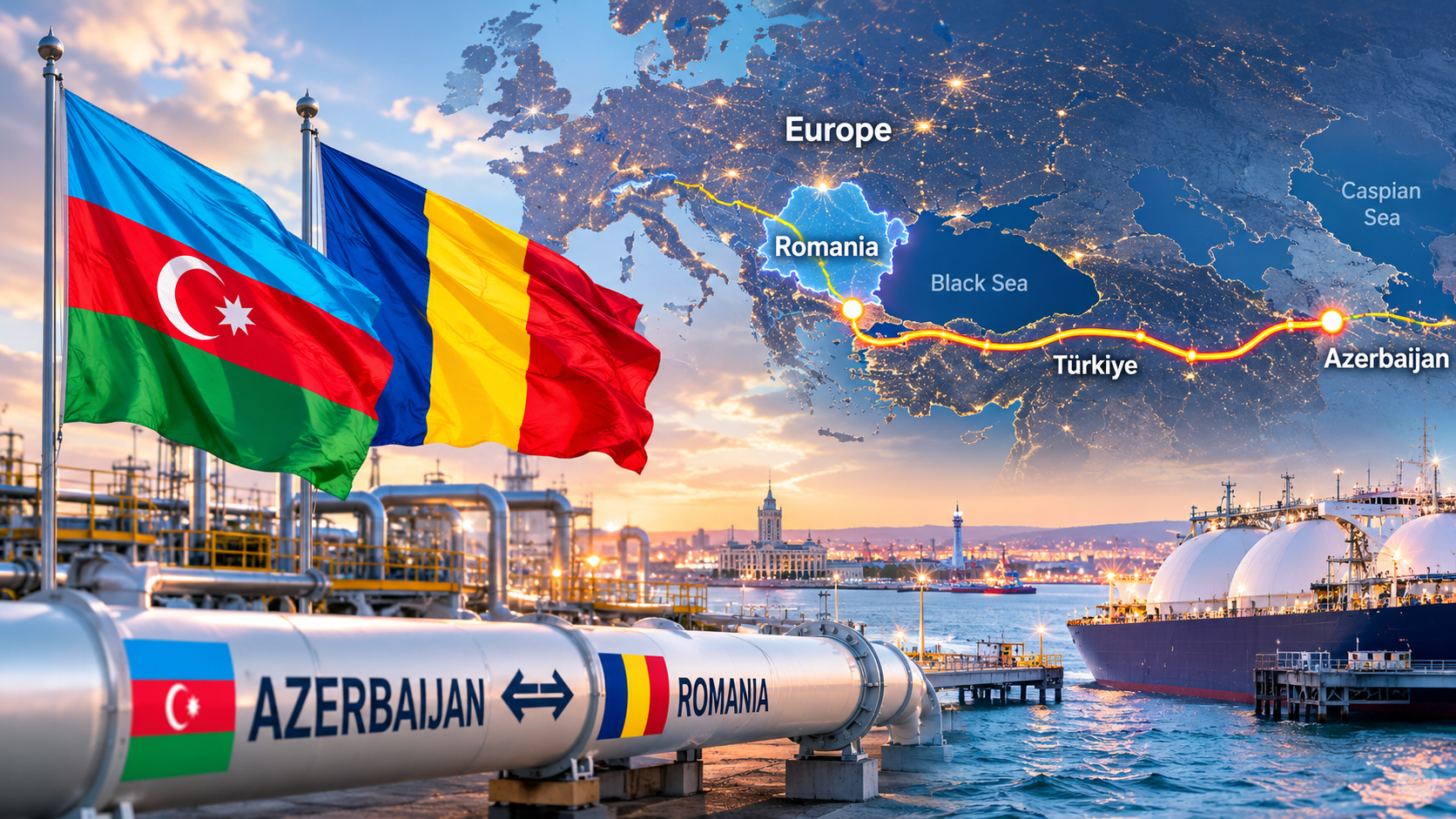
One potential alternative is the transportation of Kazakh oil across the Caspian Sea to Azerbaijani ports, followed by onward transportation through the Baku-Tbilisi-Ceyhan pipeline toward Türkiye’s Mediterranean coast. From there, crude can potentially reach European markets. The significance of such a route goes beyond the transportation of a particular volume of oil.
The more energy that can reach European markets through routes bypassing Russian territory, the less vulnerable European consumers become to disruptions connected to Russian infrastructure or geopolitical tensions.
The Caspian region possesses substantial energy resources, while Azerbaijan occupies a geographically valuable position between Central Asia and European markets. Strengthening ports, railways and pipelines could therefore create a broader network through which both commodities and energy resources can move. For Romania, the Port of Constanța could become an important component of this emerging network.
Expanding Constanța’s capacity and improving its logistics infrastructure would allow Romania to receive larger quantities of crude and other energy products through alternative routes. At the same time, stronger integration with Azerbaijan and the wider Middle Corridor could reduce the country’s dependence on a limited number of vulnerable supply chains.
For Romania, Azerbaijani gas represents a tool for diversifying energy supplies and strengthening the country’s regional role. Combined with domestic production and future offshore output from the Neptun Deep project, access to Azerbaijani gas could help transform Romania into one of the most important energy hubs in Southeastern Europe.
Existing trade figures show that Azerbaijan-Romania energy cooperation still has considerable room for expansion.
Azerbaijan's State Customs Committee reports that in January-June 2026, Azerbaijan exported just over 461,317 tonnes of crude oil to Romania, valued at more than $247.8 million. Compared with the same period in 2025, volume fell 32.7% and value fell 34.4%. Romania accounted for 4.6% of Azerbaijan's total oil exports in the first half of 2026.
It should be noted that Azerbaijan has gas supply agreements with 16 countries, including 13 European countries: Italy, Greece, Bulgaria, Romania, Hungary, Serbia, Slovenia, Croatia, Slovakia, North Macedonia, Germany, Ukraine and Austria. It demonstrates that Azerbaijan is no longer simply an alternative energy supplier for a limited number of European markets.
If the Russia-Ukraine war eventually ends and tensions in the Middle East ease, energy markets could gradually stabilize. However, peace alone will not solve Europe’s structural vulnerabilities. Despite the fact that the war in Ukraine will eventually end, Europe is unlikely to return to the energy system that existed before 2022. The experience of recent years has demonstrated the dangers of excessive dependence on concentrated supply chains. European governments and companies are therefore likely to continue prioritizing diversification.
Here we are to serve you with news right now. It does not cost much, but worth your attention.
Choose to support open, independent, quality journalism and subscribe on a monthly basis.
By subscribing to our online newspaper, you can have full digital access to all news, analysis, and much more.
You can also follow AzerNEWS on Twitter @AzerNewsAz or Facebook @AzerNewsNewspaper
Thank you!