
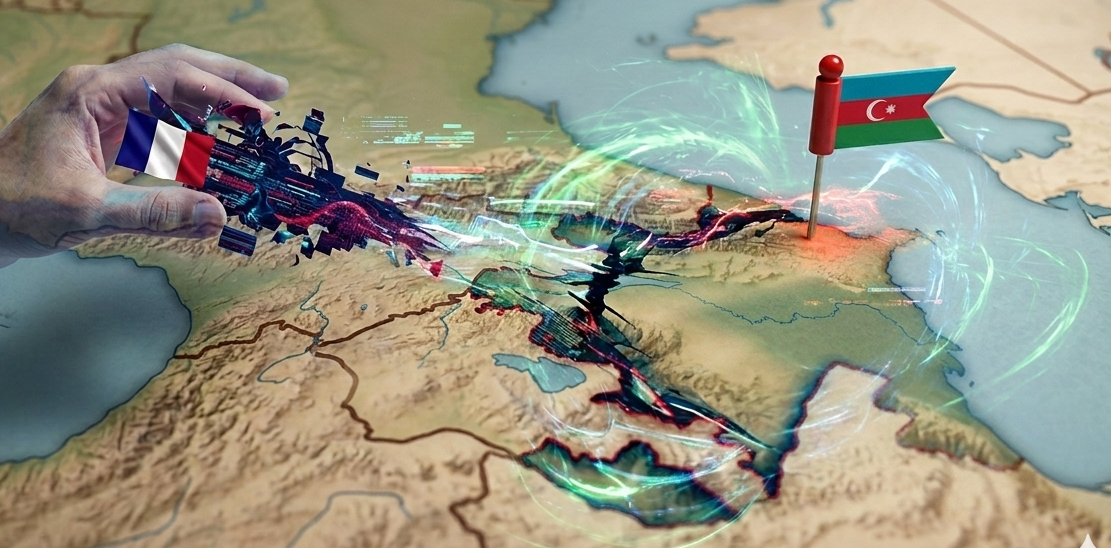
France continues hybrid threats against Azerbaijan

Ulviyya Poladova
Read moreRelations between Azerbaijan and France have experienced a steady deterioration since the end of the Second Karabakh War in 2020.
Recent political discourse in Azerbaijan has increasingly framed relations with France not simply as a diplomatic disagreement, but as part of a broader pattern of hybrid confrontation.
According to Azerbaijan's Parliamentary Commission on Countering Foreign Interference and Hybrid Threats, France continues to pursue policies and activities that constitute a comprehensive hybrid pressure campaign against Azerbaijan. The commission reports that these actions are designed to influence Azerbaijan's foreign policy choices, undermine its international standing, and shape regional dynamics in the South Caucasus.
Hybrid threats refer to the coordinated use of political, legal, informational, economic, diplomatic, and intelligence tools to achieve strategic objectives without direct military confrontation. Such methods have become increasingly common in international relations, particularly in regions where major powers compete for influence.
It is important to note that these developments are taking place against the backdrop of a fragile ceasefire and an ongoing, still-unresolved peace process between Azerbaijan and Armenia.
Azerbaijan's assessment suggests that France's activities fit within this framework, combining diplomatic initiatives, parliamentary resolutions, media narratives, lobbying efforts, and support for various political actors to advance its interests in the region.
One of the most frequently cited concerns involves the use of parliamentary mechanisms. Since November 2020, both chambers of the French Parliament have adopted several resolutions critical of Azerbaijan and supportive of Armenian positions regarding the South Caucasus conflict.
A key concept frequently referenced in this context is "lawfare," understood as the use of legal and parliamentary tools to exert political pressure. Since November 2020, both chambers of the French Parliament (the Senate and the National Assembly) have been adopting resolutions directed against Azerbaijan and contrary to the sovereignty and territorial integrity of Azerbaijan.
Although these documents, used as a means of diplomatic and political pressure, have limited legal force, they are adopted with the aim of forming similar approaches against Azerbaijan in other countries where France's sphere of influence and the Armenian lobby are strong. Such one-sided and biased documents by parliaments serve to form a negative image of Azerbaijan in the international arena and create artificial tension instead of contributing to peace and stability in the region.
Azerbaijan's parliamentary commission maintains that French officials and diplomats have actively promoted anti-Azerbaijani initiatives within international organizations, including the United Nations, European institutions, the Council of Europe, and other multilateral forums.
This reflects a broader struggle for influence over the international narrative surrounding the South Caucasus. While France presents itself as a defender of regional stability and humanitarian concerns, these actions often interpret as attempts to isolate the country diplomatically and weaken its negotiating position.
Another significant point of contention concerns media coverage. Major segments of the French media consistently portray Azerbaijan in a negative light, frequently emphasizing allegations related to democracy and regional security while giving limited attention to Azerbaijan's official positions. Approximately 40 articles critical of Azerbaijan were published in French media over the course of May and June alone, alongside numerous television reports.
The French media gives broad coverage to articles and interviews by some radical opposition representatives who have no political weight either inside or outside Azerbaijan, creating conditions for the distortion of the real situation in Azerbaijan and for calls aimed at misleading French society. These steps, calculated to stimulate the activities of radicals against Azerbaijani statehood under the guise of media freedom, are an element that serves the goals of disrupting internal stability, as well as creating social dissatisfaction and polarization in the country. The fact that the materials, contrary to the principles of objective journalism, do not include the official position of the Azerbaijani state or alternative views once again proves that these activities are also being deliberately carried out to form a negative opinion about Azerbaijan in French society.
A central element of Azerbaijan's criticism relates to the influence of the Armenian diaspora in France. France hosts one of Europe's largest Armenian communities.
Under the influence of the Armenian lobby, which has strong political and economic ties, French politicians often take pro-Armenian positions and act in a coordinated manner against Azerbaijan within the EU and international organizations. These activities are aimed at violating Azerbaijan's internationally recognized sovereignty and territorial integrity and create major tension in bilateral relations with France.
At the same time, diaspora groups view their advocacy efforts as legitimate political participation within a democratic system. The debate underscores how diaspora communities increasingly shape foreign policy discussions in many Western democracies.
The commission also points to the role of international NGOs, human rights organizations, and investigative journalism networks that have criticized Azerbaijan on issues ranging from governance to civil liberties. Some of these actors function as part of broader influence networks supported directly or indirectly by French institutions. Officials argue that coordinated campaigns on social media and digital platforms contribute to negative perceptions of Azerbaijan internationally.
Among the most serious accusations are claims related to espionage and intelligence operations. Azerbaijani authorities have repeatedly expressed concerns about alleged French intelligence activities in the region, particularly in connection with evolving security dynamics in the South Caucasus. This illegal activity was aimed at influencing processes in the region, studying Azerbaijan's internal political situation, economic development, military potential and strategic interests, as well as building agent networks consisting of citizens of Azerbaijan and other countries. The objectives included spreading disinformation inside the country, creating dissatisfaction among certain groups and carrying out other operations that would destabilize the situation.
For many years, Azerbaijan sought to cultivate a pragmatic relationship with France. Paris was viewed not only as a leading European power but also as a potential cultural and economic bridge. Yet, from Baku’s perspective, every step toward friendship was met with French retreat - particularly after the Second Karabakh War in 2020, when Azerbaijan regained control over long-occupied territories.
The repeated expressions of concern for Armenia by French political figures have eroded the notion of neutrality once associated with Paris’s role in the OSCE Minsk Group. French statements often emphasize Armenian grievances while ignoring the destruction of Azerbaijani cities and heritage sites during the three decades of occupation - a silence Baku interprets as a case of double standards.
France’s persistent framing of Armenia as a "victim" contrasts with Azerbaijan’s growing international legitimacy. Over the past three years, Baku has engaged in border delimitation talks and promoted a peace agenda, including through European intermediaries. Even French President Emmanuel Macron, during his brief meeting with President Ilham Aliyev in Copenhagen last year, acknowledged progress in the normalization process - suggesting that Paris understands, at least implicitly, the futility of resisting geopolitical reality.
Earlier this year, President Ilham Aliyev signaled Baku’s readiness to reset relations with France following years of growing political tensions between the two countries.
Speaking in an interview with France 24 on the sidelines of the Munich Security Conference, Aliyev described his meeting with French President Emmanuel Macron at the end of last year as "very positive" and revealed that both sides had agreed to "press the reset button" in bilateral relations.
"We are ready for this," Aliyev stated, emphasizing that Azerbaijan has no interest in tensions with any country, including France. The Azerbaijani president also stressed that Baku was not the source of the deterioration in relations between the two states.
During the decades of occupation, France largely remained silent while Azerbaijani cities were destroyed, mosques desecrated, cemeteries vandalized, and cultural heritage systematically erased in the occupied territories.
Paris rarely spoke about the humanitarian consequences faced by hundreds of thousands of displaced Azerbaijanis. Yet once Azerbaijan restored control over its internationally recognized territories, French rhetoric became increasingly critical and confrontational.
French society should understand that its government’s unfriendly actions and foreign policy decisions do not yield political or economic benefits for France, but instead harm and further undermine its reputation on the global stage.
Here we are to serve you with news right now. It does not cost much, but worth your attention.
Choose to support open, independent, quality journalism and subscribe on a monthly basis.
By subscribing to our online newspaper, you can have full digital access to all news, analysis, and much more.
You can also follow AzerNEWS on Twitter @AzerNewsAz or Facebook @AzerNewsNewspaper
Thank you!