
Azerbaijan's digital Silk Way moves forward as Trans-Caspian cable installation begins

Akbar Novruz
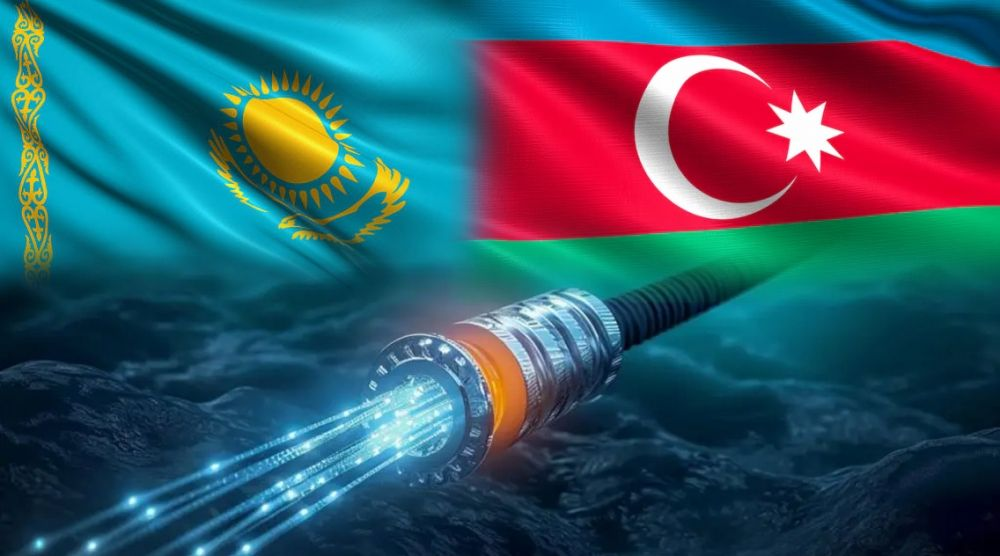
Read moreA specialized cable-laying vessel has departed from the Port of Baku to begin installing the Trans-Caspian Fiber-Optic Cable Line toward the port of Aktau in Kazakhstan, marking a key milestone in the development of the regional digital corridor. The armored fiber-optic cable was manufactured and tested in China before being delivered to Kazakhstan's Port of Kuryk and subsequently transported to Baku. The cable has now been fully loaded into a specialized reservoir aboard the cable-laying vessel.
Perhaps, vessels departing from Baku’s harbor are usually not headline-grabbers, unless they’re loaded with crude oil. This latest ship, which is headed from Baku to Aktau in Kazakhstan, loaded with hundreds of kilometers of fiber-optic cables armored in the ship’s cargo space, certainly deserves some extra spotlight. It is a modest piece of infrastructure indeed. At the same time, it signals where the economic dreams of the Caspian region are really headed, just as the presidents of Azerbaijan and five Central Asian countries are meeting in Bishkek to discuss that very sort of connectivity.
A vessel of more than 20,000 tonnes displacement, roughly 70 crew and technical staff aboard, an installation window of 15–20 days weather permitting, and a target of full commercial service by the end of 2026. The cable itself was manufactured and tested in China, then routed through Kazakhstan's port of Kuryk before onward transport to Baku for loading.
Trans-Caspian Fibre Optic Cable Line, or so the project is officially referred to, is a joint venture project undertaken by the Kazakh state carrier Kazakhtelecom, and AzerTelecom International, organized via a holding company named CaspiLink B.V. The corporate structure itself is interesting: a joint venture, domiciled in the Netherlands, involving a Kazakh state-owned company and an Azerbaijani privately held telecoms company, is just the kind of business model that Western infrastructure investors would like to see rather than a bilateral agreement between states, and could pave the way for further involvement from Europe.
The business case is clear enough, per se. There were really only two paths of data flow from Asia to Europe: an undersea path that went south through the Red Sea and the Suez Canal or a combination of terrestrial and satellite paths that went through Russia. Both options are less appealing than they once were. The Red Sea path faces serious challenges in the form of damaged cables in the midst of the Houthi attacks on shipping vessels, with multiple major outages in both 2024 and 2025. The route via Russia poses serious political risks for any business entity concerned about potential sanctions from Moscow. The third path would be one via the Caspian region, connecting the South Caucasus to Central Asia without having to cross Russian or Iranian territory. In short, this is no mere isolated curiosity. This is the digital component of the same Middle Corridor which has attracted billions in investments in ports, railways and pipelines in Georgia, Azerbaijan, Kazakhstan and beyond during the last ten years.
The traffic volume on both the terrestrial and the maritime sections of this corridor has increased substantially since 2022 despite the relatively low absolute volume of transport when compared to the Northern Corridor running through Russia. The digital connectivity has not caught up with the increase in physical transport infrastructure capacity, since it is more technically difficult to lay submarine cables in the variable marine environment and in congested shipping routes than to simply build one more railway siding. The Trans-Caspian Fiber-Optic Cable Line is a turning point in Azerbaijan’s digital future. This project positions the country not only as an energy and transport hub, but also as a digital communications hub. Its strategic importance is undeniable in terms of economic benefits, but also in terms of technological leadership in the region. Our infrastructure is ready to launch this project, but work needs to continue on developing data centers and a human resource base to realize its full potential.
In the longer term, the TCFO is expected to spark development of domestic data centres, sharpen local cybersecurity expertise, and bring Azerbaijan closer to realising its Digital Silk Way ambitions. For the EU, this offers a reliable, stable digital corridor bypassing geopolitically volatile routes. For Central Asia, it’s a long-awaited entry into the high-speed global internet backbone. For the Organisation of Turkic States, it is a leap toward deep integration in the information age.
As part of the preparatory phase, marine geological and engineering surveys in the Caspian Sea were launched in August 2025. The total length of the submarine cable will be 391 kilometers, while the maximum transmission capacity of the new line is expected to reach 400 terabits per second.
Yet, one cable system, even if constructed to modern standards of capacity, is no guarantee that Kazakhstan or Azerbaijan will emerge as a hub on the scale of Frankfurt or Singapore. Redundancy is crucial when it comes to subsea cables, and an area with just one or two new systems still leaves open the possibility of single-source failures that can knock out internet access for entire nations in other parts of the world. Developing a more robust system involving multiple cables in the Caspian could end up costing many hundreds of millions of dollars, not one boat charter, several industry analysts say.
In any case, the journey itself is what counts rather than the magnitude of the venture. Azerbaijan and Kazakhstan have wisely calculated, in the judgment of this columnist, that those in charge of the physical and digital connections of Eurasia will gain enormous clout as the global value chains become increasingly diversified away from being exposed to a point of geopolitical vulnerability. In other words, when the leaders meet this week in Bishkek to discuss the trade routes and transportation networks, they are actually talking about the right to transfer the digital communications of their region ten years from now. The ship which departed from the Baku port this week is a humble one, but the stakes behind it are big.
Here we are to serve you with news right now. It does not cost much, but worth your attention.
Choose to support open, independent, quality journalism and subscribe on a monthly basis.
By subscribing to our online newspaper, you can have full digital access to all news, analysis, and much more.
You can also follow AzerNEWS on Twitter @AzerNewsAz or Facebook @AzerNewsNewspaper
Thank you!