
Demographic transformation amid the crises of the XXI century

Ulviyya Poladova
Read moreDemographic change is becoming one of the most powerful forces shaping the twenty-first century. Across Europe and East Asia, populations are aging rapidly, fertility rates are falling below replacement levels, and labor markets are tightening. At the same time, migration flows are increasing, driven by economic inequality, conflict, climate pressures, and demographic imbalances between regions.
The global population has continued its steady rise, surpassing 8 billion people in 2022 and currently estimated at around 8.2–8.3 billion according to UN-based projections. This growth reflects a long-term trajectory: approximately 6 billion people in 1998, 7 billion in 2010, and over 8 billion by 2022.
Projections suggest that the world population could reach 9 billion by around 2037 and approach 10 billion by 2060. In some long-term scenarios, the global population is expected to increase by about 2 billion people by 2050 - from roughly 7.7 billion to 9.7 billion - and could peak at nearly 11 billion by the end of the century, despite a continued decline in fertility rates worldwide.
A striking feature of the current demographic structure is regional imbalance. About 59% of the global population lives in Asia, 19% in Africa, 9% in Europe, 8% in Latin America and the Caribbean, and roughly 5% in North America.
In many European countries, fertility rates have dropped well below the replacement level of 2.1 children per woman. As a result, the proportion of elderly citizens is rising steadily. Japan remains the most advanced example of this trend, with more than a quarter of its population already over the age of 65. South Korea has recently recorded one of the lowest fertility rates in the world, while China is also entering a period of population decline after decades of the one-child policy.
One of the most striking features of global demographics today is the rapid population growth in Africa. This trend continues even though several countries on the continent face serious challenges, including armed conflicts, political instability, and weak economic development. At first glance, this may seem contradictory: how can population increase so quickly in regions experiencing such difficulties?
It should be noted that Africa is the youngest continent in the world in terms of demographic structure. A large share of the population is under the age of 25. This creates what demographers call population momentum.
Another important dimension of global demographic change is urbanization. Across all regions, people are increasingly concentrated in cities, particularly in large metropolitan areas. Megacities such as Jakarta, Dhaka, and Tokyo illustrate the scale of this transformation, where tens of millions of people live in densely connected urban systems. These cities function as economic hubs, concentrating infrastructure, services, and innovation, but also facing challenges such as housing shortages, congestion, and environmental stress.
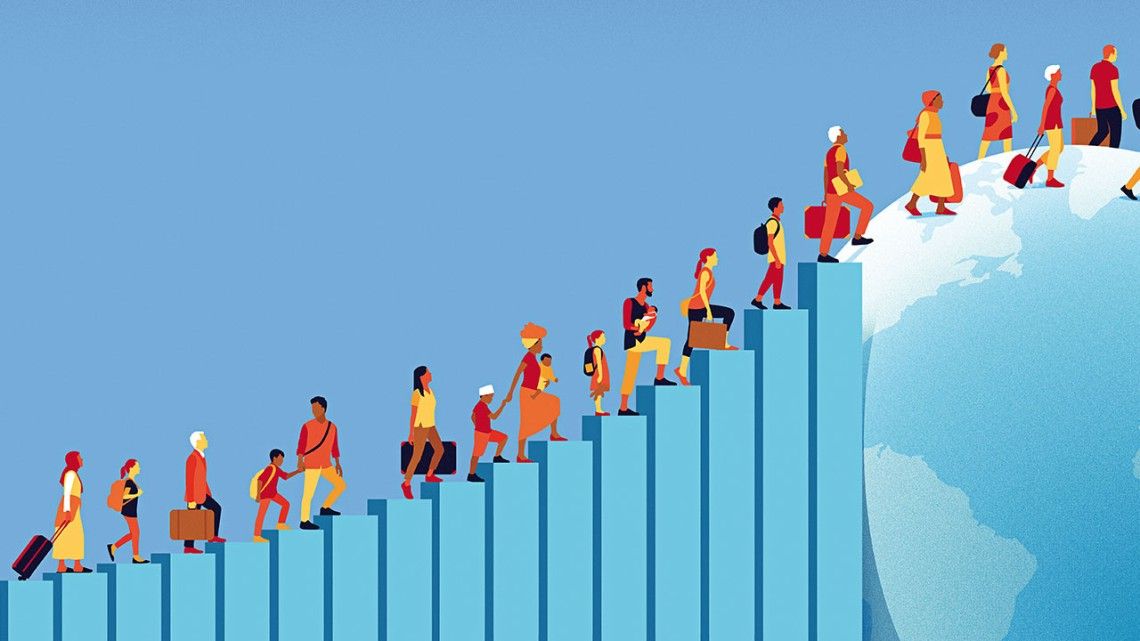
Migration has become one of the most important mechanisms for balancing demographic disparities.
Throughout history, migration has provided people with new opportunities, resources, and routes to survival and development. In contemporary conditions, it has become a structural component of the global economy. In 2019, the number of international migrants - people living outside their country of origin - reached approximately 272 million, accounting for nearly 3.5% of the global population. In 2000, this share was significantly lower, at about 2.8%.
Although Asia hosts the largest absolute number of international migrants, the fastest recent growth in migrant populations has been observed in Africa. This reflects both rapid population growth and increasing economic and political pressures in several parts of the continent. Importantly, international migration still occurs primarily within the same geographic regions, meaning that most people move between neighboring or regional countries rather than across distant continents.
Countries with aging populations and labor shortages are increasingly dependent on immigration to sustain economic activity. This creates a global system of demographic exchange: labor moves from high-growth, lower-income regions toward aging, higher-income economies. However, migration is increasingly shaped by political constraints, integration challenges, and rising social tensions in destination countries.
Climate change is also becoming a structural driver of migration. Environmental stress in vulnerable regions is expected to intensify cross-border and internal displacement over the coming decades.
At the same time, demographic change is interacting with labor market transformation, especially the rise of artificial intelligence and automation. In aging societies, shrinking working-age populations are accelerating the adoption of AI-driven technologies to maintain productivity. Countries such as Japan and Germany are increasingly investing in robotics and automation to offset labor shortages in manufacturing, healthcare, and services. In this context, technology is not just an efficiency tool but a demographic substitute for labor.
In younger societies, the situation is different. Rapid population growth creates pressure to generate large numbers of jobs each year. Here, AI introduces both opportunities and risks. This divergence means that AI is likely to widen the gap between countries that successfully integrate technology and those that struggle to do so.
Globally, AI is reshaping the nature of work itself. Routine cognitive and manual tasks are increasingly automated, while demand grows for digital skills, data literacy, and advanced technical capabilities.
Ultimately, the twenty-first century will be shaped not only by technological innovation and economic competition, but also by demographic realities. Population aging, fertility decline, urbanization, migration, and the rise of artificial intelligence are deeply interconnected processes. Together, they are transforming labor markets, redefining social structures, and altering the distribution of economic and political power across the globe.
Illustration: Joey Guidone
Here we are to serve you with news right now. It does not cost much, but worth your attention.
Choose to support open, independent, quality journalism and subscribe on a monthly basis.
By subscribing to our online newspaper, you can have full digital access to all news, analysis, and much more.
You can also follow AzerNEWS on Twitter @AzerNewsAz or Facebook @AzerNewsNewspaper
Thank you!