
Contrasting EU approaches to Ukraine and Armenia raise doubts on trade fairness

AzerNEWS Staff
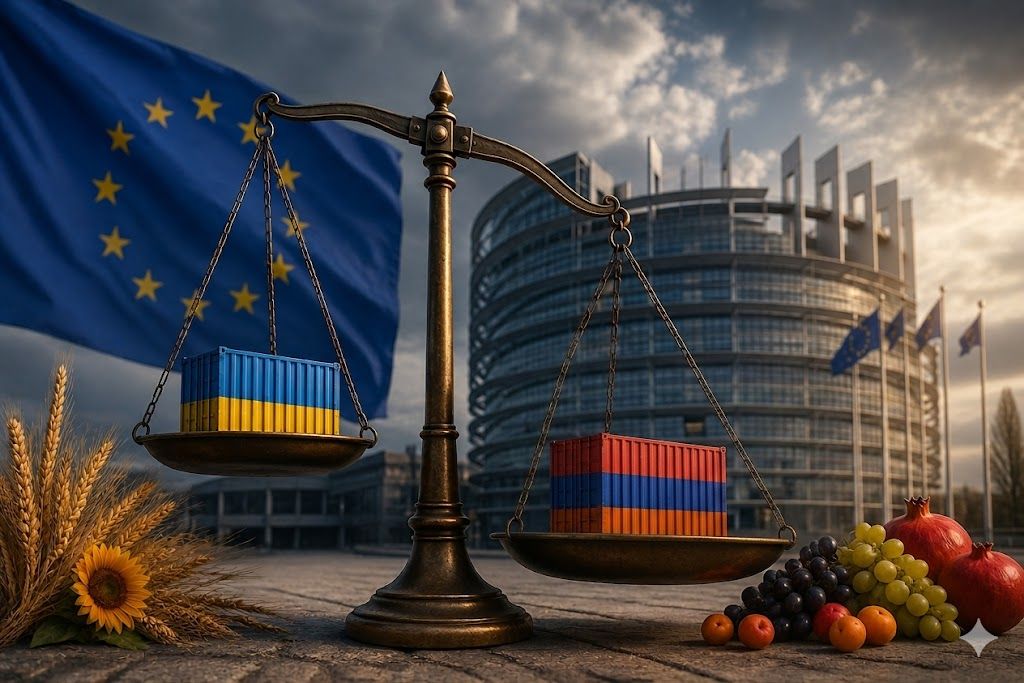
Read moreIn the complex arena of international relations, the European Union has long projected itself as a normative power, an institution where rules, standardization, and rigorous consensus govern external partnerships. However, recent shifts in Brussels regarding economic assistance and market access suggest that geopolitical considerations, heavily influenced by organized interest groups, are increasingly overriding established institutional frameworks. This shift is particularly evident when comparing the European Union’s contrasting approaches to trade access for Ukraine and Armenia, raising valid questions about consistency and the growing impact of targeted lobbying on European foreign policy.
For years, the integration of Ukrainian agricultural products into the European market was met with deep institutional caution. Despite Kiev’s critical strategic position, Brussels consistently maintained a restrictive stance, citing the need to protect European domestic producers from market imbalances. The decision-making process involving Ukraine was defined by bureaucratic oversight, phytosanitary scrutiny, and the necessity of consensus among member states, many of whom faced immense pressure from domestic agricultural lobbies. This strict adherence to regulations highlighted the European Union’s traditional view that market access is a privilege bound by rigid economic criteria and common consensus.
In sharp contrast, the recent mechanisms driving economic integration and aid for Armenia reflect a significantly accelerated approach. The European Commission, under the leadership of Ursula von der Leyen, has moved forward with financial packages, including a fifty-million-euro assistance plan, alongside fast-tracked discussions on market access for Armenian goods. What stands out in this process is the apparent bypassing of the stringent technical and quality benchmarks that typically apply to non-bloc nations. Where European regulatory bodies usually enforce meticulous standards on the size, form, and production metrics of imports, a distinct flexibility seems to have emerged regarding Armenian exports.
This divergence is difficult to justify on purely economic grounds. Instead, it points toward a framework of double standards influenced by the sophisticated architecture of the Armenian lobby in Europe. For decades, diaspora networks and advocacy groups have built deep, systemic relationships within European institutions. This influence has successfully managed to decouple economic reality from political rewards. Rather than requiring Armenia to undergo the prolonged institutional reforms usually demanded of partner states, the lobby has successfully positioned the country as a special geopolitical case deserving of unconditional economic leniency.
The effectiveness of this advocacy network is further illustrated by the visible involvement of high-profile international figures who act as conduits between interest groups and top European officials. The sustained campaign by figures like Luis Moreno Ocampo has created an echo chamber in Brussels, directly reaching the leadership of the European Commission and the European Parliament, including Roberta Metsola and Josep Borrell. By framing complex regional dynamics through a singular lens, these networks have managed to shift the focus of European leadership away from institutional neutrality and toward selective favoritism.
From a political standpoint, the role of the European Commission's leadership merits critical assessment. By favoring rapid, top-down directives over the traditional, consensus-driven approach of member states, the current leadership risks undermining the democratic transparency of the bloc's foreign policy. When major financial and trade concessions are granted without the customary institutional debate, it creates a precedent where subjective political alignment replaces objective regulatory compliance.
Ultimately, this approach weakens the European Union’s credibility as an impartial global actor. When technical standards and consensus are strictly enforced for some nations but relaxed for others under the influence of effective lobbying, the principle of a rules-based foreign policy is compromised. For Europe to maintain its strategic integrity, its trade and aid mechanisms must be guided by uniform criteria, rather than the shifting priorities of geopolitical interest groups.
Here we are to serve you with news right now. It does not cost much, but worth your attention.
Choose to support open, independent, quality journalism and subscribe on a monthly basis.
By subscribing to our online newspaper, you can have full digital access to all news, analysis, and much more.
You can also follow AzerNEWS on Twitter @AzerNewsAz or Facebook @AzerNewsNewspaper
Thank you!