
Azerbaijan strengthens Eurasian hub status as trade with China accelerates

Qabil Ashirov
Read moreIn a world increasingly defined by fragmented supply chains and shifting geopolitical alignments, connectivity has become one of the most valuable forms of economic power. For Azerbaijan, this reality is not theoretical—it is structural. The country is steadily transforming itself from a resource-dependent exporter into a strategic transit and logistics hub linking China and Europe. Its deepening economic engagement with China, marked by a reported over 30% increase in bilateral trade in the first quarter of the year, underscores this transformation and signals a new phase in Eurasian connectivity.
This sharp rise in trade is not an isolated statistic. It reflects a broader recalibration of economic geography across the region, where traditional routes are being reassessed and new corridors are gaining prominence. Azerbaijan’s position along the Middle Corridor—connecting China to Europe via Central Asia and the South Caucasus—has become increasingly significant as global trade seeks alternatives that are both efficient and politically resilient.
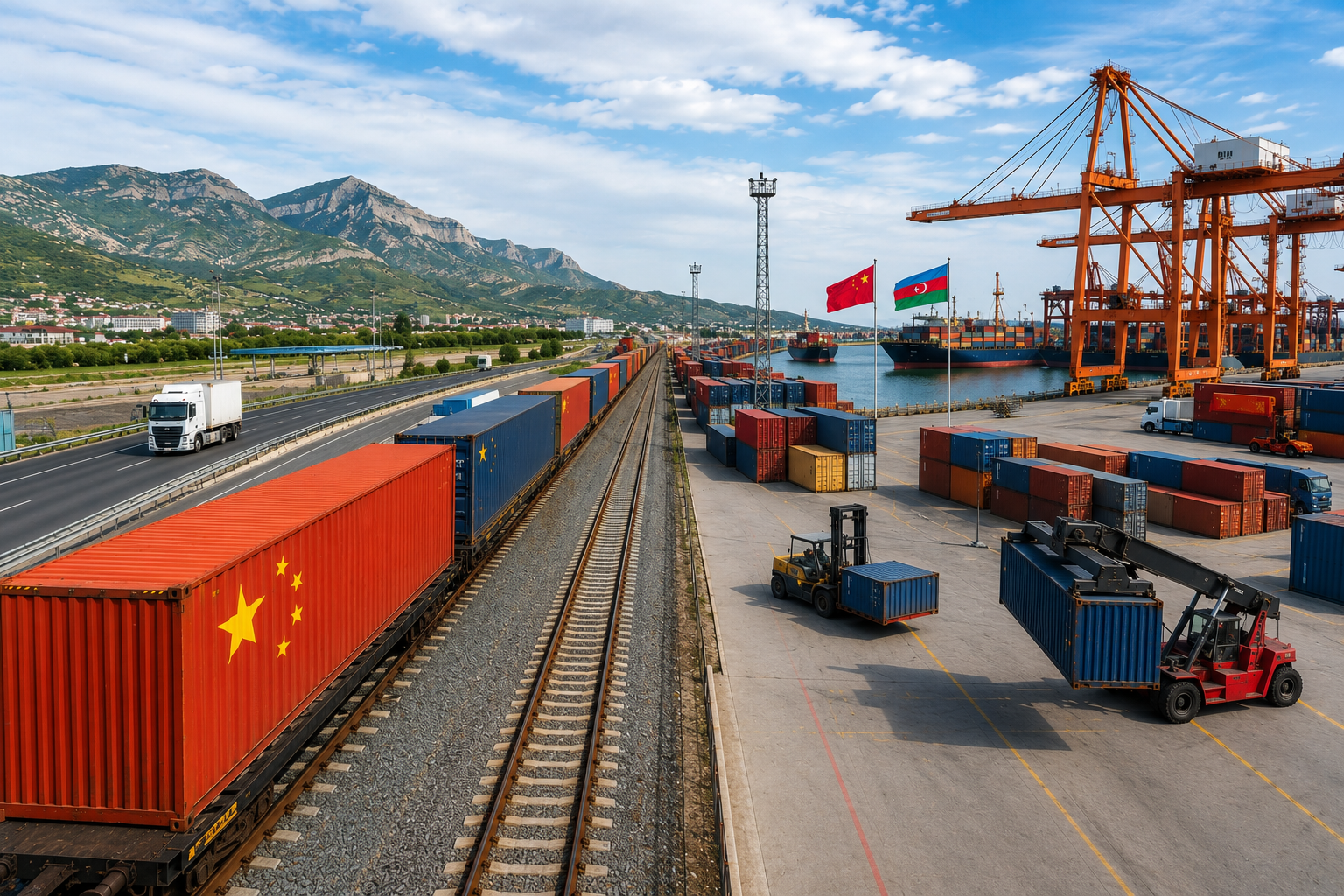
The appeal of Azerbaijan in this evolving system lies in a combination of geography and policy. Geographically, it sits at a natural junction between East and West. Politically and economically, it has invested heavily in infrastructure designed to support transit flows: modernized rail networks, expanded port capacity on the Caspian Sea, and streamlined customs procedures aimed at reducing bottlenecks in cross-border trade. These developments have turned the country into more than a transit point; they have positioned it as an active architect of regional connectivity.
China’s growing economic footprint in this context is driven by practical considerations. As its trade networks extend westward, Beijing requires reliable, diversified routes that reduce dependency on single corridors. Azerbaijan offers not only a stable transit environment but also a willing partner in infrastructure cooperation. The expansion of trade by more than 30% in just one quarter suggests that this relationship is moving beyond long-term potential into immediate economic reality.
Importantly, the composition of this trade is also evolving. While energy has traditionally dominated Azerbaijan’s external economic profile, increasing volumes of machinery, industrial goods, and high-tech equipment from China indicate a gradual diversification. This shift is significant: it reflects a transition from a narrowly defined energy partnership to a more complex economic relationship involving technology transfer, infrastructure development, and industrial modernization.
Beyond trade flows, Azerbaijan’s strategic narrative increasingly centers on its role as a connectivity hub. The country is not merely facilitating East–West transit; it is also developing North–South corridors that link the Gulf, Russia, and Europe. This multi-vector approach strengthens its economic resilience and enhances its geopolitical relevance in a region often characterized by competing transit visions.
One of the most consequential elements of this strategy is the emphasis on multimodal logistics integration. By combining maritime, rail, and road infrastructure, Azerbaijan is positioning itself as a seamless bridge in global supply chains. In an era where speed, predictability, and diversification are critical, such integration is not just an economic advantage—it is a strategic asset.
The broader implication of the rising Azerbaijan–China trade relationship is that infrastructure is becoming as important as production. Countries that control or facilitate the flow of goods increasingly hold influence comparable to those that produce them. Azerbaijan’s investment in this logic reflects a forward-looking approach to development: rather than competing in manufacturing scale, it is competing in connectivity efficiency.
However, the sustainability of this growth will depend on more than infrastructure. Regulatory alignment, regional stability, and long-term policy coordination will be essential to maintaining momentum. Competing routes across Eurasia ensure that no single corridor will dominate, and Azerbaijan will need to continue adapting to shifting trade patterns and geopolitical realities.
Still, the direction of travel is clear. The reported 30% surge in trade is not merely a statistical milestone—it is a signal of structural change. It indicates that Azerbaijan’s role in Eurasian trade is no longer peripheral or potential, but increasingly central and operational.
In this emerging landscape, Azerbaijan is not just connecting regions; it is helping redefine how regions connect.
Here we are to serve you with news right now. It does not cost much, but worth your attention.
Choose to support open, independent, quality journalism and subscribe on a monthly basis.
By subscribing to our online newspaper, you can have full digital access to all news, analysis, and much more.
You can also follow AzerNEWS on Twitter @AzerNewsAz or Facebook @AzerNewsNewspaper
Thank you!