
How Ukraine turned Russia’s southern supply network into strategic trap

Qabil Ashirov
Read moreThe tactical history of the war in Ukraine will long be studied through the lens of lines on a map, but its strategic outcome is being quietly decided by the invisible mathematics of logistics. For over two years, the Kremlin’s campaign in the south has resembled a desperate shell game, an agonizing effort to feed a voracious war machine while its supply routes are systematically amputated one by one. What began as a boastful showcase of imperial infrastructure has devolved into a bottleneck. By tracing the deliberate, multi-staged choking of Russia’s southern logistical arteries, we can witness a masterclass in asymmetric attrition—a campaign where Ukraine did not just destroy bridges, but fundamentally forced an invading army into a geographical funnel.
The cornerstone of Russia’s southern campaign was always the Kerch Strait Bridge. A multibillion-dollar monument to occupation, it was built not merely for prestige, but to serve as the heavy-metal backbone of military logistics, moving thousands of tons of armor, ammunition, and fuel directly from the Russian mainland into the Crimean peninsula. When Ukrainian security services engineered the spectacular truck bombing of the bridge in October 2022, they achieved far more than a psychological victory. They altered the physics of the war. Fearing that another catastrophic hit could permanently drop the entire structure into the sea, Moscow was forced to make a crippling concession: heavy-tonnage military cargo, particularly explosive fuel tankers and armored columns, was barred from crossing the bridge.
With the main artery restricted to light traffic, Russia pivoted to its second option: a fleet of heavy-rail ferries churning across the Kerch Strait. These massive vessels became the unsung heroes of the Russian occupation, quietly transferring entire trains loaded with vital fuel and ammunition from mainland ports like Kavkaz directly into Crimea. It was a functional backup plan, but an incredibly fragile one. Recognizing that an army cannot fight without diesel and artillery shells, Ukraine launched a relentless, synchronized hunting campaign against these maritime lifelines. Utilizing domestic Neptune cruise missiles and long-range strike drones, Ukrainian forces systematically picked apart the fleet, culminating in the sinking and crippling of the vital rail ferries Conro Trader and Slavyanin. In a matter of months, Russia’s maritime alternate route was effectively wiped off the map, leaving millions of dollars of infrastructure rotting at the bottom of the harbor.
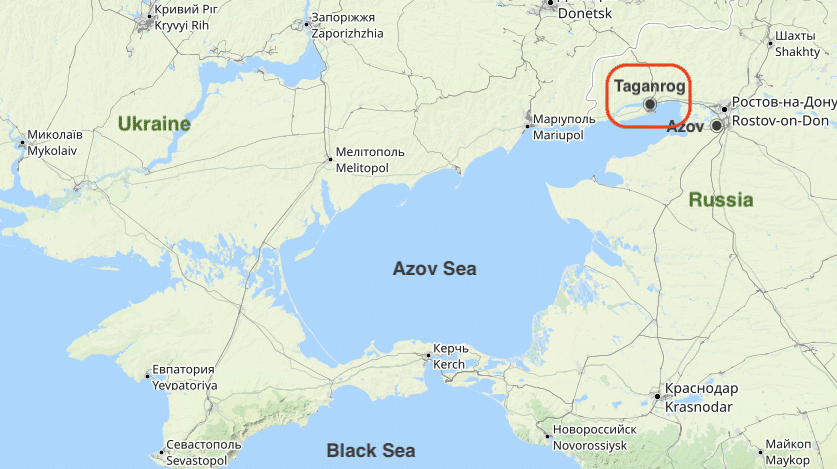
This double amputation left the Kremlin with only one viable option: a singular, vulnerable ribbon of asphalt and dirt known as the southern land corridor. This route stretches from Taganrog in Russia's Rostov region, cutting through the occupied ruins of Mariupol, Berdyansk, and Melitopol before finally terminating in Crimea. Today, every single loaf of bread, every liter of fuel, and every crate of ammunition required to sustain Russian forces in the south must travel along this specific, predictable path.
Yet, as Russia squeezed its entire logistical footprint into this narrow geographical funnel, Ukraine was already preparing the trap. The realization that Russia would be forced onto the Taganrog highway coincided with a massive, paradigm-shifting transformation in Ukrainian domestic military production. No longer reliant solely on Western aid, Ukraine scaled the manufacturing of indigenous uncrewed aerial vehicles to a staggering degree, turning the country into a hyper-innovative tech incubator.
The real breakthrough, however, was not just the sheer quantity of these drones but their rapidly evolving cognitive quality. To counter Russia’s dense networks of electronic warfare, which historically jammed the signals between human operators and their drones, Ukraine integrated sophisticated machine vision and artificial intelligence into its frontline UAVs. These new-generation drones do not require a continuous radio link to strike. Once they fly into a target zone, their onboard algorithms take over, autonomously scanning the terrain, identifying specific military targets like fuel trucks or air defense systems, and locking on with terminal accuracy entirely on their own.
The convergence of these two realities has created a claustrophobic nightmare for Russian transport columns. The Taganrog-to-Crimea highway, once viewed by Moscow as a secure rear-guard highway, has been transformed into a lethal gauntlet. Ukrainian autonomous drones now maintain an unrelenting, algorithmic watch over these essential supply lines. They do not need to physically occupy the territory to control it; instead, they exert a suffocating level of fire control that turns every convoy into a potential inferno. Truck drivers face a terrifying reality where the sky itself is automated against them, and where electronic jamming—Russia’s traditional shield—is entirely useless against an independent machine mind.
By systematically breaking the Kerch Bridge, sinking the naval ferries, and funneling Russian logistics onto a single, drone-monitored highway, Ukraine has demonstrated that modern warfare is won not by matching an enemy soldier for soldier, but by making their presence unsustainable. Russia still possesses vast numbers of troops and armor, but an army that cannot be fueled, fed, or armed is an army waiting to collapse. In the quiet, high-tech strangulation of the Taganrog corridor, we are watching the future of warfare unfold—a future where logistics are no longer just supported, but completely dictated, by autonomous algorithms in the sky.
Here we are to serve you with news right now. It does not cost much, but worth your attention.
Choose to support open, independent, quality journalism and subscribe on a monthly basis.
By subscribing to our online newspaper, you can have full digital access to all news, analysis, and much more.
You can also follow AzerNEWS on Twitter @AzerNewsAz or Facebook @AzerNewsNewspaper
Thank you!