
Oil and gas firms accelerate industrial internet adoption to optimise operations

Akbar Novruz
Read moreThe global oil and gas industry is increasingly adopting Industrial Internet technologies to enhance operational efficiency, strengthen asset management, and improve resilience across upstream, midstream, and downstream operations, according to a new report by intelligence and analytics company GlobalData, AzerNEWS reports.
In its latest report, Industrial Internet in Oil & Gas, GlobalData said the growing use of connected sensors, actuators, artificial intelligence (AI), and digital twin technologies is transforming the way companies monitor infrastructure, predict maintenance needs, and optimize production.
According to the report, AI-powered analytics and digital twins are expected to play a central role in advancing connected oil and gas assets, enabling autonomous operations, predictive maintenance, and improved decision-making across exploration, drilling, and production activities.
Ravindra Puranik, Oil and Gas Analyst at GlobalData, said the industry continues to face significant external pressures, including volatile energy prices, supply uncertainties, climate-related concerns, the growing demand for cleaner energy, and shifting global energy trade routes.
He added that operators are also dealing with operational challenges stemming from factors such as US tariffs, regional conflicts involving Iran, international sanctions, and increasing protectionist policies, prompting companies to accelerate Industrial Internet deployment to strengthen long-term growth and resilience.
The report notes that the upstream segment is leading Industrial Internet adoption as operators seek to manage increasingly complex and remote projects while addressing environmental, social, and governance (ESG) requirements. Technologies such as digital twins, AI-driven drilling optimization, and field-wide IoT networks are enabling companies to simulate operations, remotely manage wells, predict equipment failures, and accelerate production integration.
In the midstream sector, connected sensors installed across pipelines and storage facilities provide real-time data on pressure, flow rates, and infrastructure integrity, supporting faster leak detection and more effective responses to operational anomalies.
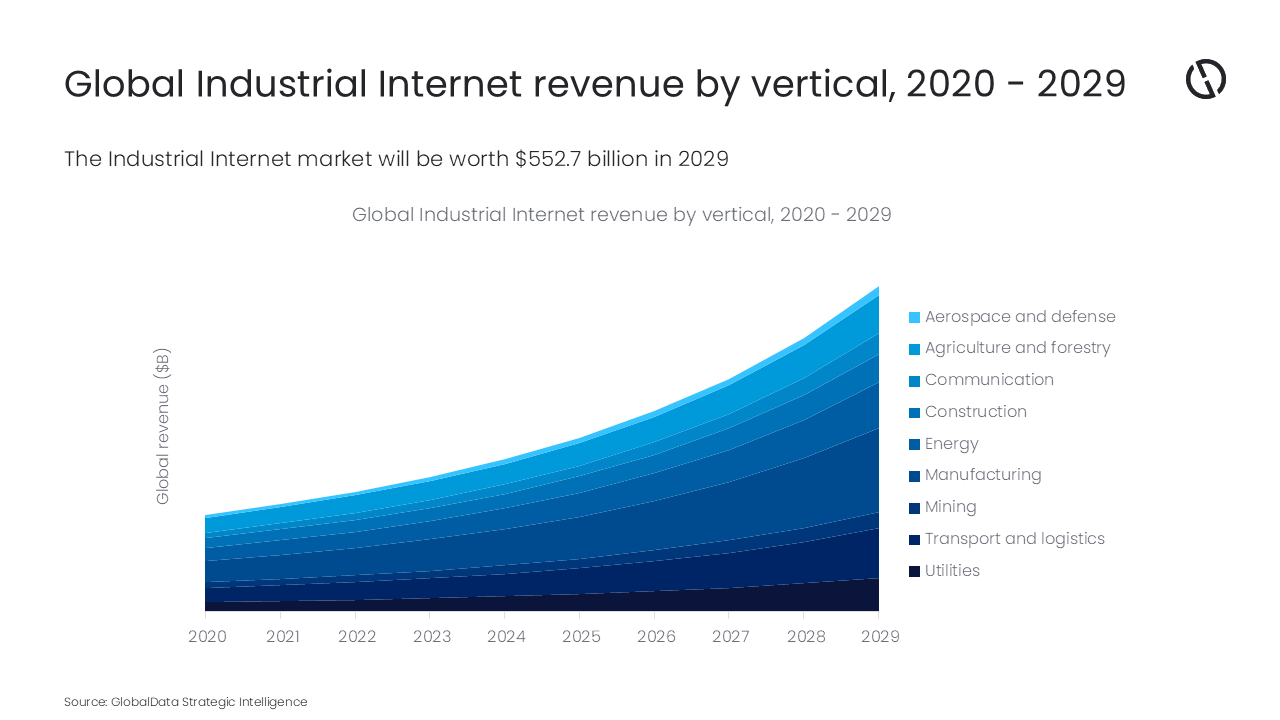
GlobalData forecasts that the global Industrial Internet market will reach $552.7 billion in revenue by 2029, representing a compound annual growth rate (CAGR) of 16% between 2024 and 2029. Within that total, the energy sector is projected to account for approximately $79 billion in Industrial Internet revenue by 2029.
For downstream operations, the report highlights that real-time data collection, advanced process automation, and digital twins are increasingly being used to optimize production, improve emissions management, enhance energy efficiency, and support proactive maintenance through continuous process modelling and scenario analysis.
Puranik concluded that autonomous operations are becoming standard practice in digitally advanced oilfields, particularly in offshore facilities such as fixed platforms and floating production, storage, and offloading (FPSO) units, where remote management is essential for both operational reliability and cost efficiency. He added that cloud-based analytics and AI systems are also improving demand forecasting and inventory management across the oil and gas value chain, even amid volatile market conditions.
Here we are to serve you with news right now. It does not cost much, but worth your attention.
Choose to support open, independent, quality journalism and subscribe on a monthly basis.
By subscribing to our online newspaper, you can have full digital access to all news, analysis, and much more.
You can also follow AzerNEWS on Twitter @AzerNewsAz or Facebook @AzerNewsNewspaper
Thank you!