
Panel on evolution of Turkic Languages held as part of int'l congress in Baku [PHOTOS]
![Panel on evolution of Turkic Languages held as part of int'l congress in Baku [PHOTOS]](https://www.azernews.az/media/2026/06/30/htyjhht1.jpg)
Laman Ismayilova
Read moreA panel session titled "The Dynamics of the Development of Turkic Languages: Historical and Philological Perspectives" has been held at the Heydar Aliyev Center as part of the international congress "The First Turkological Congress: A Century of Scientific and Cultural Heritage," AzerNEWS reports citing Azertag.
The session was moderated by Shafag Mehraliyeva, Executive Director of the Writer's House Literature Support Foundation.
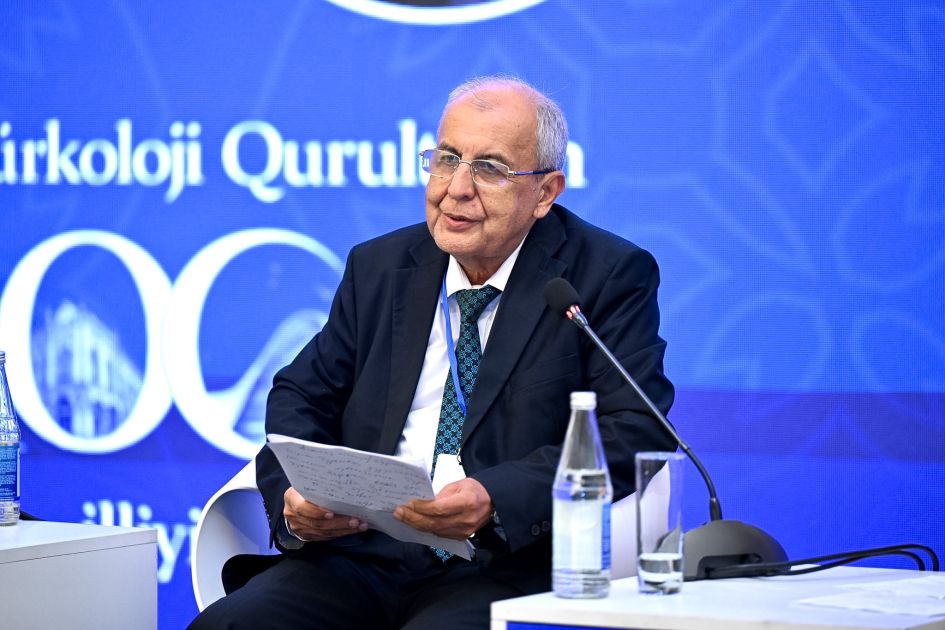
Opening the discussion, Academician Nizami Jafarov, Director of the Atatürk Center in Azerbaijan, noted that one of the most widely debated issues in modern Turkology is the concept of a common Turkic literary language. He explained that the historical development of Turkic peoples across different geographical regions and socio-political environments has led to both shared linguistic characteristics and distinctive national features.
Jafarov emphasized that cultural integration within the Turkic world is accelerating, making the development of a common alphabet, unified terminology, and a shared scientific space increasingly important. He noted that from the 17th to the 19th centuries the differentiation of Turkic languages intensified, and by the early 20th century, terms such as Azerbaijani Turkish, Turkish of Turkiye, Uzbek Turkish, and Kazakh Turkish had become widely used in academic literature. Despite these distinctions, he stressed, all belong to the same Turkic language family and share common historical roots.
Professor Osman Mert, President of the Turkish Language Association, stated that the ideas put forward during the First Turkological Congress, held in Baku in 1926, remain highly relevant today. In his view, the congress was not merely a historic event but a milestone that continues to shape the scientific and cultural development of the Turkic world.
He underlined that Turkology, encompassing language, history, literature, folklore, archaeology, and other humanities disciplines, plays a central role in strengthening unity across the Turkic world. Although the congress discussed such key issues as a common alphabet, terminology, dictionaries, and scientific cooperation, subsequent political developments prevented many of these initiatives from being fully realized. Nevertheless, recent progress on a common Turkic alphabet, shared history projects, and expanded academic cooperation represents a continuation of those original ideas. Professor Mert added that the adoption of the Common Turkic Alphabet in Baku in 2024 marked a major historic achievement and reaffirmed the Azerbaijani capital's pivotal role in scientific and cultural cooperation across the Turkic world.
Speaking at the session, Professor Oh Eun-kyung, Director of the Institute for Eurasian Turkic Studies at Dongduk Women's University in Seoul, said that the First Baku Turkological Congress was far more than a conference on alphabet reform; it was a historic initiative aimed at uniting Turkic peoples within a common intellectual space.
According to Professor Oh, the time has come to move beyond classical Turkology toward a modern model of Turkic World Regional Studies. He noted that the establishment of the Organization of Turkic States and the "Turkic World Vision–2040" strategy have created new opportunities for cooperation. Among the key priorities for the future, he identified the creation of digital knowledge networks, artificial intelligence-based academic translation systems, and common scientific platforms. He added that the 21st century should become an era of advancing the Turkic world's shared scientific and cultural heritage on a global scale.
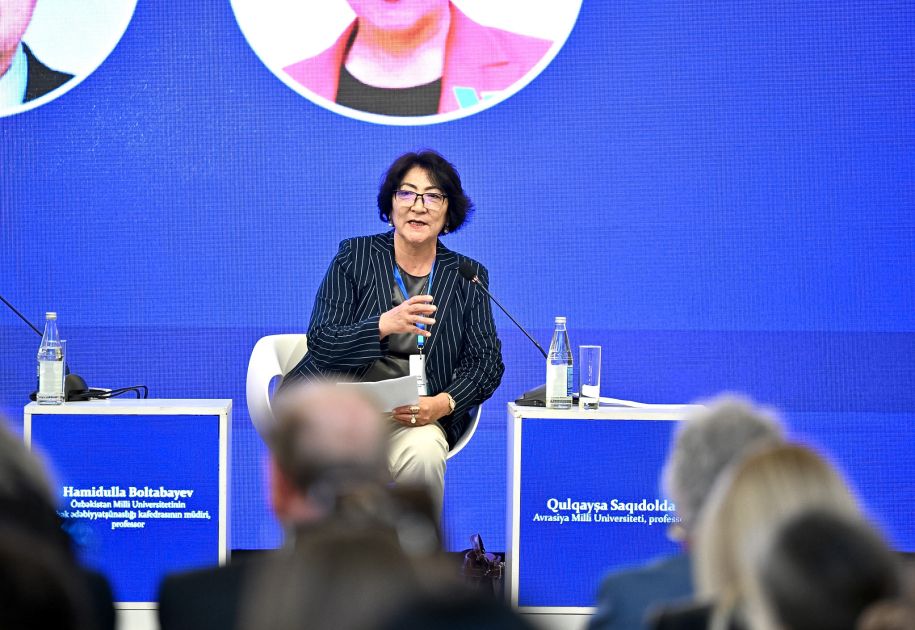
Professor Hamidulla Boltabayev, Head of the Department of Uzbek Literary Studies at the National University of Uzbekistan, emphasized that the First Turkological Congress played a significant role in shaping the shared scientific and cultural values of Turkic peoples. He noted that fundamental issues, including a common alphabet, terminology, literary language, and the historical development of Turkic languages, were extensively discussed during the congress and continue to retain their relevance today.
Boltabayev highlighted the active participation of Uzbek scholars in the congress, where they presented important research on the grammar, history, and theoretical aspects of Turkic languages. He also pointed to the rich literary heritage of the renowned Uzbek thinker Alisher Navoi and his contribution to the development of the Turkic literary language as one of the congress's key discussion topics. According to the professor, the legacy of the First Turkological Congress remains highly significant for strengthening scientific cooperation, preserving shared cultural values, and advancing Turkological studies across the Turkic world.
Professor Gulgaya Sagidola of L.N. Gumilyov Eurasian National University stressed that a common Turkic alphabet is of strategic importance for bringing the scientific, cultural, and information space of the Turkic world closer together. She noted that cooperation in this field among Azerbaijan, Kazakhstan, Kyrgyzstan, Uzbekistan, Turkmenistan, and Turkiye has expanded considerably in recent years.
She also observed that although the Turkic republics made substantial progress toward adopting the Latin alphabet after gaining independence, the transition remains ongoing in several countries. According to Sagidola, the creation of a common alphabet is not merely about standardizing writing systems but also about strengthening scientific, cultural, and information exchange among Turkic peoples.
The panel formed part of Turkic World Week, launched in Baku to commemorate the 100th anniversary of the First Turkological Congress. The week-long series of scientific and cultural events is being held in accordance with the decree signed by President Ilham Aliyev on October 22, 2025, on celebrating the centenary of the historic congress.
Running through July 3, Turkic World Week is jointly organized by the Azerbaijan Culture Ministry, the Azerbaijan National Academy of Sciences (ANAS), and the Ministry of Science and Education, in partnership with the Organization of Turkic States (OTS), TURKSOY, Baku State University, the Turkic Academy, and the Turkic Culture and Heritage Foundation.
Here we are to serve you with news right now. It does not cost much, but worth your attention.
Choose to support open, independent, quality journalism and subscribe on a monthly basis.
By subscribing to our online newspaper, you can have full digital access to all news, analysis, and much more.
You can also follow AzerNEWS on Twitter @AzerNewsAz or Facebook @AzerNewsNewspaper
Thank you!