
Russia after Ukraine war: why won’t economy enter recession?

Qabil Ashirov
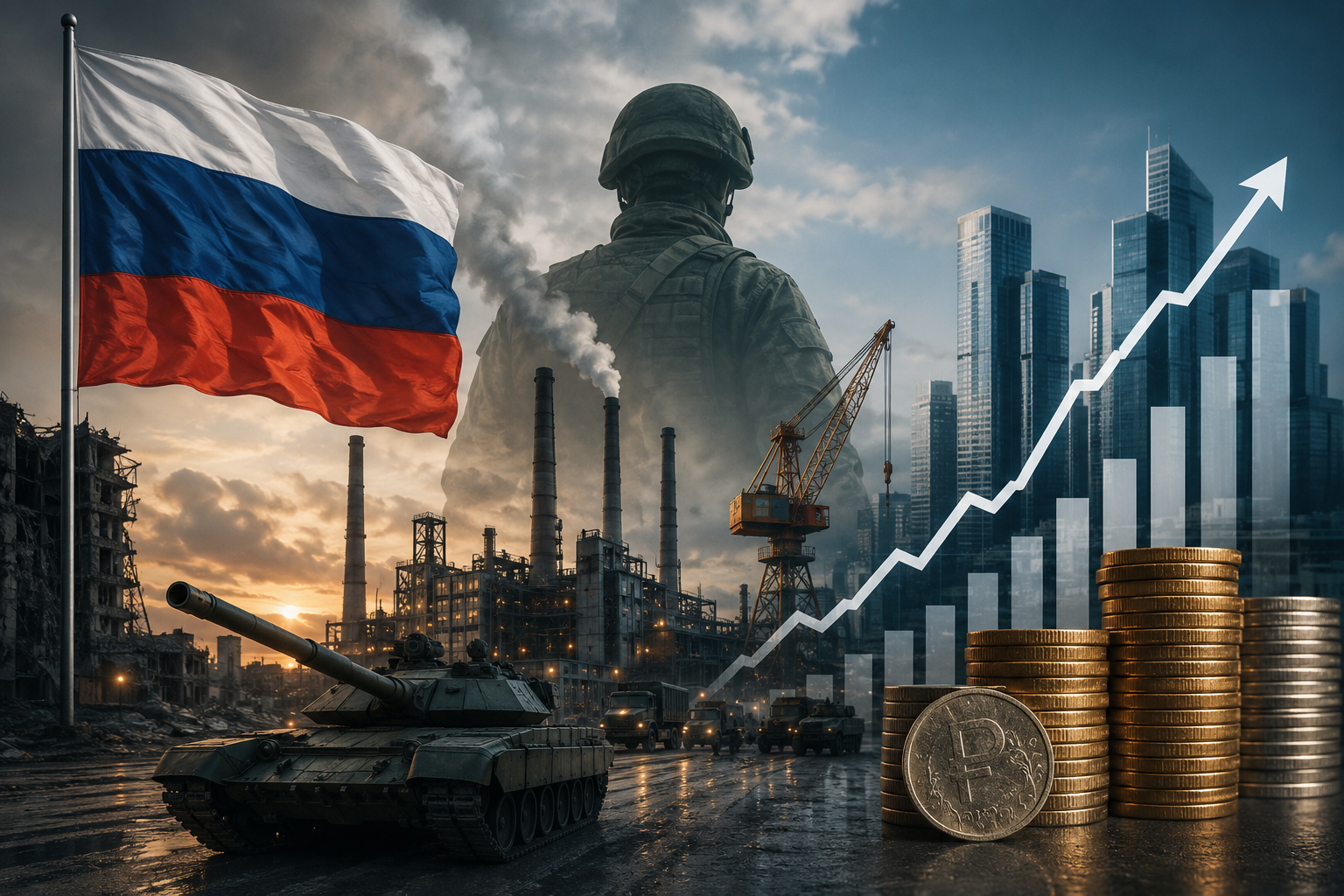
Read moreBefore Russia launched its full-scale invasion of Ukraine in February 2022, one of the most common predictions was that war and Western sanctions would quickly push the Russian economy into collapse. Five years later, that prediction looks difficult to defend. Russia did not avoid economic damage, but the economy adapted far better than many expected.
The first assumption was that Western sanctions would cripple Russia’s economy. They did not. The second was that sanctions would cause shortages of basic goods. Admittedly, in the first days of the war, many Russians rushed to supermarkets to buy flour, sugar, buckwheat and other staples, fearing that shortages were imminent. Yet widespread food shortages never materialized. The third prediction was that the ruble would collapse. It plunged initially, but the Russian government and central bank imposed capital controls, restrictions on foreign-currency transactions and other emergency measures that stabilized the currency. The fourth was that GDP would stagnate or contract. Instead, after the contraction of 2022, Russia recorded strong growth in 2023 and 2024. Even in 2025, when growth slowed sharply, the economy did not enter the kind of collapse that had been predicted. Inflation became a serious problem, but it never turned into hyperinflation.
These outcomes do not prove that sanctions were ineffective or that the Russian economy is healthy. They demonstrate something more specific: the Russian state was capable of reorganizing the economy around the shock and sustaining a high level of economic activity.
That matters when considering what happens if the war ends tomorrow.
One argument is that Russia would immediately face a social crisis because hundreds of thousands of contract soldiers would return to civilian life. This is possible, but it is not inevitable. If the war ends without a fundamental transformation of the European security environment, Moscow will still have strong incentives to maintain a large military. European governments are already increasing defense spending, while NATO is preparing for a much more heavily armed security environment. Russia is therefore unlikely to simply send its wartime military personnel home and dismantle the structures built since 2022. A significant portion of those soldiers could remain in the armed forces.
The stronger argument is that Russia’s GDP has been artificially inflated by the war economy. Military spending has indeed become enormous. SIPRI estimates that Russia’s military expenditure reached about 16 trillion rubles, or 7.5 percent of GDP, in 2025. The 2026 budget envisaged around 14.9 trillion rubles, or 6.3 percent of GDP. But it does not follow that ending the war would automatically eliminate this economic activity.
Russia has consumed enormous quantities of its own military stocks during the war. This is particularly clear in artillery ammunition. RUSI estimated that Russia needed approximately 4 million 152mm and 1.6 million 122mm shells in 2024 to meet its military objectives. Russian industry expected to produce only around 1.3 million 152mm and 800,000 122mm shells. RUSI therefore estimated that Russia would need to draw down its remaining stockpile of roughly 3 million rounds, much of it in poor condition.
The scale of foreign ammunition purchases reinforces the point. RUSI, citing Open Source Centre and Reuters analysis, estimates that North Korea may have supplied between 4.2 million and 5.8 million artillery rounds to Russia since 2023.
In other words, the war has not simply created a temporary demand for Russian military factories. It has also consumed a large part of the military inventory that Russia accumulated over decades.
That creates an important distinction between the end of the war and the end of military production. If fighting stops, Russia will no longer need to produce weapons at the same rate for immediate battlefield consumption. But it will have a powerful reason to continue producing them: rebuilding its depleted stocks.
This process could take years. Russia has already expanded its defense-industrial capacity substantially since 2022. A July 2026 CSIS study found that Russian defense companies have expanded domestic arms production both to replace battlefield losses and to meet future military demand.
Therefore, the most likely post-war scenario may not be “war ends, military factories close, and GDP collapses.” It may instead be “war ends, battlefield demand falls, but military procurement remains high while Russia rebuilds its arsenal.”
That does not mean Russia would necessarily experience strong economic growth. The wartime economy has also created serious distortions: labor shortages, high inflation, elevated interest rates and pressure on civilian investment. A reduction in military demand could therefore slow growth significantly.
But a slowdown is not the same thing as a recession, and a recession is not the same thing as economic collapse.
The paradox of Russia’s wartime economy is that the very process that has inflated economic activity has also consumed enormous quantities of military equipment. If the war ends, Russia will lose part of the demand generated by the conflict—but it will inherit a large military-industrial rebuilding program.
The idea that peace would automatically cause a Russian recession therefore rests on a questionable assumption: that Russia’s military economy exists only to fight the war in Ukraine. Russia’s history, security environment and depleted military stocks suggest otherwise.
The end of the war may reduce Russia’s economic growth rate. It may even produce a period of economic adjustment. But there is little reason to assume that peace itself would cause the Russian economy to suddenly collapse.
Here we are to serve you with news right now. It does not cost much, but worth your attention.
Choose to support open, independent, quality journalism and subscribe on a monthly basis.
By subscribing to our online newspaper, you can have full digital access to all news, analysis, and much more.
You can also follow AzerNEWS on Twitter @AzerNewsAz or Facebook @AzerNewsNewspaper
Thank you!