
Nakhchivan’s infrastructure push signals new role in Eurasian trade

AzerNEWS Staff
Read moreNakhchivan has always been more than a geographically separated part of Azerbaijan. Located between Turkiye, Iran and Armenia, the autonomous republic has historically stood at the intersection of important commercial and cultural routes connecting different parts of the region. Today, that geographical position is gaining a new meaning. With major investments in infrastructure, energy, transportation and industry, Nakhchivan is entering a period in which its location could become one of its greatest economic advantages.
The attention given to Nakhchivan by the national leadership has deep historical roots. Heydar Aliyev played a particularly important role in shaping the republic's modern political and economic trajectory. During his years in Nakhchivan, he attached particular importance to strengthening the region's position within Azerbaijan and preserving its economic and strategic significance at a difficult period in the country's history. His approach to Nakhchivan was based not only on protecting its immediate interests, but also on understanding the autonomous republic's broader historical and geopolitical importance.
That legacy has continued under President Ilham Aliyev. Nakhchivan's development has remained a consistent element of state policy, reflected in repeated presidential visits, infrastructure projects and programmes aimed at strengthening the republic's economic potential. President Ilham Aliyev has visited Nakhchivan 16 times and, during these visits, participated in the opening of numerous social, economic and infrastructure facilities while setting priorities for the region's future development.
The scale of the recent transformation is becoming increasingly visible. The 2023–2027 State Programme for the socio-economic development of Nakhchivan established 11 priority areas, covering economic growth, social development and the deeper integration of the autonomous republic into Azerbaijan's economy. Since 2023, hundreds of production and service facilities have been created, while preferential financing has supported hundreds of entrepreneurial projects.
The economic figures also point to a changing environment. Between 2023 and 2025, Nakhchivan's real GDP increased by 7.6 percent, industrial production rose by 4.6 percent, while transport and warehousing expanded by 25.7 percent. Investment in fixed capital increased 2.5 times over the same period. These figures are important because they show that Nakhchivan's transformation is not limited to individual construction projects. It is gradually creating a broader economic base.
Yet the most significant opportunity may lie ahead.
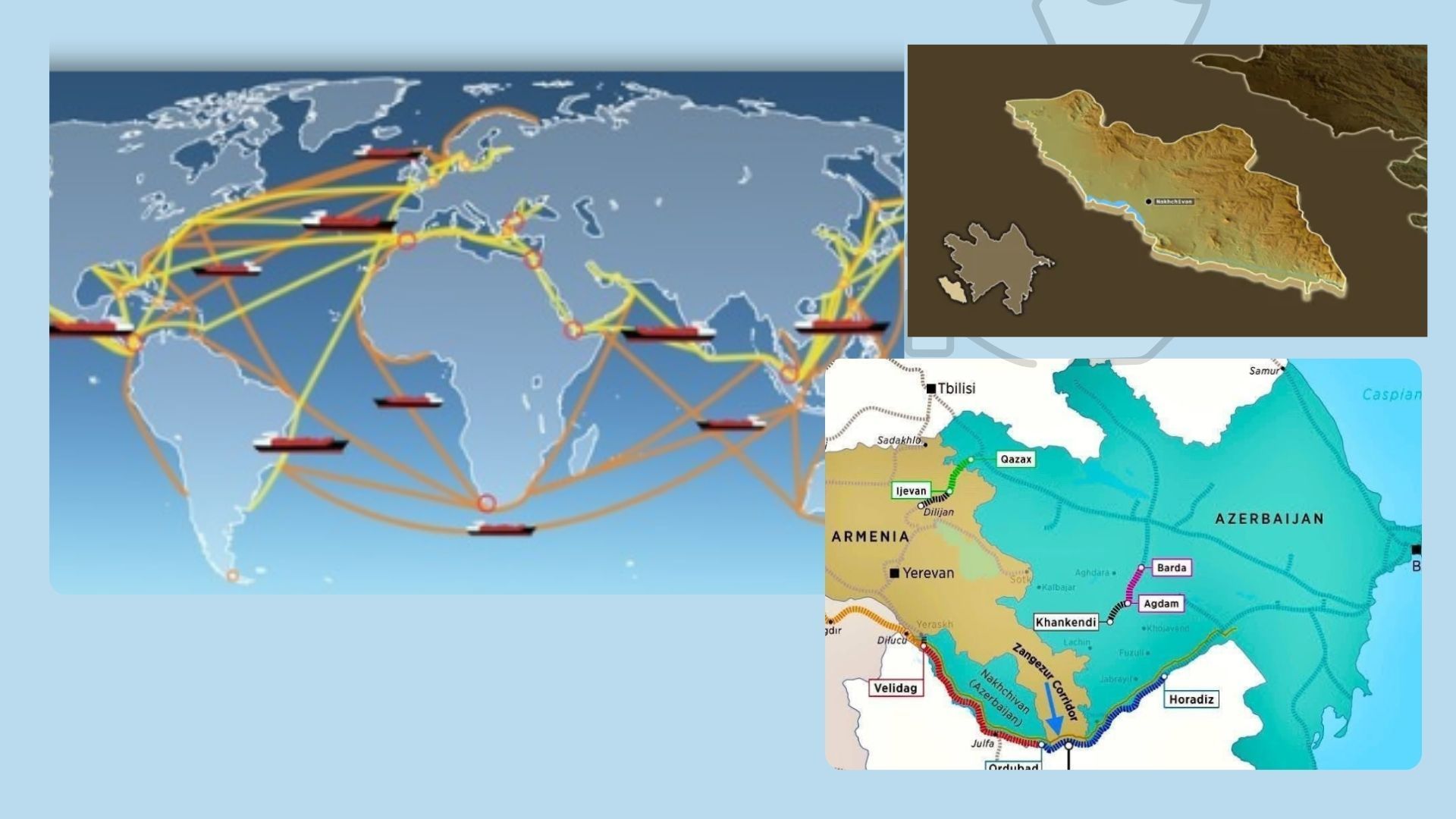
For decades, Nakhchivan's geographical separation from mainland Azerbaijan limited its ability to fully exploit its location. The restoration of direct transportation connections could change this fundamentally. The development of railway links toward Nakhchivan, together with the Qars–Igdir–Nakhchivan railway project in Turkiye, has the potential to place the autonomous republic within a much larger transportation network.
This is where TRIPP and the broader restoration of regional communications become particularly important. The significance of these projects extends beyond the creation of a single transport route. Their larger potential lies in connecting Azerbaijan's mainland with Nakhchivan and linking these routes with the East-West and North-South transportation corridors.
For Azerbaijan, this means another opportunity to strengthen its position as a transportation hub between Central Asia, the Caspian region, Turkiye and Europe. For Nakhchivan, it could mean a fundamental change in its economic role.
Historically, major trade routes passed through Nakhchivan. The new regional environment creates an opportunity to revive this function in a modern form. If railway connections, highways, customs infrastructure, logistics centres and industrial facilities develop together, Nakhchivan could become a major regional trading and distribution centre.
The comparison with Dubai is therefore useful as a vision of what connectivity can achieve. Nakhchivan does not need to copy Dubai's economic model. Its own advantage is different: it sits at the meeting point of several countries and transportation directions. With sufficient logistics capacity and investment, this geography could allow it to serve a market stretching from Central Asia to Europe and from the South Caucasus toward the Middle East.
Turkiye and Iran will naturally be central to this process. Nakhchivan's border with Turkey provides a direct connection to one of the region's largest economies, while its border with Iran opens another route toward the Middle East and South Asia. At the same time, a peaceful and connected South Caucasus could create new opportunities for economic cooperation with Armenia.
The energy dimension adds another layer to Nakhchivan's transformation.
Recent investments are strengthening the autonomous republic's energy infrastructure, including new substations, hydropower facilities and the development of additional generation capacity. The Igdir–Nakhchivan natural gas pipeline, inaugurated in March 2025 in the presence of the presidents of Azerbaijan and Turkiye, has further diversified Nakhchivan's gas supply.
This creates the basis for a new energy model. Nakhchivan can gradually move from being primarily an energy-importing territory toward greater self-sufficiency, supported by diversified gas and electricity supplies and a growing role for renewable energy. In the longer term, this could create opportunities not only for energy security but also for electricity production and potential green-energy exports.
The next stage could be the development of industrial and production clusters around the new transport routes. Once logistics become easier and more predictable, companies have greater incentives to establish warehouses, processing facilities and manufacturing operations close to major corridors. Nakhchivan's industrial park could become an important part of this process by providing infrastructure and incentives for new investment.
This is where the long-term significance of Ilham Aliyev's Nakhchivan policy becomes particularly visible. The objective is not simply to improve roads, construct buildings or modernize utilities. It is to create the conditions under which Nakhchivan can participate more actively in Azerbaijan's national economy and in the wider regional economy.
The transformation also represents a continuation of a broader historical approach associated with Heydar Aliyev. His understanding of Nakhchivan emphasized the republic's strategic importance to Azerbaijan. Under Ilham Aliyev, that strategic vision is increasingly being expressed through economic integration, infrastructure connectivity and international transportation projects.
The significance of Azerbaijan's military victory is also becoming clearer through this process. The new regional reality has created conditions for transportation links, economic cooperation and infrastructure projects that previously could not be developed in the same form. The next stage is to translate the political and military outcome into lasting economic connectivity.
In this sense, the statement that President Ilham Aliyev has won both the war and the peace carries an economic meaning as well. The victory on the battlefield changed the regional balance. Diplomacy, transportation corridors, railway projects, logistics centres and economic cooperation can now turn those new realities into long-term development.
Nakhchivan could become one of the clearest examples of this transition.
Its future may increasingly be defined by railways rather than isolation, logistics rather than geographical constraints, production rather than limited markets, and energy generation rather than dependence. The roads that once ended at borders could become connections between major markets.
If these projects continue to develop as planned, Nakhchivan may enter a new era in which its historical role as a crossroads is revived in a modern form. The autonomous republic could become an important link between Azerbaijan's mainland, Turkiye, Iran, Central Asia and Europe, while also contributing to the creation of a new transportation and economic map for the South Caucasus.
The deeper significance of this transformation is that Nakhchivan's geography is no longer simply a challenge to overcome. It is increasingly becoming an asset to be used.
The vision associated with Heydar Aliyev's strategic understanding of Nakhchivan and the infrastructure-driven development policy pursued by Ilham Aliyev are converging at a particularly important moment. As regional communications reopen and Eurasian trade routes diversify, Nakhchivan has the opportunity to turn its historic position at the crossroads into a modern economic gateway.
A new chapter is therefore beginning for Nakhchivan — one in which the republic can move from the periphery of regional trade toward the centre of it.
Here we are to serve you with news right now. It does not cost much, but worth your attention.
Choose to support open, independent, quality journalism and subscribe on a monthly basis.
By subscribing to our online newspaper, you can have full digital access to all news, analysis, and much more.
You can also follow AzerNEWS on Twitter @AzerNewsAz or Facebook @AzerNewsNewspaper
Thank you!