
Iranian or Persian? Historical dispute behind Yerevan's Blue Mosque

Qabil Ashirov
Read moreIran's Ambassador to Armenia, Khalil Shirgholami, is either trolling Armenians or has contracted the same disease of degradation that appears to afflict him while living in Armenia. There is little other way to interpret his remarks in an interview with Armenian media, in which he stated: “The Blue Mosque in Yerevan has always been, and will remain, part of Armenian-Iranian heritage.”
In a previous article on Azernews, it was pointed out that Armenians appear to live in a parallel world and have virtually no knowledge of the historical cultures of the countries surrounding them. They are so unfamiliar with their neighbours' histories that they perceive those countries' history and cultures through the distorted lens of their own parallel reality. In those publications, it was also addressed the practice of referring to mosques located in Armenia as Persian mosques, demonstrating that such a practice is associated with Christianity rather than Islam. There is no such concept in Islam as a Persian mosque, an Arab mosque or a Turkish mosque. In Islam, places of worship are named neither after ethnic groups nor even after religious denominations. Unlike Islam, Christianity has such distinctions, as illustrated by the Russian Orthodox Church, the Armenian Catholic Church and others. Even though three of Armenia's four neighbouring countries are Muslim-majority states, Armenians have reached such a state of degradation that they appear unaware of even the most basic facts about their neighbours.
Several days ago, Armenians went even further by naming Yerevan's Blue Mosque after an Armenian poet and installing a bust of that poet inside the mosque. The decision was criticised in our previous article, pointing out that it had no connection with Islam and that, under Islamic rules, such a practice constitutes shirk (associating partners with God).
Apparently, this justified criticism by the Azerbaijani media has unsettled Armenians, prompting them to approach Iran's ambassador to the country on the matter. However, the ambassador's ambiguous response has left us wondering what exactly he intended to say. His description of the mosque as having no “Azerbaijan origin” and being part of “Armenian-Iranian heritage” suggests that he has contracted the same fascist disease as part of Armenians, who claim to have invented the apricot, discovered television, and so on.
On the other hand, a look at Armenian media coverage reveals that the word “Persian” does not appear in the ambassador's remarks. He speaks of Iranian culture, yet Armenian media outlets, when paraphrasing his statements, use the term “Persian”. This raises the possibility that the ambassador is actually trolling Armenians. By repeatedly circulating his remarks, Armenians, who suffer from historical degradation, have once again demonstrated that they live in a parallel world.
As for my own assessment, the ambassador's use of the expression “Iranian-Armenian heritage” further reinforces the impression that living in Armenia has caused him to develop the same affliction as the Armenians. At the same time, however, it must be acknowledged that the fascist mentality prevalent among certain segments of the Persian population, particularly starting from the Pahlavi era, is hardly any less pronounced than that found among Armenians. The fact that someone raised under such influence is now living in Armenia arguably suggests that the most dangerous disease of the past century, fascism, has become even more deeply entrenched in that individual.
I would also like to address the ambassador's attempt to conceal Persian culture behind the broader concept of Iranian culture and present it to the world as though the two were interchangeable. As is known, certain cultures around the world cannot be attributed merely to a single ethnic group. Take Soviet culture, for example. Only an ignorant person would claim that Soviet culture belonged exclusively to Russians. Dozens of ethnic groups contributed to its formation. One of the greatest writers of Soviet culture, Chingiz Aitmatov, shook the literary world with his works, yet he was not Russian by ethnicity but Kyrgyz. The Soviets were socialists, an ideology that originated in Europe and had no particular connection to Russians. They regarded Karl Marx as something of a prophet, although Marx was an ethnic German Jew. One of their founding leaders, Lenin, was of Chuvash descent, while another, Stalin, was Georgian.
Consider Islamic culture. It is equally incorrect to associate it exclusively with Arabs. Nizami Ganjavi, for instance, was Azerbaijani. He wrote his works in Persian, yet his literary legacy is a prominent example of Islamic culture. Take Amir Khusrow Dehlavi as another example. He was from India, yet he represented Islamic culture.
Iranian culture belongs to the same category. Only ignorant people would associate Iranian culture exclusively with Persians. Iranian culture is not Persian culture; it is a shared heritage. Anyone who has studied Iranian history knows that during the Achaemenid Empire, one of the earliest Persian empires, kings would travel on foot from the capital to Azerbaijan when ascending the throne, seeking to have their legitimacy confirmed. A local priest in Azerbaijan would place the crown on the king's head, thereby legitimising his rule. In other words, if the king was Persian, it was Azerbaijan that granted him legitimacy.
After the Arabs erased the Persian Empire from history, most of the states established in the region were Azerbaijani dynasties, including the Qara Qoyunlu, Aq Qoyunlu, Safavids, Afsharids and Qajars.
During the Achaemenid and Sasanian periods, it was Azerbaijanis who granted legitimacy to kings ascending the throne. Following the Arab conquests, most of the empires established across the Iranian Plateau until 1926 were of Azerbaijani origin. The Shia branch of Islam, which today forms one of the foundations of the Iranian state, expanded so significantly thanks to Ismail, an Azerbaijani ruler. Religious theatre, now an integral part of Iranian culture, was also adopted from representatives sent to the Vatican during the reign of Shah Abbas, another Azerbaijani ruler, and subsequently brought back to the region.
Furthermore, while Russian served as the lingua franca of Soviet culture, the ancient East, including Islamic and Iranian culture, had three major lingua francas: Arabic, Persian and Azerbaijani.
In short, just as Islamic culture is distinct from Arab culture, and Soviet culture is distinct from Russian culture, the shared culture created by the peoples inhabiting the Iranian Plateau, including Azerbaijanis, Talysh, Kurds, Georgians, Baloch, Tabaris and others, cannot simply be reduced to Persian culture.
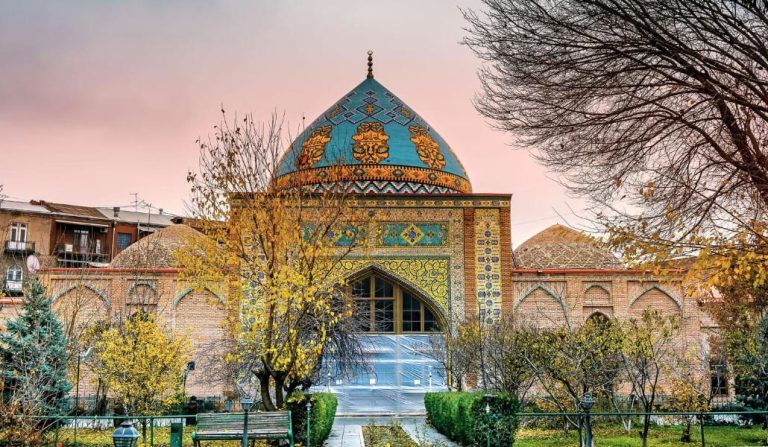
The Blue Mosque in Yerevan was built between 1770 and 1776, during the period of the Iravan Khanate. At the time, the overwhelming majority of the khanate's population was Azerbaijani. The language used in the khanate was Azerbaijani, and the khan himself was Azerbaijani. Taking a particular architectural feature or ornament from the mosque, labelling it Iranian culture and subsequently presenting it as Persian is nothing short of degradation.
Here we are to serve you with news right now. It does not cost much, but worth your attention.
Choose to support open, independent, quality journalism and subscribe on a monthly basis.
By subscribing to our online newspaper, you can have full digital access to all news, analysis, and much more.
You can also follow AzerNEWS on Twitter @AzerNewsAz or Facebook @AzerNewsNewspaper
Thank you!