
Why gold is losing its shine even as Middle East burns

Qabil Ashirov
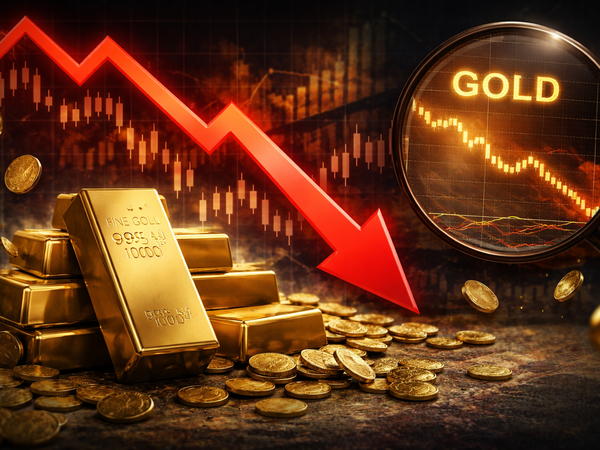
Read moreGold's latest selloff is exposing a fundamental change in the relationship between geopolitical risk and financial markets. Despite an ongoing military conflict between the United States and Iran, the precious metal has fallen to its lowest level since September 2025, trading around $3,773 an ounce on November 18. More significantly, bullion has surrendered approximately 32.6% of its January 2026 record high of $5,595. The scale of the correction suggests that investors are reassessing the cost of holding gold in an environment where interest-bearing assets are becoming increasingly attractive. The central driver is no longer simply geopolitical uncertainty. It is the growing influence of US monetary policy on global capital allocation.
The most important explanation for gold's decline lies in an unusual economic chain reaction triggered by the Middle East conflict. Military escalation has increased uncertainty surrounding energy supplies and contributed to inflationary pressures. Under normal circumstances, rising geopolitical risk and concerns about purchasing power would support demand for gold. This time, however, the inflationary consequences have created a countervailing force: expectations of higher interest rates. The Federal Reserve is increasingly concerned that inflation could remain above its 2% target, making monetary easing difficult and potentially requiring additional tightening. Consequently, an event that would traditionally support gold has helped strengthen the very monetary conditions that undermine its price.
The mathematics of the investment decision are straightforward. Gold generates no interest or dividend income, meaning its attractiveness depends heavily on expected capital appreciation and its diversification benefits. US Treasury securities, by contrast, provide regular interest payments. With the 10-year Treasury yield hovering around 5.14%, investors can obtain substantial dollar-denominated returns without accepting the price volatility associated with bullion. The difference becomes particularly important when inflation expectations remain elevated, and the Federal Reserve signals that borrowing costs could rise further. Every additional increase in bond yields raises the opportunity cost of holding gold.
The currency market reinforces this pressure. The US dollar has climbed to a 19-month high, making dollar-priced gold more expensive for buyers using other currencies. This creates a double constraint on international demand: investors outside the United States face a stronger dollar while US-based investors enjoy increasingly competitive returns on government securities. The combination of currency appreciation and higher yields has therefore become more powerful than gold's traditional geopolitical appeal.
Market expectations illustrate the scale of the shift. According to Reuters, investors were pricing in a 97.8% probability of a 25-basis-point Federal Reserve rate increase in December, with a smaller 2.2% probability assigned to a 50-basis-point move on November 18. These expectations matter because financial markets operate on anticipated policy changes rather than waiting for central banks to act. Much of the adjustment in gold prices can occur before an actual rate increase, as investors reposition portfolios in anticipation of higher returns elsewhere.
The correction also needs to be considered against the extraordinary rally that preceded it. Gold reached approximately $5,595 an ounce in January 2026. At $3,773, the metal has lost around $1,822 per ounce from that peak. This is a decline of approximately 32.6%, large enough to alter investor positioning and challenge expectations built during the previous rally. Some of the selling pressure can be attributed to profit-taking, the unwinding of crowded positions and momentum-driven trading. Once prices break important technical levels, systematic investors and leveraged traders can accelerate the decline, turning a monetary-policy adjustment into a broader liquidation cycle.
Nevertheless, the current correction does not necessarily signal the end of gold's longer-term investment appeal. The same factors supporting higher interest rates could eventually create new demand for precious metals. US government borrowing requirements, rising debt-servicing expenses and persistent fiscal deficits remain structural vulnerabilities. A 5% borrowing cost is attractive to investors holding Treasury securities, but it also increases the government's financing burden. If interest payments continue absorbing a larger share of federal expenditure, concerns about fiscal sustainability could strengthen the case for alternative reserve assets. Central-bank diversification away from excessive dependence on individual currencies could provide another source of structural demand.
The outlook for the next 12 months therefore depends on which of these forces becomes dominant. ANZ identifies $3,600 an ounce as a potential support area in the near term while maintaining a longer-term target of $4,800 in 2027. The latter would represent an increase of approximately 27.2% from the November 18 price. Such a recovery is possible, but it requires a meaningful change in the monetary environment. A decline in inflation, stabilisation of energy prices and a reduction in US real Treasury yields would make gold considerably more competitive. Renewed central-bank purchases and investment demand could then provide additional momentum.
My base-case assessment is that gold is more likely to experience a volatile stabilisation phase before attempting a sustained recovery. Over the next three to six months, the $3,500-$3,800 range appears plausible if the Federal Reserve maintains a restrictive stance and the dollar remains strong. However, looking towards November 2027, I see a reasonable possibility of prices recovering towards $4,200-$4,600 an ounce, provided inflation gradually moderates and real yields begin declining. This would imply an appreciation of approximately 11%-22% from current levels. A move towards $4,800-$5,000 would represent a stronger bullish scenario, requiring a more pronounced shift towards monetary easing or a renewed wave of institutional and central-bank buying. Conversely, persistent inflation and further rate increases could push prices towards $3,300-$3,600.
The critical variable is therefore not the intensity of geopolitical conflict alone, but its interaction with the cost of capital. Gold's 2026 correction demonstrates that investors can tolerate considerable geopolitical uncertainty when alternative assets offer attractive real returns. The metal remains a potential hedge against monetary instability, sovereign debt risks and currency depreciation, but its effectiveness as a short-term safe haven depends heavily on the interest-rate environment. Until the balance shifts in favour of lower real yields and a weaker dollar, gold may struggle to recover its previous momentum. The next major rally will probably require more than another geopolitical shock: it will require a change in the economics of holding dollars.
Here we are to serve you with news right now. It does not cost much, but worth your attention.
Choose to support open, independent, quality journalism and subscribe on a monthly basis.
By subscribing to our online newspaper, you can have full digital access to all news, analysis, and much more.
You can also follow AzerNEWS on Twitter @AzerNewsAz or Facebook @AzerNewsNewspaper
Thank you!