
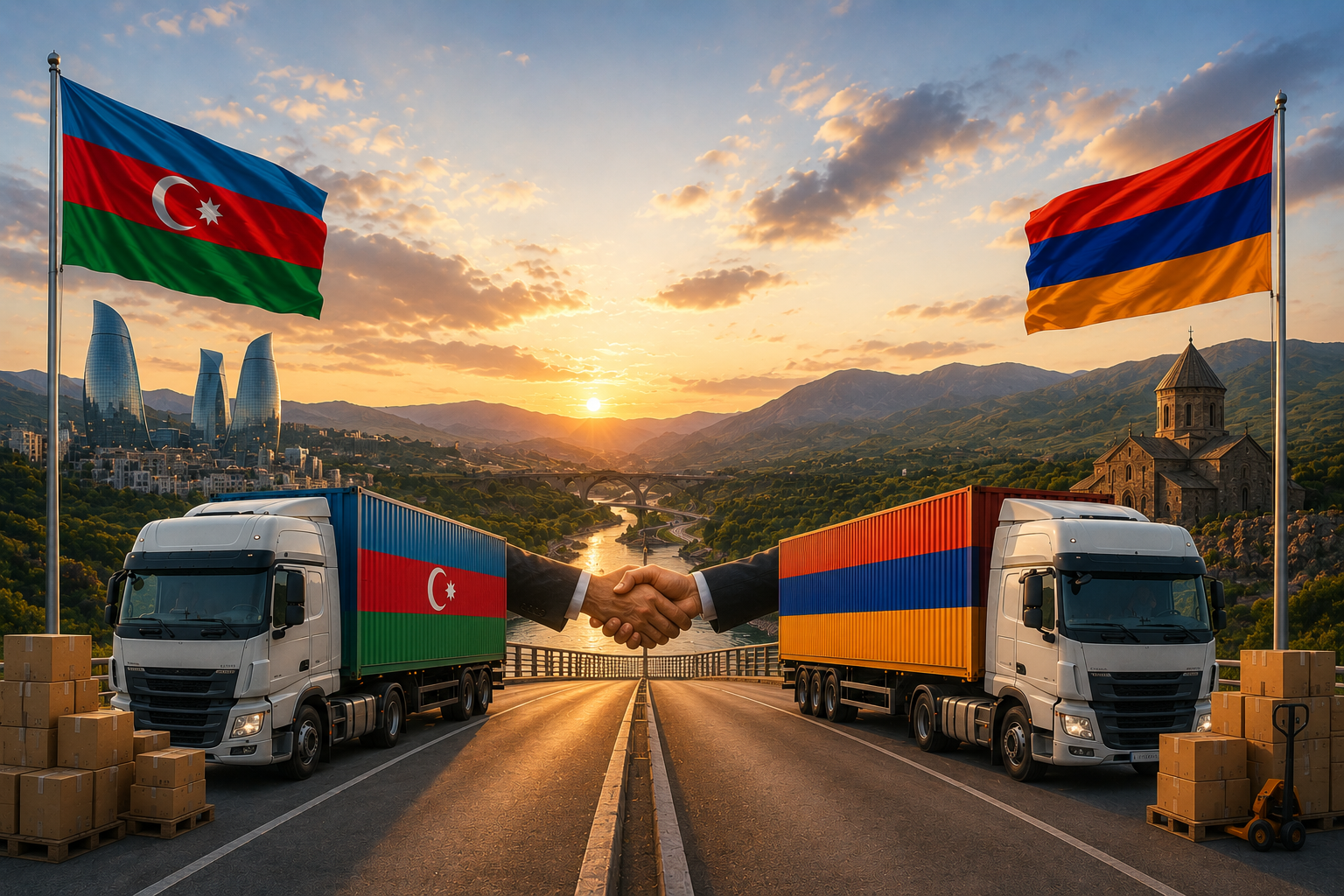
Baku and Yerevan seek to turn peace into economic interdependence

Qabil Ashirov
Read moreRecent messages from the leaders of Azerbaijan and Armenia are increasingly strengthening the impression that the conflict that shaped relations between the two countries for more than three decades is moving into the past, while peace and practical cooperation are becoming more realistic prospects. Armenian Prime Minister Nikol Pashinyan's latest statement suggests that Armenia is preparing to resume exports to Azerbaijan, potentially paving the way for more balanced trade between the two countries.
This development is important not simply because of the value of the goods that may initially cross the border, but because of what it represents. Since gaining independence, Azerbaijan and Armenia have never developed normal, direct and mutually beneficial trade relations. Their borders remained closed for decades, while the conflict prevented the emergence of ordinary economic ties. In recent years, however, limited economic interaction has started to appear, most notably through Azerbaijan's fuel exports to Armenia. The emergence of Armenian exports to Azerbaijan would therefore represent another step toward establishing a genuine commercial relationship.
Trade can play a particularly important role in consolidating peace. It would be unrealistic to claim that trade alone can guarantee a lasting settlement, but economic interdependence can create powerful incentives for both sides to preserve stability. When businesses, consumers, transport operators and energy companies begin benefiting from cross-border economic activity, the cost of renewed confrontation becomes considerably higher. In this sense, trade can help transform peace from a political objective into an economic interest shared by both societies.
There is also a straightforward economic argument. Neighboring countries are often among each other's most important trading partners because geographical proximity reduces transportation costs and facilitates supply chains. Azerbaijan's non-oil exports, for example, are strongly connected with regional markets such as Russia, Türkiye and Georgia. Armenia could gradually become another important destination if political and logistical barriers continue to disappear. For Armenia, access to the Azerbaijani market would provide another nearby market for its producers. For Azerbaijan, Armenian goods could add another source of supply and create opportunities for companies operating in trade, logistics and distribution.
Yet the larger economic benefit of peace is likely to come from reduced geopolitical risk rather than trade alone. Both Azerbaijan and Armenia have spent substantial resources on defence and security because of the unresolved conflict. A durable peace would not eliminate the need for defence spending, but it could reduce the economic pressure associated with permanent confrontation and allow both governments to devote a greater share of resources to infrastructure, education, technology and social development. The economic dividend of peace could therefore be much larger than the initial value of bilateral trade.
Energy cooperation could become an even more important component of this process. During his recent visit to Nakhchivan, Azerbaijani President Ilham Aliyev spoke about the possibility of electricity exports and indicated that regional countries could potentially benefit from such energy cooperation. Pashinyan's latest comments about the possibility of cooperation with Azerbaijan in the electricity sector suggest that this idea is no longer merely a theoretical discussion. If technical and political conditions permit, electricity could become one of the first strategic sectors in which the two countries develop practical interdependence.
This possibility becomes more interesting when Armenia's ambitions in artificial intelligence and digital infrastructure are considered. Armenia has been seeking to attract investment into AI infrastructure and data-centre projects, including initiatives involving US companies. Such facilities can require substantial and reliable electricity supplies. Armenia is already developing additional generation capacity, but meeting rapidly growing electricity demand will require significant investment over the coming years.
Nuclear power is an important part of Armenia’s electricity mix, but the country will also need to expand and diversify its energy capacity as electricity demand grows. This is particularly relevant as Armenia seeks to attract investment in energy-intensive industries and digital infrastructure, including AI-related projects.
For Azerbaijan, this could create an additional opportunity for regional energy cooperation. Azerbaijan has significant energy resources and is expanding its role as a reliable electricity and energy partner in the region. If bilateral relations continue to improve, electricity trade could become another area of practical cooperation, with Azerbaijan potentially supplying electricity to Armenia when commercially and technically feasible. Such cooperation would strengthen Azerbaijan’s role in the emerging regional economic architecture while creating a new source of energy security for Armenia.
The most important transformation, therefore, may not be measured in the first million dollars of bilateral trade. Its significance lies in the possibility of creating a cycle in which trade encourages trust, trust enables infrastructure cooperation, infrastructure creates economic interdependence, and interdependence makes peace more valuable for both sides. Azerbaijan enters this process from a position of considerable economic and energy strength, giving it an opportunity to contribute to regional connectivity while also benefiting from the opening of a new neighbouring market.
After more than thirty years of confrontation, the emergence of trade, energy cooperation and potentially wider economic links would mark a fundamental change in the South Caucasus. If the political momentum continues, Azerbaijan and Armenia could gradually move from being defined by the economic costs of conflict to being connected by the economic benefits of peace.
Here we are to serve you with news right now. It does not cost much, but worth your attention.
Choose to support open, independent, quality journalism and subscribe on a monthly basis.
By subscribing to our online newspaper, you can have full digital access to all news, analysis, and much more.
You can also follow AzerNEWS on Twitter @AzerNewsAz or Facebook @AzerNewsNewspaper
Thank you!