
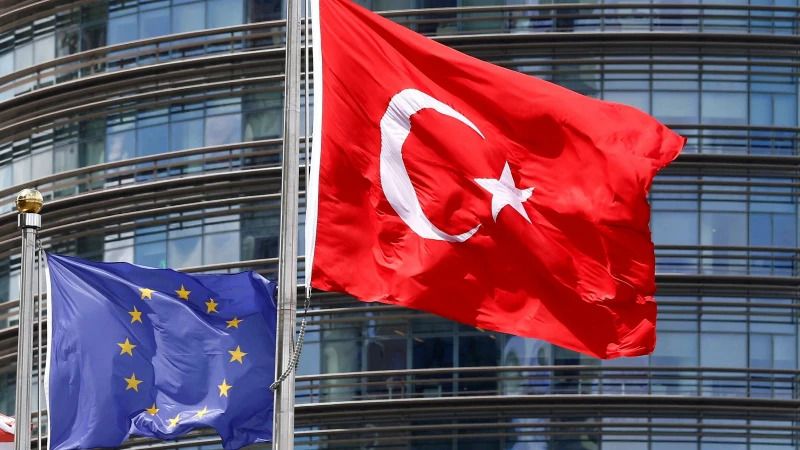
EU sees Türkiye as key to Caucasus stability and NATO security
By News Centre
European Union High Representative for Foreign Affairs and Security Policy Kaja Kallas said connectivity issues would also be on the agenda during her talks in Türkiye, emphasizing Ankara's growing strategic importance in the broader region.
"When we look beyond the Middle East and turn to the Caucasus, we see that Türkiye plays a very important role there as well. That is why it is important to hold these discussions and evaluate what we can do together," Kallas said.
She also announced that she would return to Türkiye on July 7-8 for the NATO Summit in Ankara.
"Of course, every summit is described as historic, but this time it truly is. Transatlantic relations have come under serious pressure recently. Therefore, sending a message of unity is extremely important. This will be a strong message not only for the Alliance but also for our adversaries," she said.
According to Kallas, the main issues on the agenda at the Ankara Summit will include increasing defence industry production, enhancing credibility in defence and deterrence, and determining how additional support can be provided to Ukraine.
Asked whether Europe needs a common army, Kallas replied with a straightforward "No."
She noted that each member state already has its own armed forces, which are part of NATO's broader defence structure.
"It is therefore not feasible for every EU member to establish a second army under European leadership. We need to work with the tools we already have. We must strengthen our defence capabilities and invest more in defence, but it is equally important that we do so together because the threats we face are regional and, consequently, the response must also be regional," she said.
Addressing concerns over how European capitals can strengthen their defence capabilities without duplicating NATO's efforts, Kallas stressed that the goal is precisely to avoid any overlap and that the European Union remains in close and constant contact with the Alliance.
"What matters to us is strengthening the European pillar within NATO and thereby making NATO itself stronger. To achieve this, we are identifying existing capability gaps. We are also encouraging member states to participate in joint procurement projects because some defence capabilities are too costly for a single country to provide on its own. We are also evaluating how defence spending can be used more efficiently," she said.
Kallas added that Europe also has much to learn from Ukraine regarding the development of new capabilities.
"All of these efforts are aimed at making Europe stronger within NATO," she said.
'Türkiye Holds an Extremely Important Position Within NATO'
Commenting on Türkiye's role in the emerging European security architecture and within NATO, Kallas said:
"Türkiye is a candidate country for the European Union. Of course, there have long been problems concerning fundamental rights and freedoms, which form the basis of membership. However, from NATO's perspective, Türkiye possesses the Alliance's second-largest army and a very strong defence industry. Therefore, it holds an extremely important position within NATO."
She added that when considering the broader framework of European security and regional stability, dialogue with Türkiye remains essential.
"When we look at European security as a whole and particularly assess regional stability, including stability in the Caucasus, we need to maintain dialogue with Türkiye," she said.
Kallas also stated that the European Union and Türkiye should address the Cyprus issue and emphasized that the bloc supports the mediation and negotiation efforts undertaken by United Nations Secretary-General António Guterres.
She underlined her belief that achieving a peaceful settlement of the Cyprus issue would help unlock solutions to many other challenges.
Regarding Israel's alleged violations of international law in the Middle East, Kallas said the issue is discussed during every meeting of the EU Foreign Affairs Council.
"The steps taken by Israel are widely condemned across Europe. In particular, the actions of violent settlers and settlement activities are effectively making a two-state solution impossible," she warned.
Kallas reiterated that Europe is among the strongest supporters of both a two-state solution and the Palestinian people.
She said that the European Union consistently raises "difficult issues" during its contacts with Israel and commented on Israeli Foreign Minister Gideon Saar's decision to suspend dialogue with her.
"Dialogue is the only way to raise these issues and make our voices heard," she said.
When asked how such dialogue could continue if one side refuses to engage, Kallas replied:
"That is a truly difficult question. Minister Saar has said that he will not meet with me at the moment, but I do not believe that this is the right response when faced with criticism."
Here we are to serve you with news right now. It does not cost much, but worth your attention.
Choose to support open, independent, quality journalism and subscribe on a monthly basis.
By subscribing to our online newspaper, you can have full digital access to all news, analysis, and much more.
You can also follow AzerNEWS on Twitter @AzerNewsAz or Facebook @AzerNewsNewspaper
Thank you!