
SOCAR is building global business beyond Azerbaijan’s oilfields

Qabil Ashirov
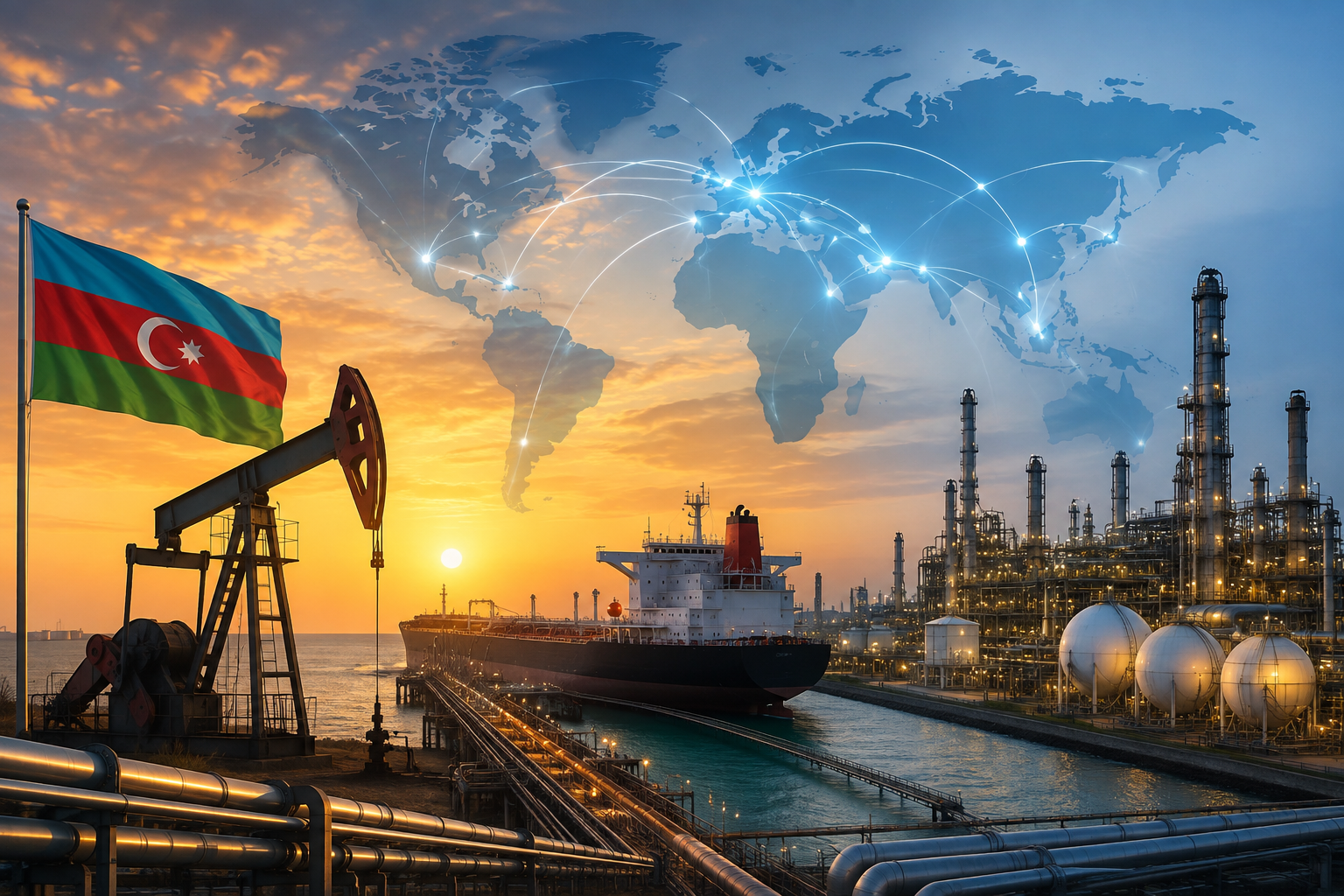
Read moreSOCAR is no longer a company whose fortunes can be understood simply by looking at Azerbaijan’s domestic economy. Its 2025 financial results offer a much broader picture: Azerbaijan’s state oil company is increasingly becoming a global energy business, with a growing share of its commercial activity taking place beyond the country’s borders. That transformation is not only strengthening SOCAR itself; it could also make Azerbaijan’s economy more resilient.
The numbers are striking. SOCAR generated AZN 86.3 billion in sales revenue in 2025. Of this amount, AZN 50.6 billion, or 58.6%, was attributed to Switzerland. Türkiye accounted for another AZN 16.5 billion, while Azerbaijan generated AZN 13.7 billion. In other words, the Azerbaijani market accounted for less than one-sixth of SOCAR’s consolidated sales revenue.
These figures should not be interpreted simply as evidence that SOCAR is selling enormous quantities of oil and gas directly to Swiss consumers. Switzerland is a major international commodity-trading center, and SOCAR Trading, the company’s international marketing and development arm, is based in this global trading environment. The importance of Switzerland in SOCAR’s revenue structure therefore reflects the increasingly international nature of the company’s trading operations.
This is strategically important. A traditional national oil company is usually heavily dependent on the economic and energy conditions of its home country. SOCAR, however, is gradually developing a different structure. Its production base remains closely connected to Azerbaijan, but its commercial network extends far beyond it.
Türkiye is perhaps the clearest example. SOCAR has built a substantial industrial presence there spanning refining, petrochemicals, energy and other strategic sectors. Its Turkish operations include the STAR Refinery and Petkim, while the company has also expanded into logistics, infrastructure and other areas. SOCAR’s sales revenue from Türkiye increased by 71.1% in 2025, reaching AZN 16.5 billion.
This means Türkiye is not simply another foreign market for SOCAR. It is becoming a major industrial platform through which Azerbaijan participates in a much larger regional economy.
The same logic can be seen in SOCAR’s broader international expansion. In 2025, the company continued to increase its international asset portfolio and strengthen its position along the energy value chain. It acquired a 10% effective interest in Israel’s Tamar gas field and expanded its international partnerships, while also continuing projects connected with refining, petrochemicals, gas and energy infrastructure.
At the same time, SOCAR has not abandoned its Azerbaijani foundation. Quite the opposite. The company continues to invest in domestic assets, including the redevelopment of the mature Bahar and Gum-Deniz fields. SOCAR and SLB signed an agreement in 2025 aimed at accelerating the redevelopment of these fields and improving their production potential.
This creates an important balance. Azerbaijan remains the foundation of SOCAR, but it is no longer the entire business environment in which SOCAR operates.
That distinction matters for Azerbaijan itself.
If SOCAR earned almost all of its revenue inside Azerbaijan, the company would be far more exposed to domestic economic conditions. Its performance would depend heavily on the size of the local market, domestic demand and developments within Azerbaijan’s own economy.
A globally active SOCAR has a different risk profile. Its revenues are connected to international oil and gas trading, refining, petrochemicals, transportation, energy infrastructure and foreign markets. A downturn in one market does not necessarily translate into an equivalent downturn across the entire group.
This does not mean that SOCAR has become independent of Azerbaijan. It has not. Its ownership, strategic role and resource base remain fundamentally Azerbaijani. But its growing international footprint means that Azerbaijan is effectively exporting not only hydrocarbons, but also corporate expertise, capital and business capabilities.
That could become increasingly valuable as the global energy system changes.
The future of energy will not be determined solely by how much oil or gas a country produces. Trading networks, refining capacity, petrochemicals, infrastructure, technology and access to international markets will increasingly determine who captures value from the energy chain.
SOCAR is already moving in that direction.
The significance of the 2025 revenue figures therefore goes beyond the size of SOCAR’s balance sheet. They show the emergence of a company whose economic geography is becoming much larger than Azerbaijan itself.
Azerbaijan built SOCAR as its national energy company. SOCAR is now building a global business that can, in turn, strengthen Azerbaijan.
That may ultimately be one of the most important advantages of SOCAR’s internationalization: the stronger the company becomes outside Azerbaijan, the more economic value Azerbaijan can potentially derive from having a global energy champion of its own.
Here we are to serve you with news right now. It does not cost much, but worth your attention.
Choose to support open, independent, quality journalism and subscribe on a monthly basis.
By subscribing to our online newspaper, you can have full digital access to all news, analysis, and much more.
You can also follow AzerNEWS on Twitter @AzerNewsAz or Facebook @AzerNewsNewspaper
Thank you!