
Azerbaijan, Turkmenistan are turning Caspian into trade bridge

Qabil Ashirov
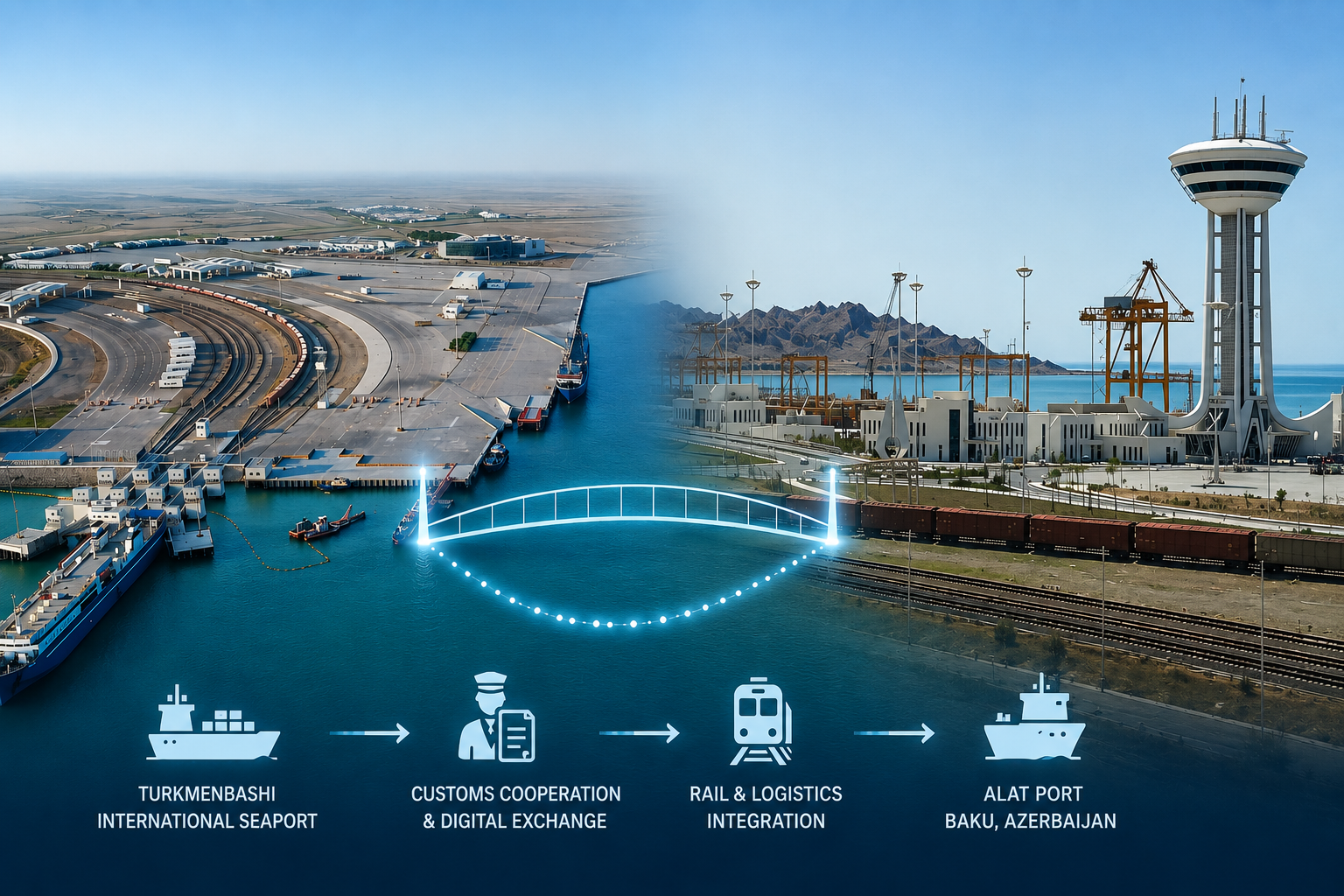
Read moreThe latest cooperation between Azerbaijan’s Alat Port and Turkmenistan’s Turkmenbashi International Seaport may appear to be a technical development involving customs procedures and cargo monitoring. In reality, it points to a much broader transformation taking place across the Caspian Sea. As trade routes between Asia and Europe are being reshaped, the ability of Azerbaijan and Turkmenistan to coordinate their ports could become one of the factors determining whether the Middle Corridor develops into a genuinely competitive Eurasian trade route.
The most important change is that the Middle Corridor is moving beyond the stage of simply building infrastructure. Railways, ports, ships and roads remain essential, but the next challenge is to make these separate elements function as one integrated logistics system.
This is particularly important for the Caspian crossing. A cargo shipment travelling from Central Asia to Europe does not care whether it is moving through the territory of Azerbaijan, Turkmenistan or another country. What matters to the cargo owner is how quickly and predictably the shipment reaches its destination. Delays at ports, repeated document checks, weak information exchange or poor coordination between transport authorities can make an otherwise modern corridor less competitive.
Azerbaijan and Turkmenistan appear increasingly aware of this challenge. In June, their customs authorities exchanged technical specifications for the initial exchange of information on goods and vehicles transported between the two countries, as well as a protocol on cooperation in customs statistics. The two sides have also discussed information technology, risk management and the organization of customs operations at seaports.
This matters because the Caspian is no longer simply a geographical obstacle between Central Asia and the South Caucasus. It is gradually becoming an integrated logistics platform. The more efficiently cargo can move between Turkmenbashi and Alat, the less the sea crossing becomes a bottleneck in the wider Europe–Asia supply chain.
The growth of Azerbaijan’s port activity demonstrates why this issue is becoming increasingly important. Baku International Sea Port handled 8.2 million tons of cargo in 2025, an 8.1 percent increase from the previous year. Transit cargo accounted for 5.59 million tons, while transit non-oil cargo reached 4.5 million tons, rising 9.1 percent. More than 62 percent of the wagons handled at the port moved on the Baku–Turkmenbashi–Baku route.
These figures show that the Turkmen route is not a secondary connection for Azerbaijan. It is already an important component of the country’s transit infrastructure.
The physical connection is also being strengthened. In May, the first dry cargo vessel, Gadamly, built in Turkmenistan for Azerbaijan Railways, arrived at Baku International Sea Port. The vessel is designed for regular container transportation between Baku and Turkmenbashi and can carry 6,100 tons of cargo or 240 twenty-foot equivalent units. A second vessel for the route is also under construction.
This combination of ships, ports, railways and customs cooperation is far more significant than any individual project. It indicates that Azerbaijan and Turkmenistan are gradually building a system in which the Caspian crossing can operate with greater predictability.
That is precisely what the Middle Corridor needs.
For years, discussions about international transport corridors have focused heavily on infrastructure capacity. But modern logistics is increasingly about coordination and digitalization as much as physical infrastructure. A port can have sufficient cranes and berths, but if customs information arrives late, cargo can still wait. A railway can have sufficient capacity, but if schedules are poorly synchronized with ships, the advantage is reduced.
The Middle Corridor therefore does not simply need more infrastructure. It needs more integration.
This is where Azerbaijan has an opportunity to move from being a transit country to becoming a logistics coordinator. The country has invested heavily in the Baku International Sea Port, the Baku–Tbilisi–Kars railway and related logistics infrastructure. Azerbaijani officials have increasingly emphasized that the Middle Corridor should function not merely as a transit route but as a platform for regional economic integration.
The Alat–Turkmenbashi connection can become one of the strongest examples of this approach. If customs procedures, cargo information, port schedules, railway operations and maritime services become increasingly synchronized, the Caspian crossing can offer something that international shippers value enormously: predictability.
That could also benefit Turkmenistan. A more efficient connection to Alat gives Turkmen cargo better access to the South Caucasus, Türkiye and European markets. For Azerbaijan, meanwhile, stronger links with Turkmenistan expand the country's role as a gateway for Central Asian trade.
The strategic significance extends beyond bilateral relations. Kazakhstan, Turkmenistan, Azerbaijan, Georgia and Türkiye are gradually creating a chain of interconnected transport infrastructure linking Central Asia with Europe. Each section of that chain must work efficiently if the whole route is to compete with alternative corridors.
The future success of the Middle Corridor will therefore depend not only on how much cargo it can carry, but on how reliably it can move that cargo.
The cooperation between Alat and Turkmenbashi should be viewed in this context. It is a relatively small step in institutional terms, but it reflects a much larger trend: the Caspian is becoming less of a barrier between Central Asia and the South Caucasus and more of a bridge connecting them.
Here we are to serve you with news right now. It does not cost much, but worth your attention.
Choose to support open, independent, quality journalism and subscribe on a monthly basis.
By subscribing to our online newspaper, you can have full digital access to all news, analysis, and much more.
You can also follow AzerNEWS on Twitter @AzerNewsAz or Facebook @AzerNewsNewspaper
Thank you!