
Azerbaijan aims to rejuvenate its white gold with new cotton scheme

Akbar Novruz
Read moreThere is no doubt that cotton in Azerbaijan carries significance far beyond its meager 2% contribution to the overall output in the agriculture sector. At a recent regional conference held in the Sabirabad District, which was tasked with implementing the decisions made by President Ilham Aliyev during the May 25 agricultural development conference, Agriculture Minister Majnun Mammadov gave the numbers behind the significance of cotton. The production and processing of cotton alone employ about 50,000 permanent and temporary employees and thus affect the lives of up to 200,000 to 300,000 people, out of a population of about 10.2 million. Given that only 6.3% of land is used for crop cultivation, this has quite a large impact on the country's economy. Historically, "white gold" (cotton) contributed around 25% of the nation's agricultural revenue. While that share has fluctuated, it remains a heavily state-subsidized, strategic pillar of the non-oil economy.
However, the global market environment surrounding such attention has been more complex than that suggested by the boom. According to the June 2026 forecast from the International Cotton Advisory Committee, global cotton area will fall 1% to 30.1 million hectares and global production to drop 2% to 25.7 million tonnes during the 2026/27 season because of poor sentiment regarding demand, rising costs and 'strategic downsizing' in China where it is expected that inefficient, water stressed areas will be retired and high productivity areas planted instead. The cost of fertilizers have increased more than 12% in Q1 of 2026 because of tensions in the Middle East and the disruptions of global supply chains as a result of issues at the Hormuz Strait. The price of the Cotlook A index for the 2025/26 crop season from ICAC is forecasted to remain between 73 and 84 cents per pound, with an average of 78 cents per pound.
The honest starting point for any assessment of Azerbaijan's cotton sector is that it has, for most of the past decade, underdelivered against its own ambitions. According to the State Programme for the Development of Cotton Growing 2017–2022, the goal of 500,000 tonnes of yearly production was established.
This objective was not fulfilled. Declining yields due to climatic factors from 2022 to 2024 further exacerbated this situation. As a result, the production figures remained significantly behind not only those achieved during the era of the Soviet Union (when Azerbaijan produced over 800,000 tonnes of cotton per year and was considered one of the main cotton-growing republics in the USSR), but also behind the objectives it had outlined recently. Only 2025 was the year when a breakthrough was finally achieved.
The new State Programme for 2026-2030 defines much more targeted targets: 50 centners per hectare (almost 40 percent up from 2025's 36.1 centners), a 17% increase in production, and, most importantly, an increase in processing capability four times over. And the latter is the number that deserves attention because it signals a structural change in priorities: from increasing the output of cotton to increasing the value extracted from existing cotton crops. At present, Azerbaijan produces far more raw and partly processed cotton than textiles: 114,300 tonnes of raw cotton in 2025 compared to 15,100 tonnes of yarn and 12.8 million metres of fabric. It is obvious what economic forces lie behind this disparity: raw cotton fiber is worth substantially less than yarn, cloth, and clothes.
Production vs processing
Out of all the stages of cotton's production chain, raw cotton and yarn show the biggest gap deficit in terms of value capture. Both fabric and garments show the highest value-add in the finished product.
The difference between the quantity of raw fibre exported (114,300 tons) and the amount of yarn exported (15,100 tons) demonstrates exactly the problem that the four-fold increase in processing ability aims to address. While one ton of raw cotton fibre at the present rate of procurement ($470 per ton - 800 manat) provides only a part of the revenues one ton can provide when turned into yarn, fabric, and garments. Deputy Minister of Economy Samad Bashirli's statements made at the Sabirabad conference, about aiming to "extend the domestic value chain" by establishing yarn, fabric, and textile production capacities, represent an economic policy that Azerbaijan was slower than its neighbors, such as Uzbekistan and Türkiye, to adopt.
Investment
Uzbekistan is leading with its advanced textile initiatives, including a significant agreement signed in July 2024 for cultivation and cottonseed oil production at the Imishli Agropark, along with a commitment of $54.4 million for yarn, textile, and garment facilities in Mingachevir Industrial Park, set to take place between 2025 and 2029. Notably, a garment factory is already operational in Khankendi, creating over 200 jobs as the first major textile investment in the liberated territories.
In Türkiye, the TÜİB (Turkish-Azerbaijani Businessmen and Industrialists Public Union) Karabakh Project anticipates generating between 5,000 and 10,000 jobs as the Turkish-Azerbaijani Businessmen and Industrialists Public Union drives a large textile manufacturing expansion in the Karabakh region, aiming to be one of the largest employment drivers in the post-conflict reconstruction efforts.
Meanwhile, in China, Chinese agricultural techniques have already been implemented in the Ujar District and the Shirvan Experimental Station, with expectations of future investments in Azerbaijani textile manufacturing, though these have not yet matched the scale of commitments from Uzbekistan or Türkiye. Lastly, early-stage discussions are ongoing with the UAE and India, as AZPROMO confirmed at the 5th Agribusiness Development Forum in May 2026, covering plans for a fully integrated production chain from cultivation to textile manufacturing, though no contracted figures have been disclosed yet.
If the renaissance of cotton production in Azerbaijan is timely or not is largely determined by the relative weight of ICAC forecast used, but even the forecasts provided by the committee itself have changed their meaning in the last several months, from a projection for a 4% reduction in production in March/April to a milder 2% contraction by June along with price ranges that have not fallen off the face of the map and still remain in the 73-84 cent range without drastic falls or rises. The market that Azerbaijan is returning back to is one that slowly finds its equilibrium and does not undergo a sudden shortage crisis, certainly not as exciting as the shortage explanation, but much more beneficial than prices of 60 cents and below in mid-2025.
Rather, the key issue becomes whether, by the time the next price cycle comes around, the processing capacity, the contract farming reform, and the irrigation infrastructure development have been done on an adequate scale. This is because the fourfold increase in processing capacity, if realized, will allow Azerbaijani cotton producers and processors to protect themselves from much of the commodity price fluctuations which have characterized this sector in the recent past. In other words, it will provide greater security from whatever the Cotlook cotton price happens to be during each particular season, as they add value along the chain. This, rather than the favorable harvest experienced this year, will form the criterion on which the State Programme for 2026-2030 will be judged.
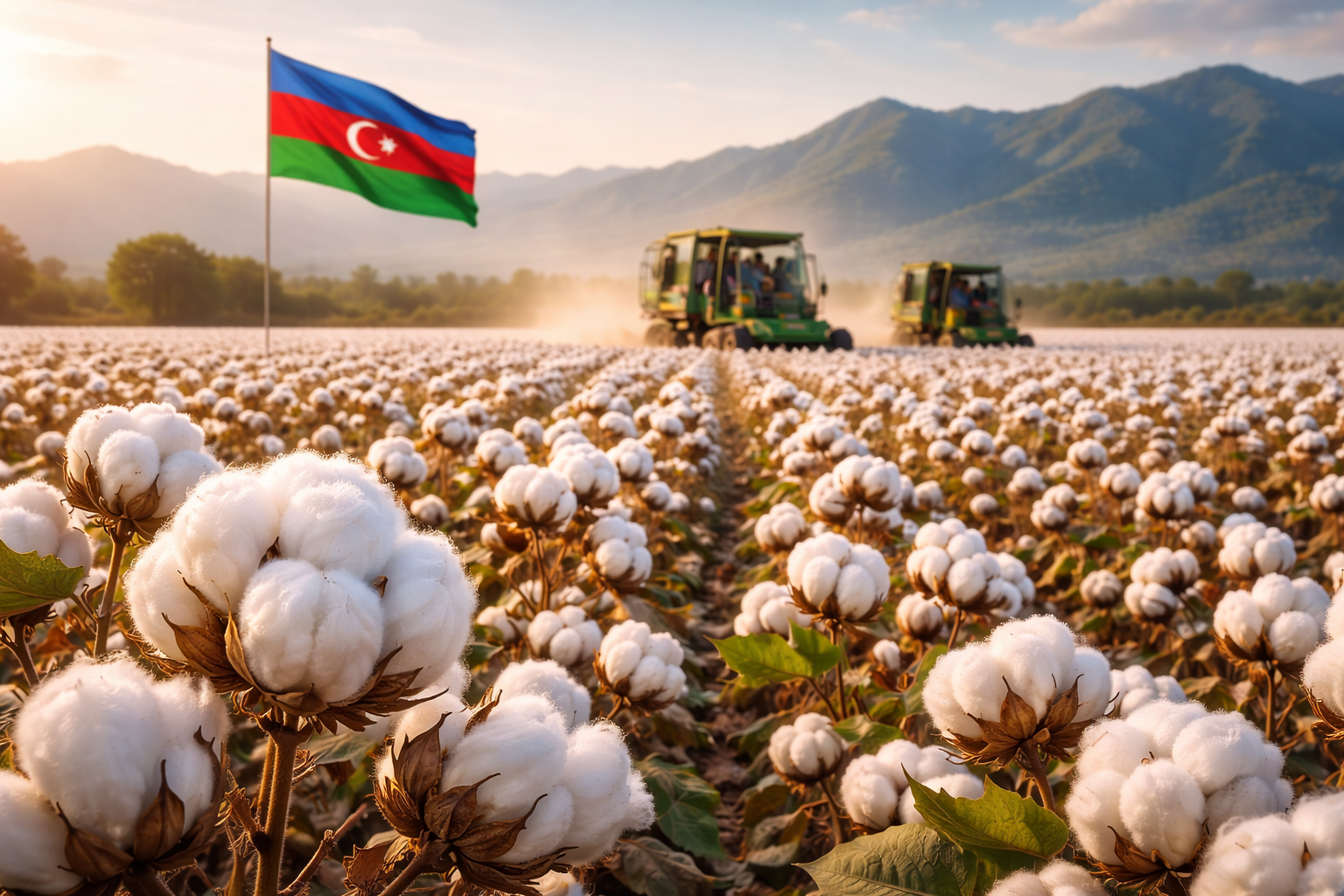
*image generated with AI
Here we are to serve you with news right now. It does not cost much, but worth your attention.
Choose to support open, independent, quality journalism and subscribe on a monthly basis.
By subscribing to our online newspaper, you can have full digital access to all news, analysis, and much more.
You can also follow AzerNEWS on Twitter @AzerNewsAz or Facebook @AzerNewsNewspaper
Thank you!