
Azerbaijani top official: Situation will change if Armenia agrees upon proposals
By Aynur Jafarova
Armenia differently perceives the calls for peace made by the co-chairmen of the OSCE Minsk Group, other representatives and leaders of countries, head of the Azerbaijani Presidential Administration's Political Analysis and Information Provision Department Elnur Aslanov believes.
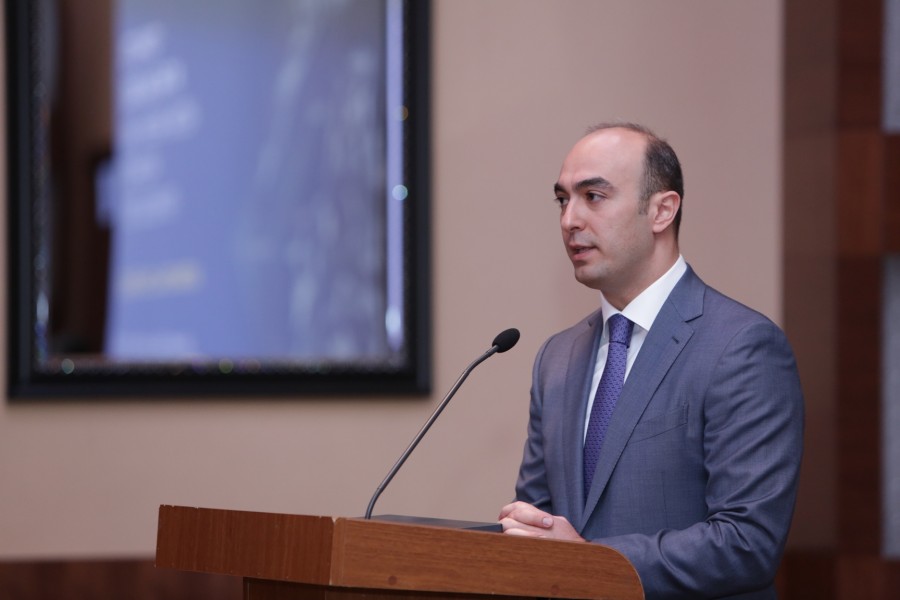
Speaking at the international conference on "Conflicts in the Caucasus: History, Present and Prospects for Settlement" on Monday, Aslanov said that Azerbaijani territory has been occupied by Armenia for over 20 years.
"The UN Security Council's resolutions on the liberation of Azerbaijani territories by Armenian forces have not been fulfilled for more than 20 years. This is Armenia's attitude to the UN Security Council's resolutions, international law, justice, and in particular, politics in the region. This policy differs with destructiveness and it could turn into one of the factors contributing to the socio-economic decline of the South Caucasus," he said.
"Despite all these difficulties, Azerbaijan has done much for 20 years of its development," he added.
"Today, Azerbaijan's military budget is more than Armenia's total budget," Aslanov said. "Today, Armenia's economic situation is characterized by the fact that around 100,000 people leave the country annually. Armenia's current economic situation is similar to that of early 1990s. This is a result of the destructive policy conducted by state leaders in connection with the conflict, the policy as a result of which millions of people in the region live as refugees."
If more than one million are refugees and internally displaced persons, then more than one million people are living in a very difficult and deplorable socio-economic situation in Armenia, Aslanov said.
"No end is in sight. The end can be put when Armenia withdraws its troops from Nagorno-Karabakh and the surrounding occupied regions, when it frees the Azerbaijani territories and directs the current policy to the restoration of peace, stability and tranquility in the region. Unfortunately, we do not see this," he said.
According to Aslanov, if Armenia agreed upon the proposals and had not understood the calls for peace as tightening the status quo, the situation would change greatly.
"But, unfortunately, Armenia differently perceives the calls for peace made by the co-chairmen of the OSCE Minsk Group, other representatives and heads of the countries," he said. "Armenia sees this as an extension of the status quo, as a continuation of the current situation and believes that the calls for peace mean that Azerbaijan will not resort to other options, though international law and other principles give us a chance at any time to use other possibilities to return back the Azerbaijani territories."
Armenia occupied over 20 percent of Azerbaijan's internationally recognized territory, including Nagorno-Karabakh and seven adjacent regions, after laying territorial claims against its South Caucasus neighbor that had caused a lengthy war in the early 1990s. The UN Security Council has adopted four resolutions on Armenia's withdrawal from the Azerbaijani territory, but they have not been enforced to this day.
The international conference, "Conflicts in the Caucasus: History, Present and Prospects for Settlement", was organized by the Center for Strategic Studies under the President of Azerbaijan and the Caucasus Center for Strategic Studies with support of the Georgian Foundation for Strategic and International Studies and the Caucasus Development Fund of Georgia.
Besides Elnur Aslanov, head of the Institute of Strategic Studies of the Caucasus Eldar Ismailov, director of the South Caucasus Regional Security Institute Aleksandr Rusetski, editor-in-chief of the Caucasus and Globalization journal Nazim Muzaffarli as well as head of the Center for Strategic Studies under the President of Azerbaijan Farhad Mammadov made speeches at the event.
The conference was attended by 60 officials, diplomats, scientists and experts from 20 countries.
Here we are to serve you with news right now. It does not cost much, but worth your attention.
Choose to support open, independent, quality journalism and subscribe on a monthly basis.
By subscribing to our online newspaper, you can have full digital access to all news, analysis, and much more.
You can also follow AzerNEWS on Twitter @AzerNewsAz or Facebook @AzerNewsNewspaper
Thank you!