
Russia's diesel ban reveals Armenia's energy security dilemma

Akbar Novruz
Read moreAt a televised government meeting chaired by President Putin on Wednesday morning, Russian Deputy Prime Minister Alexander Novak delivered the announcement that Yerevan had been quietly dreading for weeks. The Russian government has put a total ban on all diesel exports, to take immediate effect until July 31, as Ukraine's systematic bombing of Russian oil refineries via drones has slowed down crude-processing rates to their lowest point in several years, creating long queues at petrol stations throughout the country. To the rest of the world, this news is just another energy market story. European diesel margins reached an all-time high of $60.17 per barrel following the news, while Iran's war has already squeezed the same global barrel pool from the other side. But for Armenia, this is more of a crisis: 150,000 out of 180,000 tonnes of Armenia's imported diesel come from Russia, and the country has no refineries, oil wells of its own, and no viable alternatives it could exploit.
The fuel crisis in Russia of 2025–2026 started in August 2025 after an increase in the number of Ukrainian drone attacks on Russian oil refineries, which led to damage to the infrastructure and a decrease in the production of refined products within the Russian oil sector. In June 2026, the fuel crisis developed to such an extent that a state of emergency was declared in Crimea, where it became impossible to buy fuel products. Gasoline exports were banned in April 2026 for the first time. Today's diesel export ban is the final stage in a process that has been evident for months to those who have been observing the numbers of Ukraine's drone strikes. In just the first six months of 2026, Ukraine has conducted no less than 194 attacks on Russian oil refineries compared to only 17 in the corresponding period last year.
The Armenian government has not been unaware of the risk. Prior to the June 7 parliamentary elections in Armenia, PM Pashinyan openly stated that his trip to Moscow would promptly solve the export problems, in part, those related to potential fuel shortages. His trip to Yekaterinburg on July 6 for an international industrial exposition, in the view of the Armenian newspaper Hraparak, has yielded no breakthrough results. As the newspaper says, the products of the delegation “do not correspond to our market”, which means a political message rather than an economic evaluation. In Armenian paper Hraparak's piece, the position of the Kremlin is that it insists that Armenia make a choice between TRIPP/EU integration and Russian economic cooperation. And here comes the diesel ban.
But are the options of Yerevan that dire?
Armenia's dependence on external fuel sources effectively makes it vulnerable to economic and political developments in other countries. Restrictions on exports from the afore-mentioned Russia, aimed at protecting its domestic market, create significant uncertainty regarding fuel supplies for Yerevan. The alternatives available to Armenia are quite limited. Although Iran has been viewed as the second main supplier for many years, international sanctions against the country and the risk of potential military escalations in the region render this option unreliable. Other possibilities, such as imports from Romania, Bulgaria, Greece, and the UAE, cannot substitute for Russian supplies due to high logistics costs and limited availability.
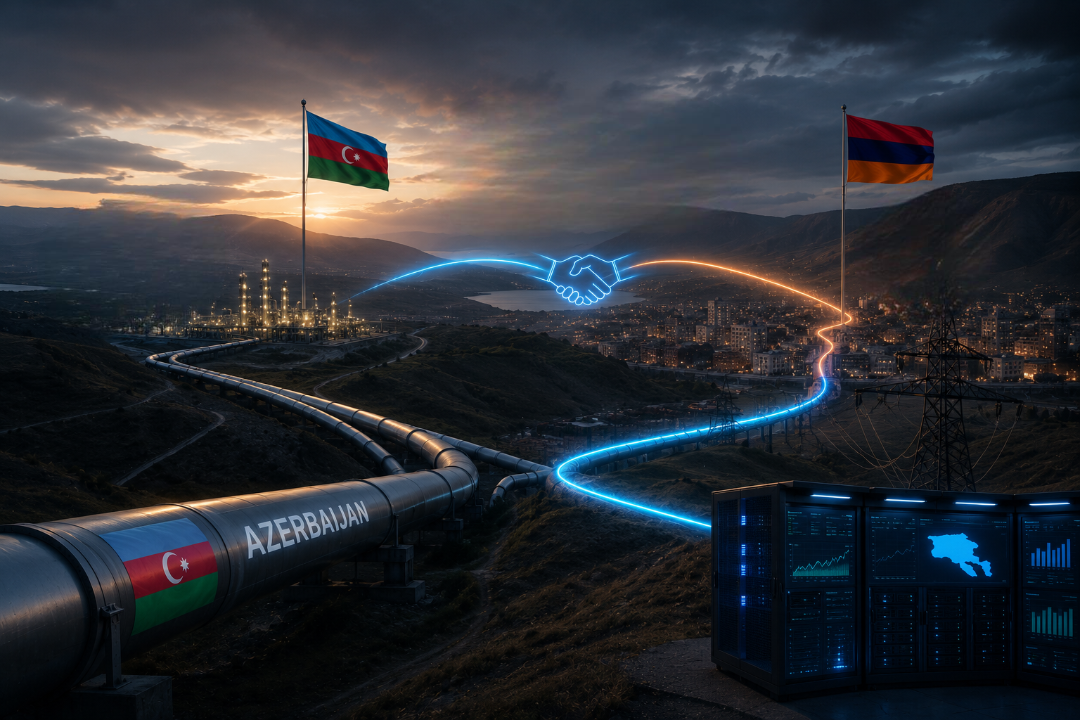
The element that lends special credence to the Azerbaijani alternative today is a logistical point dating back seven months. As far back as December 18, 2025, Azerbaijan made its first export of automotive fuel to Armenia since the war ended between the two countries. Before this, Azerbaijan had allowed cargo from Russia and Kazakhstan to pass through its territory and be delivered to Armenia, a goodwill gesture that preceded any official peace process. In the seven months since then, more than 13,000 tonnes of diesel, as well as over 4,000 tonnes of AI-92 and AI-95 gasoline, have been delivered. This is a small amount compared to the 150,000 tonnes of fuel Armenia had imported from Russia per year. However, what these figures represent is a supply chain that works and a relationship that has endured the shift from confrontation to commerce.
The key benefit for Azerbaijan is not cost but the fact that its refinery capacity through SOCAR, including the two Italian refineries added in May 2026 via the purchase of Italiana Petroli, provides the volume-production infrastructure, should the commercial terms be favourable. However, the key benefits are geographic location and the direction of political development, as well as the economists' concept of switching costs. The distance between Azerbaijan and Armenia is shorter than any European alternative. The relation between Baku and Yerevan, despite being burdened by two wars, is developing within a formal diplomatic framework - from the Washington declaration of peace to the recent visit of Hajiyev and Grigoryan in Dilijan and the planned next meeting in Azerbaijan. In the current case, fuel delivery and the process of establishing peace are one issue: each tonne of Azerbaijan diesel delivered to Yerevan is an element of the process of normalising relations initiated by both countries.
According to Bloomberg and Vortexa, Russia accounted for around 11% of global diesel in 2025. The ban starting from July 8 until July 31 is a one-month emergency situation defined as a domestic stabilisation measure. However, the underlying factors leading to this situation are not going to resolve themselves in one month. 21 out of Russia's 38 big refineries have been affected since January 2025; the drone campaign from Ukraine does not seem to end any time soon; and at the same time, Russia is lowering the quality of fuel (Euro-5 down to Euro-3), importing fuels from India and Asia, and even considering supplies from Belarus and Kazakhstan to satisfy their internal needs. A country that imports fuel in order to keep its internal market running cannot be a structural supplier of 83% of the Armenian market.
The July 31 expiry date is unlikely to be the end of the story. As long as the intense exchanges of skirmishes continue, this supports the fact. Even if the ban expires, the actual problem of reduced Russian refining capabilities will remain, and Moscow will now have shown that it is prepared to limit its exports to meet its own needs, irrespective of the costs this move will have on economies such as Armenia that don’t have any alternative options.
For Yerevan, this decision marks the most unambiguous warning that the energy dependence issue that Pashinyan has been cautiously balancing on the sidelines of his Western course can no longer be postponed indefinitely. Armenian-Azerbaijani peace talks, TRIPP route, BTK railway negotiations, all of this should not be limited to 'tool of diplomacy', but also about the infrastructure of energy security diversification. Every step in the direction of Baku means simultaneously taking a step further away from the supplier that today has warned the market of its inability to provide its consumers even at home.
Here we are to serve you with news right now. It does not cost much, but worth your attention.
Choose to support open, independent, quality journalism and subscribe on a monthly basis.
By subscribing to our online newspaper, you can have full digital access to all news, analysis, and much more.
You can also follow AzerNEWS on Twitter @AzerNewsAz or Facebook @AzerNewsNewspaper
Thank you!