
Iran's weapons in Armenia reveal a strategy, not a friendship

Akbar Novruz
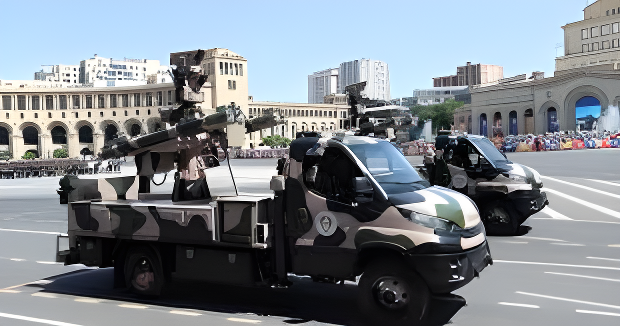
Read moreMilitary parades are designed to communicate. When Armenia staged its first such display in a decade on May 28th in Yerevan's Republic Square, the message was deliberately polyglot with howitzers manufactured by France, rockets manufactured by India, drones by China, and missiles by Greece all passing by in a parade designed to emphasize their purchases following Russia's decision to stop selling them weapons, one thing in particular stood out within those purchases made from countries in the vicinity of NATO: The AD-08 Majid, an Iranian air-defence system mounted onto trucks by Iran's Defense Industries Organization.
The Armenian government did not disclose any information about the system’s origins and introduced it under the Armenian name of “Scorpion.” Around four pieces of the system had already been identified by open sources through videos released three days earlier. The timing could not have been more appropriate. It was taking place just hours after US President Donald Trump gave his endorsement to the Armenian Prime Minister Nikol Pashinyan in the lead-up to parliamentary elections scheduled for June 7th, and after visiting the capital by Secretary of State Marco Rubio.
This was no fluke. According to reports from Iran International, a Persian news station, in July of 2024, the governments of Tehran and Yerevan signed an undisclosed arms deal worth an estimated $500 million in contracts split between them and completed by the first half of the year. The details for this contract came from a military officer in the Middle East region, detailing a wide array of weapons that included Shahed-series drones, Mohajer reconnaissance drones, and several air-defense missile systems like the Majid, 3rd Khordad, and Arman. While Armenia denied the allegations, Iran did not offer a statement at all. This denial has since grown stale, and the deployment of the Majid is confirmation enough.
According to reports, the deal went further than just the hardware deal. Co-operation in intelligence gathering, joint training exercises, military training by Iranian personnel, and, most importantly, the establishment of Iranian bases within Armenian territory were also included in the deal. The cost of the deal was also quite substantial, amounting to about a third of the total $1.4bn cost of the whole year’s military expenditure for the year 2024. The exact means of paying the costs of the deal were also uncertain, although deferred payments would most probably have been employed.
Iranian hardware reportedly covered under the 2024 arms agreement
- Shahed-136, Shahed-129, Shahed-197 and Mohajer drones
- AD-08 Majid short-range air-defence system (now confirmed, parade 2026)
- 3rd Khordad, 15th Khordad and Arman air-defence missile systems
- Intelligence sharing, joint training and military instructor deployment
- Possible establishment of Iranian military bases on Armenian territory
The perpetual patron
Well, the support from Iran for Armenia is not new actually. While in the 2020 44-day war, where the Azerbaijani forces, armed with Israeli kamikaze aircraft and Turkish Bayraktars, have managed to liberate territories occupied by Armenians for almost 30 years, the backing from Iran was both diplomatic and material. According to Robert Kocharyan, the former Armenian president and the current pro-Russian opposition candidate on the upcoming elections, it was only Iran that allowed airspace for weapons transportation into Armenia, the only country in this regard, during that war. This, as Kocharyan tried to showcase the loyalty of Russia, inadvertently proved the same about Iran.
This trend had been observed both prior to and during the war. During the period when the Armenians occupied Azerbaijani territories, Iran continued to have economic contacts with the occupying authorities, serving as a trade link that involved the transit of fuel and other products, as well as a market for the natural resources stolen from the seized territory, according to reports from Azerbaijan. As reported by Azerbaijani news outlets in 2022, the passports of 27 Iranians, who entered the town of Khankendi, the then capital of the Armenian-occupied Karabakh region, were made public, but their intentions have never been explained by Tehran. In the period of actual war in 2020, Iran conducted military exercises near the border with Azerbaijan, and warned that it could not accept any changes to borders in the region, which, despite its diplomatic phrasing, was an act of signaling against any further advances by Azerbaijan. This did not have any reciprocation. During the period when Iran itself was fighting a war, Azerbaijan gave aid to Iran, and even helped diplomatically.
The key factors that would explain why Iran consistently supports Armenia are geography and transit economics, not the bond between Shiites and Iran, because Iran actually has a significant Azerbaijani minority and shares a greater land border with Azerbaijan than Armenia does. The answer is much simpler: it lies in what a dominant and connected Azerbaijan would mean for Iran, namely, the Zangezur Corridor.
The corridor, the suggested route of transport passage from mainland Azerbaijan through the Armenian province of Syunik and further to Türkiye, was outlined in the August 2025 deal on peace between the warring nations, brokered by the U.S. President Donald Trump, who termed it the "Trump Route for International Peace and Prosperity" and granted America the right to develop the route for 99 years. The reaction of Iran to these plans could not have been slower, although it was fierce and strong. Tehran perhaps, would not "overlook" such actions. Representatives of Iran's Foreign Ministry stated their concern about the possible presence of "extra-regional actors" (which means Washington) in the security matters of South Caucasus. What makes such concerns legitimate, however, is the fact that in case the Zangezur Corridor starts to function, the land passage from Baku to Ankara will be free from passing through Iran's territory, thus depriving the latter of some revenues from such passages.
The arming of Armenia may be seen from this perspective more as a safety measure than as one of support, a means by which to keep one’s neighbor weak and dependent, such that any effort at regional connectivity can succeed only with the blessing of Iran. This has been a policy adopted in the past by Tehran in relation to Armenia, even when it was governed by a pro-Russian regime, and continues to be practiced today while under a Western-leaning leadership.
The sight of Iranian missile batteries being displayed on Yerevan parade ground is awkward, but then again, there is a method to Pashinyan’s madness. The Armenian military buildup since the end of 2020 has revolved around one and only one priority, which is making sure that Armenia will not find itself as easy prey for drone and guided weapons attacks again. To achieve this, Armenia had to procure advanced air defense batteries from any source willing to sell them. France, India, Greece, and China have sold those air defense batteries to Armenia. It seems that so did Iran, with its unique Majid air defense battery.
The willingness of Washington to accept such an approach is another matter altogether. Obtaining technology from a nation that faces all-encompassing sanctions from the US, especially when the deal entails Iran gaining access to facilities within Armenian territory, seems to be at odds with America’s growing fondness for the regime in power, evidenced by its signing of official documents and Rubio’s visit, as well as Trump’s approval.
For its part, Iran has shown that its Caucasus strategy can endure a change of regimes in Yerevan as well as in Tehran. It supported Armenia during the time Kocharyan headed the state, and continues to do so today under Pashinyan’s leadership. Likewise, it did so when Raisi headed Iran, and has maintained such an approach after him. Iran's calculation should not be identified only as ideological or emotional. It is geographical, economic, and has a long-term view, because of the corridor that it simply cannot allow to open up, and the neighbor which it simply cannot allow to become too powerful.
Here we are to serve you with news right now. It does not cost much, but worth your attention.
Choose to support open, independent, quality journalism and subscribe on a monthly basis.
By subscribing to our online newspaper, you can have full digital access to all news, analysis, and much more.
You can also follow AzerNEWS on Twitter @AzerNewsAz or Facebook @AzerNewsNewspaper
Thank you!