
Azerbaijan seeks bigger role in Asia-Europe trade as SCO corridors expand

Ulviyya Poladova
Read moreAs the Shanghai Cooperation Organisation (SCO) summit is being held in Bishkek on August 31–September 1, transport and connectivity are again in focus. The summit, which marks the SCO’s 25th anniversary, is expected to address a broad range of economic and regional cooperation priorities, including transport and infrastructure.
In the modern world, a country’s international standing is determined not only by the size of its territory, population and economy. It is determined by its geographical location, ability to influence regional processes, and position along transport and communication routes connecting different economic regions, which are also key factors shaping its strategic importance. At a time when global economic activity is increasingly shifting toward Asia, and new transport and energy routes are gaining geopolitical importance alongside their economic value, the role of countries linking major regions is becoming even more significant.
Azerbaijan is one of the countries with such a strategic position. Located at the crossroads of Europe and Asia and with access to the Caspian Sea, Azerbaijan has developed modern transport infrastructure that enables it to serve as an important link between Central Asia, the South Caucasus, Türkiye and Europe. The country’s growing position in the international system in recent years has also been accompanied by efforts to make more effective use of these advantages.
The main strength of the Shanghai Cooperation Organisation (SCO) lies in its demographic and economic scale. The organisation includes China and India, two of the world’s largest population and consumer markets. Russia, Pakistan and Iran also have large populations and sizeable domestic markets. This represents not only significant consumer potential, but also a vast labour force, industrial capacity and a broad base for future economic growth. The nominal GDP of China, at around $19.5 trillion, India at $3.96 trillion, and Russia at $2.56 trillion, clearly demonstrates the economic scale of the SCO space. The rapid development of Central Asian economies such as Kazakhstan and Uzbekistan further adds to this picture.
For Azerbaijan, this space is important in terms of existing trade ties, as well as opportunities to expand transport, logistics, investment, industrial and energy cooperation. However, Azerbaijan’s main advantage is not its ability to compete with SCO members in terms of economic scale, but rather its capacity to connect this vast economic space with broader Eurasian markets.
The same logic applies to transport. The SCO space covers a large part of the major land transport routes running from east to west and from north to south. Expanding links between China and Central Asia’s production and trade centres, Russia, Iran and India, the Caspian region and Western markets is creating new logistics opportunities.
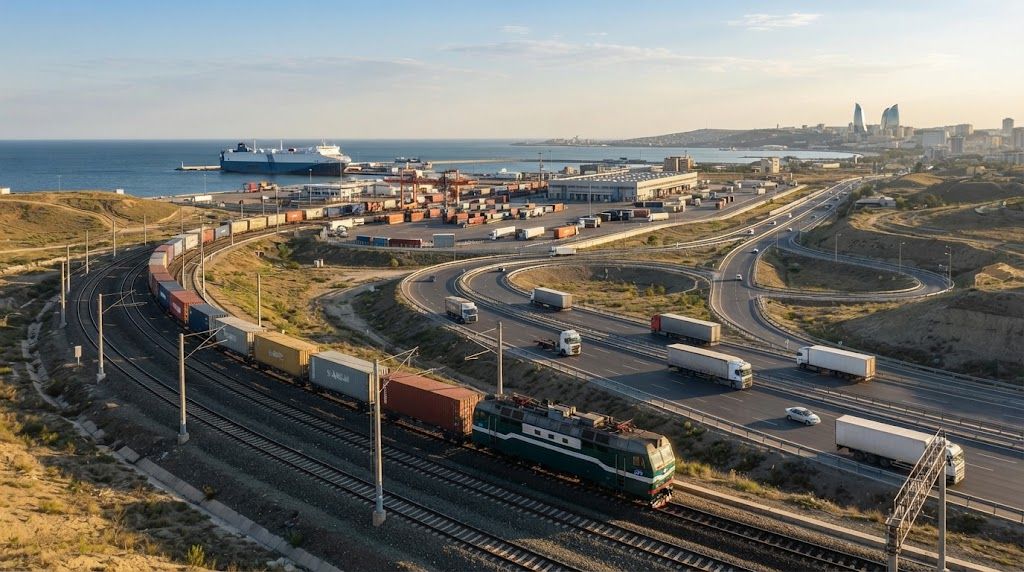
Azerbaijan occupies a particularly important position on this map. The country lies at the intersection of the East-West and North-South transport routes. The Port of Baku, the Baku-Tbilisi-Kars railway, the Middle Corridor and the North-South International Transport Corridor provide connections in different directions. The first phase of the Port of Baku has an annual cargo handling capacity of 15 million tons and 100,000 TEUs, while plans to increase this capacity to 25 million tons and 500,000 TEUs could further strengthen Azerbaijan’s role in the region’s transport network.
Cooperation within the Shanghai Cooperation Organization (SCO) has significant potential to contribute to the development of transport corridors connecting China with Europe, according to Alper Özel, Chairman of the Executive Board of Türkiye’s International Transporters’ Association (UND).
Commenting on this issue for AzerNEWS, Özel noted that the SCO framework could create additional opportunities for strengthening transport links between China, Central Asia, the Caspian Sea, Azerbaijan, Türkiye and European markets.
"Political dialogue between countries, the facilitation of customs procedures, digitalization and the harmonization of transport infrastructure can contribute to increasing cargo flows," Özel said.
However, he emphasized that political will alone would not be sufficient to ensure the sustainable growth of the Middle Corridor. "For the corridor to grow in real terms, border crossings must be accelerated, transit costs, which are currently high, must be reduced, and a predictable and regular transport capacity must be established along the entire route," he stressed.
According to Özel, strengthening transport links between China, Central Asia and the South Caucasus would further increase Azerbaijan’s logistical importance.
He noted that Azerbaijan’s geographical position makes it a critical link connecting the Caspian Sea with Türkiye and European markets. In this regard, the Baku-Alat Port, as well as the country’s railway and road connections, provide important advantages. At the same time, Özel emphasized that Azerbaijan’s role should extend beyond that of a transit country.
"For Azerbaijan to become a genuine regional logistics hub, it is necessary to increase vessel capacity in the Caspian Sea, accelerate port operations, establish regular services and reduce waiting times for cargo," he noted.
Özel also cautioned that growing demand for freight transportation does not automatically translate into improved corridor performance.
Touching upon cooperation between Azerbaijan and Türkiye, Özel noted that bilateral transport cooperation is one of the determining factors for the competitiveness of the Middle Corridor. He stressed that road, rail and Caspian connections between the two countries should be addressed as an integrated system.
According to Özel, increasing the capacity of the Baku-Tbilisi-Kars railway, digitalizing customs and transit procedures, and putting new connections into operation could significantly strengthen the corridor. However, he pointed out that competition for China-Europe freight is not determined by distance alone.
An expert also added that removing bottlenecks, particularly those associated with the Caspian Sea crossing, is critical for the Middle Corridor to compete with alternative routes, including the Northern Corridor and maritime routes.
Further to comments, an expert, Natig Mammadov, said that Azerbaijan has the potential to become an important logistics bridge between the countries of the Shanghai Cooperation Organisation (SCO) and European markets. According to Mammadov, Azerbaijan is already emerging as one of the important transport and logistics hubs of Eurasia, benefiting from its geographical position at the intersection of major East-West and North-South routes. However, he noted that geography and infrastructure alone are not enough.
Mammadov noted that the SCO economic space includes some of the world's largest production, energy and consumer markets. China is a major global manufacturing centre, while Kazakhstan and other Central Asian countries have substantial natural resources and growing trade volumes. In this environment, Azerbaijan can serve as a connecting link between the expanding economies of Asia and European markets.
The Baku International Sea Trade Port in Alat is central to this strategy. Cargo arriving from Kazakhstan and other Central Asian countries can cross the Caspian Sea, enter Azerbaijan and continue by rail or road toward Georgia and Türkiye before reaching Europe. But Mammadov stressed that Alat should not be viewed simply as a port.
"Alat has the potential to become not merely a port but a major international logistics centre," he said, pointing to the need for further development of storage, cargo processing, container handling and other logistics services.
The Caspian Sea remains one of the most difficult sections of the Middle Corridor. Unlike a conventional rail route, cargo travelling through the corridor must change modes of transportation when crossing the Caspian. Goods arriving by rail must be transferred to vessels and then transferred again to rail or road transport after reaching Azerbaijan. Every additional transfer brings extra costs and creates another opportunity for delays.
Mammadov said expanding the maritime side of the corridor should therefore be one of Azerbaijan’s main priorities. This includes increasing the capacity of the Port of Alat, expanding container terminals and storage facilities, and introducing more modern cargo-handling systems. He also highlighted the need to increase the number of ferries and specialised container vessels operating between Kazakhstan and Azerbaijan.
"Modern ports alone are not sufficient if vessels arrive irregularly or cargo has to wait several days for departure," the expert said.
In his view, more predictable maritime connections, stable schedules and a unified cargo booking system would significantly reduce waiting times and make the route more attractive to Chinese exporters and international logistics companies.
Mammadov believes China is likely to increase its use of the Middle Corridor in the coming years, although he cautioned against expecting it to replace existing China-Europe routes.
"The more realistic scenario is that the Middle Corridor will become an important additional and strategically significant transport route," he said.
Looking ahead, Mammadov expects several developments to shape the Middle Corridor over the next three to five years. He pointed to an increase in Chinese transit through Central Asia and across the Caspian Sea, a stronger role for Azerbaijan as the principal transit hub on the western shore of the Caspian, and further growth in container transportation along the Alat-Georgia-Türkiye-Europe route.
He also expects the Middle Corridor to gradually move from being viewed as an alternative route to becoming a permanent part of the broader China-Europe logistics network. Still, he stressed that the corridor should not be seen as a replacement for maritime transportation or other established routes. Rather, China is likely to pursue a multi-route strategy, choosing between corridors according to cargo type, price, delivery time and geopolitical conditions. For Azerbaijan, this creates a significant strategic opportunity.
The bigger prize is to turn transit into a full-scale logistics industry - and ultimately transform Azerbaijan from a transit country into one of the key trade and logistics hubs linking the fast-growing economies of Asia with European markets.
Here we are to serve you with news right now. It does not cost much, but worth your attention.
Choose to support open, independent, quality journalism and subscribe on a monthly basis.
By subscribing to our online newspaper, you can have full digital access to all news, analysis, and much more.
You can also follow AzerNEWS on Twitter @AzerNewsAz or Facebook @AzerNewsNewspaper
Thank you!