
SOCAR’s Uzbekistan venture marks its shift from national champion to global operator

Qabil Ashirov
Read moreThe burgeoning strategic alliance between Azerbaijan and Uzbekistan has rapidly evolved from traditional diplomatic goodwill into one of the most consequential economic and geopolitical partnerships in modern Eurasia. Bound by a shared Turkic heritage, mutual geopolitical alignment, and a common vision for trans-Caspian connectivity, Baku and Tashkent are actively constructing an economic axis designed to bridge the South Caucasus directly with Central Asia. At the very core of this bilateral synergy lies energy co-development, a strategic pillar that not only promises to transform both domestic economies, but also provides the foundational platform for Azerbaijan’s broader global energy ambitions.
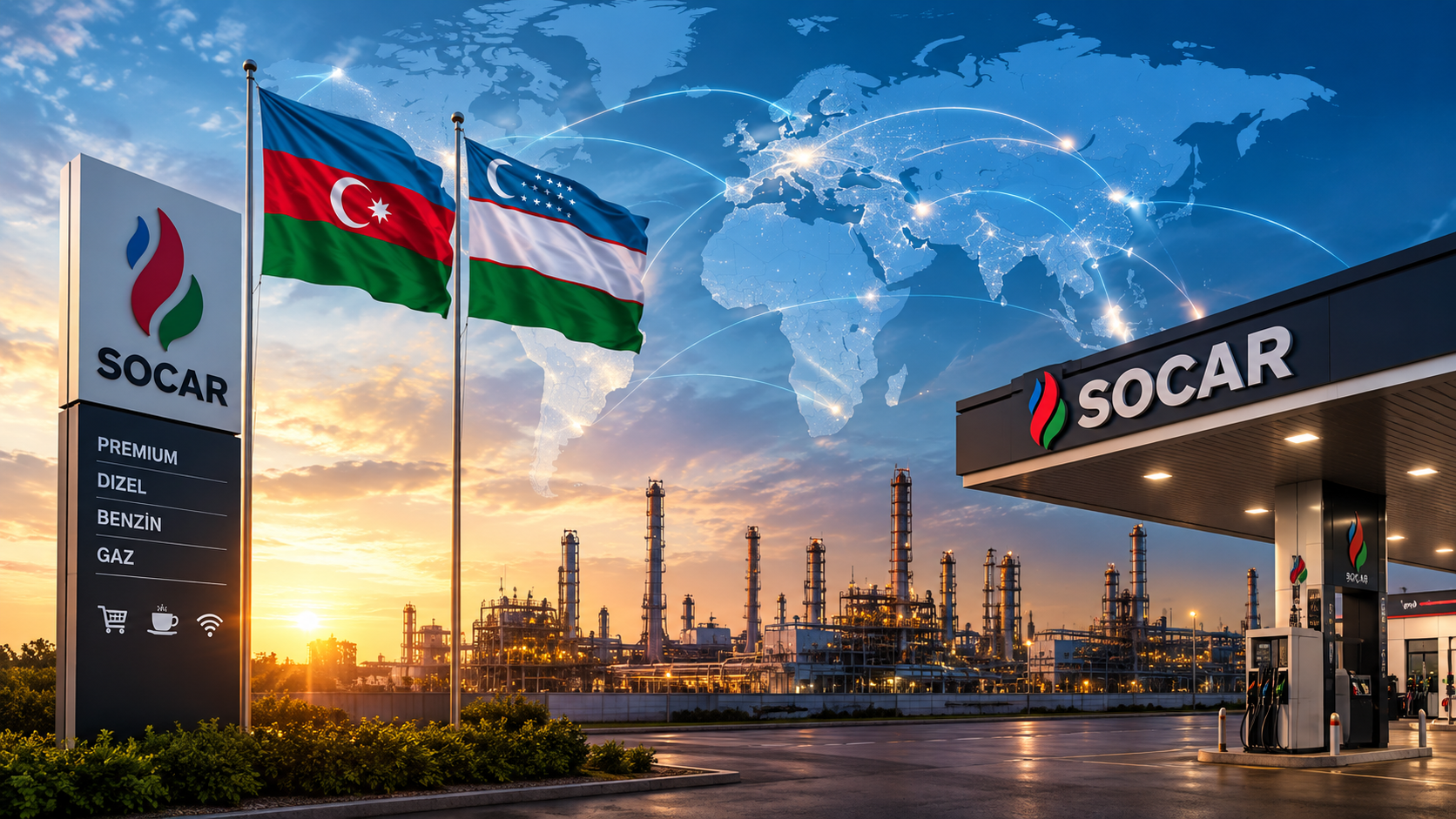
The centerpiece of this deepening bilateral relationship is the State Oil Company of the Republic of Azerbaijan’s (SOCAR) ambitious entry into Uzbekistan’s upstream sector. Under a landmark Production Sharing Agreement (PSA) executed alongside Uzbekneftegaz, SOCAR has officially assumed the role of operator to explore and develop six investment blocks across the resource-rich Ustyurt Plateau. Backed by an estimated $2 billion investment footprint, the project targets reserves of up to 100 million tons of oil and 35 billion cubic meters of natural gas.
This venture offers profound mutual advantages for both nations. For Uzbekistan, bringing in Azerbaijani technical teams allows Tashkent to leverage decades of Caspian deep-reservoir engineering expertise to unlock unexploited reserves, modernize local extraction infrastructure, and satisfy rising domestic industrial demand. For Azerbaijan, securing a major operational foothold in the Ustyurt basin reinforces its economic footprint in Central Asia while creating long-term commercial synergies. Crucially, as these Central Asian assets mature, they naturally strengthen the volume and viability of the Middle Corridor, consolidating Azerbaijan’s position as the primary transit and logistics bridge connecting Eurasian energy flows to global markets.
Yet, SOCAR’s expansion into Uzbekistan represents far more than a successful bilateral commercial deal. It marks a historic turning point in the institutional evolution of Azerbaijan’s state oil enterprise. For an entire generation, SOCAR was viewed primarily as a domestic steward—responsible for managing the Caspian Sea’s offshore reserves, safeguarding sovereign energy security, and making downstream investments in regional refining hubs such as Türkiye’s STAR Refinery or retail distribution networks across Georgia and Central Europe.
The Ustyurt project signals that this traditional model has evolved. SOCAR is no longer merely an exporter of Azeri Light or a domestic asset holder; it is actively transforming into an agile, multi-asset international upstream operator capable of managing complex exploration and production projects across foreign jurisdictions.
This operational maturity and strategic confidence are simultaneously being demonstrated across multiple high-stakes maritime basins around the world. In the Eastern Mediterranean, SOCAR has embedded itself into one of the globe's most vital gas supply corridors by acquiring a 10 percent equity stake in Israel’s producing Tamar field. Furthermore, in partnership with international energy majors, SOCAR secured an operator role for offshore exploration blocks located near the giant Leviathan field.
Expanding its reach even farther west into the Atlantic Ocean, SOCAR acquired a 10 percent interest from Italian major Eni in Côte d’Ivoire’s offshore Baleine project. As SOCAR’s first major upstream venture in Sub-Saharan Africa, the Baleine entry demonstrates that Baku’s corporate development strategy is no longer constrained by geographic proximity or historical trade paths. Instead, the company is actively bidding for tier-one, low-carbon-intensity deepwater assets alongside established global supermajors.
The economic and strategic rationale underpinning this aggressive geographical diversification is both clear and compelling. First, building a international upstream portfolio across Central Asia, the Middle East, and West Africa systematically insulates Azerbaijan’s sovereign balance sheet from localized geological depletion curves in legacy Caspian basins. Balancing early-stage exploration in Uzbekistan with cash-generative producing assets in Israel and Africa creates a resilient, multi-tiered revenue model.
Second, operating in complex third-party legal, regulatory, and technical environments raises SOCAR’s institutional engineering and environmental standards to the highest international benchmarks. It confirms to international capital markets that Azerbaijani technical expertise is fully portable and competitive on a global scale.
Ultimately, the strategic journey that began by deepening bilateral ties across the Caspian Sea with Uzbekistan now extends to the Mediterranean and the Atlantic. By marrying bilateral economic statecraft in its immediate neighborhood with high-value upstream asset acquisitions worldwide, Azerbaijan is proving that its national energy enterprise can successfully project both economic influence and operational excellence far beyond its traditional boundaries.
Here we are to serve you with news right now. It does not cost much, but worth your attention.
Choose to support open, independent, quality journalism and subscribe on a monthly basis.
By subscribing to our online newspaper, you can have full digital access to all news, analysis, and much more.
You can also follow AzerNEWS on Twitter @AzerNewsAz or Facebook @AzerNewsNewspaper
Thank you!