
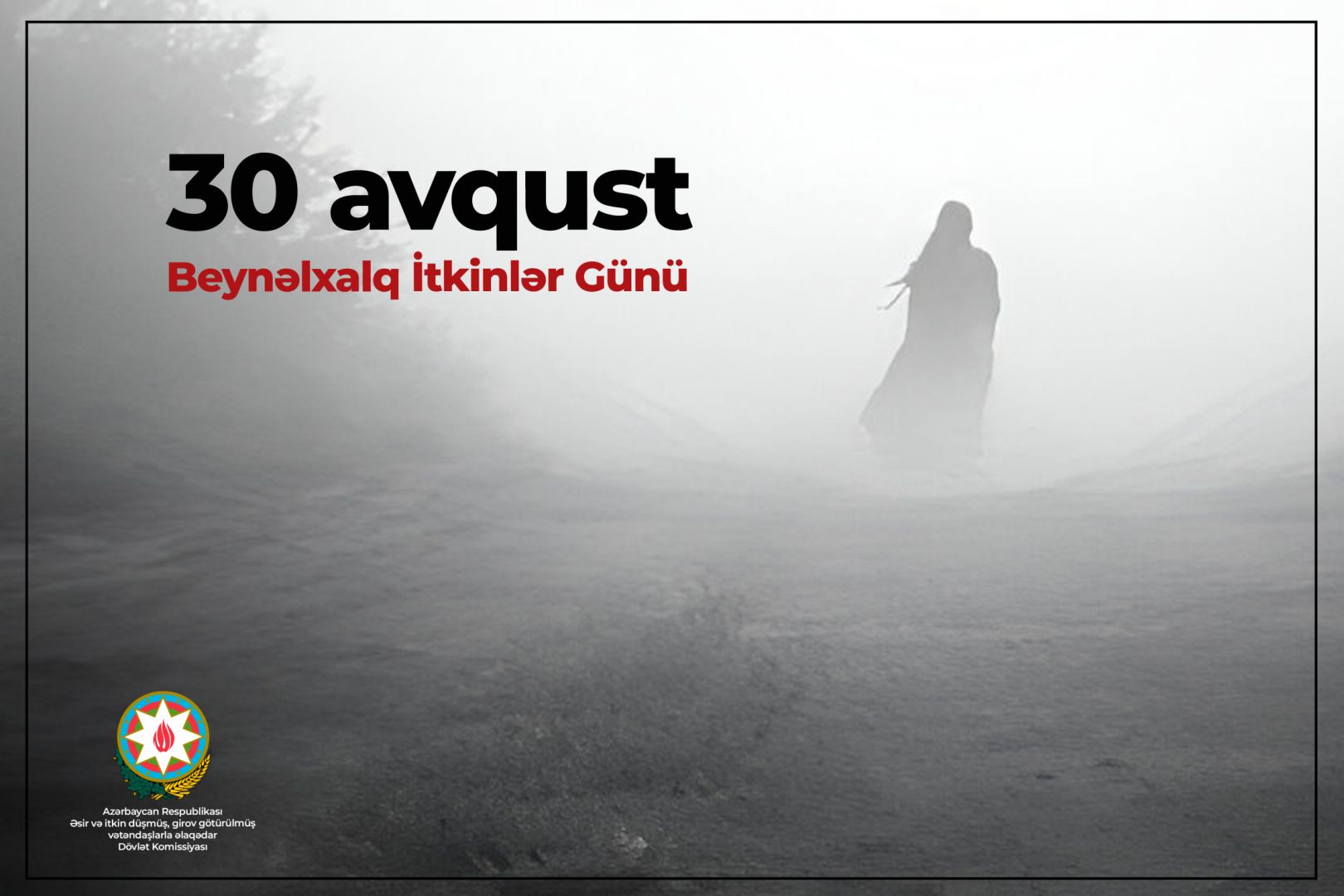
Int'l Day of Victims of Enforced Disappearances highlights plight of missing persons

AzerNEWS Staff
Read moreThe United Nations (UN) General Assembly expressed serious concern in a resolution adopted in 2010 over the growing number of cases of enforced disappearances worldwide. Such cases include the arrest, detention and abduction of individuals.
Under the same resolution (A/RES/65/209), the General Assembly declared August 30 the International Day of the Victims of Enforced Disappearances.
Enforced disappearances have become part of strategies aimed at creating an atmosphere of terror and, according to experts of the UN General Assembly, have evolved into a global problem.
Various public organizations are involved in addressing the issue of missing persons. Traditionally, on this day, these organizations appeal to governments to take all possible measures to prevent and eliminate such cases.
An important instrument in this effort is the International Convention for the Protection of All Persons from Enforced Disappearance, adopted in 2006.
The problem remains unresolved. Hundreds of thousands of cases of enforced disappearance have yet to be investigated, while new cases continue to occur every year. The disappearance of people against their will is one of the most serious and grave violations of human rights.
Enforced disappearance causes severe suffering both for victims and their families. Victims are often subjected to torture and live under constant threat to their lives. Their relatives, unable to obtain information about the fate of their loved ones, remain between hope and despair, waiting anxiously for news for years and, in some cases, never receiving it.
Victims who are deprived of legal protection and effectively "disappeared" from society are stripped of all their rights and become entirely dependent on those who abducted them. Even when a person ultimately survives and escapes this nightmare, the physical and psychological wounds caused by violence, along with the lasting effects of cruelty and torture that often accompany it, never fully heal.
Children may also be among the direct or indirect victims of enforced disappearances. The disappearance of a child constitutes a direct violation of several provisions of the Convention on the Rights of the Child, including the right to recognition of their identity. A child who loses one of their parents as a result of enforced disappearance also suffers a serious violation of their rights.
For this reason, on the International Day of the Victims of Enforced Disappearances, activists and public organizations call on civil society to draw attention to the issue and take all necessary measures within their means to help eliminate it.
4,010 people registered as missing as a result of Armenia's military aggression against Azerbaijan
The Republic of Azerbaijan has faced the humanitarian issue of persons missing as a result of armed conflict, as well as the broader problem of war victims, since Armenia's military aggression against Azerbaijan began in 1988. For many years, Azerbaijani citizens and state institutions have worked tirelessly to address the moral and psychological consequences of this grave situation.
During the First Karabakh War, amid intensive military operations, and throughout the occupation period from 1994 to 2020, Armenian armed formations committed crimes of ethnic cleansing and genocide. Azerbaijani civilians were killed on a mass scale, while those taken prisoner or hostage were held in inhumane conditions and subjected to horrific torture, deprivation and treatment contrary to the principles of humanity. These circumstances resulted in Azerbaijani citizens going missing and their fate remaining unknown. Despite all the difficulties, issues concerning war victims, including citizens who were taken prisoner or hostage and those who went missing, have remained under the constant attention of National Leader of the Azerbaijani people Heydar Aliyev and, subsequently, President Ilham Aliyev. According to data as of June 30 this year, 4,010 people have been registered by the State Commission on Prisoners of War, Hostages and Missing Persons as missing as a result of Armenia's military aggression against Azerbaijan. Of these, 4,004 went missing during the First Karabakh War, while six disappeared during the 44-day Second Karabakh War in 2020. Of the 4,010 missing persons, 3,228 are military personnel and 782 are civilians. Among the civilians, 71 are minors, 288 are women and 319 are elderly people.
Under the framework agreement on the "Collection and Centralized Management of Ante Mortem Information on Missing Persons", signed in 2008 between the State Commission on Prisoners of War, Hostages and Missing Persons and the Delegation of the International Committee of the Red Cross in Azerbaijan, the collection of biological samples from close relatives of missing Azerbaijani citizens began in 2014. Since 2023, this work has been carried out by the Genetic Research Center established within the Main Department of Military Medicine of the State Security Service on the instructions of President Ilham Aliyev. According to data as of June 30 this year, biological samples from 11,542 donors connected to persons missing as a result of Armenia's military aggression against Azerbaijan have been collected and systematized. DNA profiles obtained from the collected biological samples are extracted and archived by the Genetic Research Center of the Main Department of Military Medicine of the State Security Service.
The nearly 30-year occupation of Azerbaijan's internationally recognized sovereign territories prevented the fate of missing Azerbaijani citizens from being established. Following the 44-day war in 2020 and the anti-terror measures carried out in 2023, identifying burial sites belonging to missing citizens in the liberated territories, together with conducting the necessary excavation and exhumation work, became the foremost task assigned to the State Commission by President Ilham Aliyev. Accordingly, intensive searches for burial sites belonging to missing persons, along with excavation, exhumation and identification of discovered human remains, have been conducted in these territories since February 2021.
According to data as of June 30 this year, human remains believed to belong to 893 missing persons have been discovered. Since search and excavation operations began in the liberated territories, 32 mass graves have been identified. Human remains believed to belong to 253 individuals have been recovered from these mass graves and exhumed in the presence of representatives of the investigative authorities.
Here we are to serve you with news right now. It does not cost much, but worth your attention.
Choose to support open, independent, quality journalism and subscribe on a monthly basis.
By subscribing to our online newspaper, you can have full digital access to all news, analysis, and much more.
You can also follow AzerNEWS on Twitter @AzerNewsAz or Facebook @AzerNewsNewspaper
Thank you!