
Türkiye expands judicial dialogue through new partnership with Spain
By News Centre
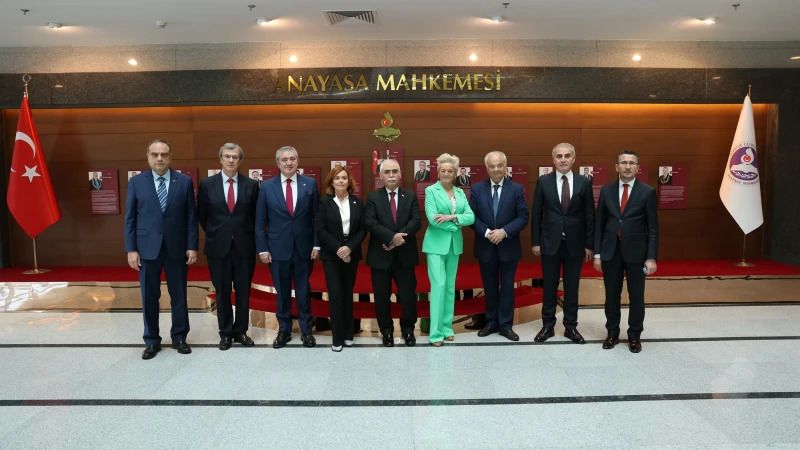
The President of the Constitutional Court of the Republic of Türkiye, Kadir Özkaya, received a delegation from the Constitutional Court of Spain on a working visit to Türkiye. Following the meetings, a cooperation agreement was signed between the two constitutional courts. The visiting delegation, which held a series of high-level engagements in Türkiye, was also received by President Recep Tayyip Erdoğan.
The Spanish delegation, headed by Vice President Inmaculada Montalbán Huertas, visited Türkiye on 15–16 June 2026 within the framework of a mutual understanding reached during the Turkish Constitutional Court’s working visit to Spain in February 2026, which envisaged the continuation of reciprocal exchanges.
President Kadir Özkaya first met Vice President Huertas and her delegation in his office. This was followed by inter-delegation talks. The meetings were attended by Turkish Constitutional Court Vice Presidents Basri Bağcı and İrfan Fidan, as well as judges Engin Yıldırım, Recai Akyel, Yıldız Seferinoğlu, Selahaddin Menteş, Yılmaz Akçil, Ömer Çınar, Metin Kıratlı, and Secretary-General Murat Azaklı. Discussions focused on potential areas of cooperation, best practice examples, and the exchange of institutional experience.
In his remarks, Özkaya expressed satisfaction with the growing strength of relations between the two courts in recent years, stating that this cooperation reflects the deep-rooted friendship and partnership between Türkiye and Spain in the field of constitutional justice. He emphasized that joint efforts within the framework of the World Conference on Constitutional Justice and the Conference of European Constitutional Courts, guided by shared values and objectives, have played an important role in strengthening institutional ties.
Recalling that Türkiye introduced its individual application mechanism in 2012, Özkaya noted that European experiences were examined during its establishment, with Spain’s constitutional complaint system serving as one of the key reference models. He stressed that over time, the individual application system has become a fundamental component of the Turkish constitutional order, significantly contributing to the protection of fundamental rights and freedoms and the strengthening of the rule of law.
Highlighting that Türkiye and Spain share common values under the European Convention on Human Rights framework, Özkaya stated: “Our shared commitments to protecting human dignity, safeguarding fundamental rights and freedoms, and strengthening the rule of law continue unabated. In this regard, the jurisprudence of the European Court of Human Rights (ECtHR) has had a decisive influence on both Turkish and Spanish legal systems. Our constitutional courts serve as a bridge between the ECtHR and national legal orders. The use of ECtHR principles in interpreting and applying constitutional guarantees related to fundamental rights makes a meaningful contribution to the strengthening of a common European legal space.”
Özkaya further described the Spanish Constitutional Court as one of the most respected institutions of constitutional adjudication, noting its internationally recognized contribution to human rights protection, the rule of law, and the development of democratic constitutional order.
Referring to current global challenges, Özkaya emphasized that wars, conflicts, and humanitarian crises once again highlight the importance of protecting human rights. He stated: “In particular, in the face of the severe humanitarian tragedy currently unfolding in Palestine, it is of great importance that strong emphasis is placed on international law, human rights, and the protection of civilians. In this context, we closely follow and appreciate Spain’s and Spanish legal circles’ sensitivity toward the protection of international law and human rights. Every effort to defend universal legal values contributes to building a more just and peaceful world.”
Drawing attention to contemporary issues such as digital transformation, artificial intelligence technologies, personal data protection, freedom of expression, and environmental rights, Özkaya underlined that these developments have made cooperation between constitutional courts more important than ever. Referring to the newly signed agreement, he said:
“We regard this cooperation agreement not only as a document aimed at enhancing institutional collaboration between our two courts, but also as a strong expression of our shared commitment to democracy, human rights, the rule of law, and the ideal of universal justice. I believe this agreement will enhance the exchange of knowledge and experience, encourage joint scientific and academic work, strengthen professional relations between our judges and rapporteurs, and further deepen the friendship between our institutions.”
Vice President Inmaculada Montalbán Huertas expressed her satisfaction at being in Türkiye, thanking the Constitutional Court for its hospitality. She noted that reciprocal visits between the two constitutional courts would further strengthen existing ties and friendly relations. She emphasized that such exchanges provide valuable opportunities for sharing experience and significantly contribute to the development of constitutional justice.
Huertas also underlined that the friendly relations between Türkiye and Spain positively influence judicial dialogue and cooperation. She expressed confidence that the cooperation agreement would elevate institutional relations to a higher level, adding that maintaining constructive dialogue with the Turkish Constitutional Court is a priority. She concluded by expressing hope that strong ties between the two countries would continue through joint projects and reciprocal visits.
Following the talks, technical working sessions were held focusing on the exchange of knowledge and experience. In sessions titled “Constitutional Complaint Mechanism” and “Constitutional Jurisdictional Conflicts and Resolution Procedures,” presentations were delivered by Vice President Basri Bağcı, Judge Engin Yıldırım, and Spanish Constitutional Court members María Luisa Segoviano Astaburuaga and José María Macías Castaño.
During the visit, a bilateral cooperation agreement was signed with the aim of enhancing cooperation and dialogue between the two constitutional courts and promoting the exchange of knowledge and experience.
Özkaya described the agreement as a natural outcome of the constructive dialogue initiated in Madrid in February 2026 and as a new phase in institutional relations, stressing its value in strengthening the fundamental principles of constitutional justice. Vice President Huertas also expressed her belief that the agreement would reinforce cooperation between the courts and contribute significantly to the protection of the rule of law and fundamental rights and freedoms.
President Recep Tayyip Erdoğan received Vice President Inmaculada Montalbán Huertas and the accompanying delegation at the Presidential Complex in Ankara, upon invitation from the Turkish Constitutional Court. President Özkaya was also present at the meeting.
The Spanish Constitutional Court delegation also met separately with the President of the Court of Cassation of Türkiye (Yargıtay), Ömer Kerkez, and the President of the Council of State of Türkiye (Danıştay), Zeki Yiğit.
Here we are to serve you with news right now. It does not cost much, but worth your attention.
Choose to support open, independent, quality journalism and subscribe on a monthly basis.
By subscribing to our online newspaper, you can have full digital access to all news, analysis, and much more.
You can also follow AzerNEWS on Twitter @AzerNewsAz or Facebook @AzerNewsNewspaper
Thank you!