
Emine Erdoğan calls for global action on protecting children in digital world

AzerNEWS Staff
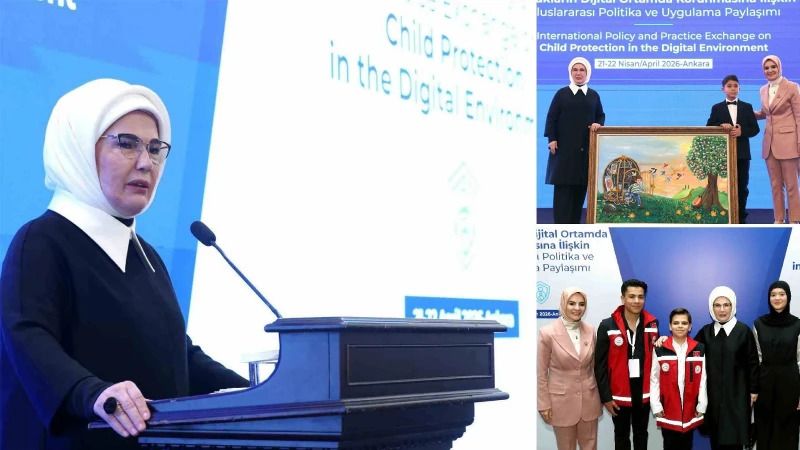
Read moreThe Ministry of Family and Social Services, in cooperation with the Office of the United Nations (UN) Secretary-General’s Special Representative on Violence Against Children and UNICEF, organized a meeting at a hotel titled “International Policy and Practice Sharing on the Protection of Children in the Digital Environment.”
Emine Erdoğan, speaking at the event, stated that in today’s world, dangers surround children not only on the streets or in the physical world but also in the borderless digital space. She emphasized that the risks faced by children—who make up one-third of internet users worldwide—have reached alarming levels.
Noting that this issue transcends national borders and requires the development of joint solutions and coordinated action, Emine Erdoğan thanked the Ministry of Family and Social Services for hosting such a meaningful meeting, as well as UNICEF and the UN Secretary-General’s Special Representative on Violence Against Children for their valuable cooperation.
She said that thanks to information technologies, children today have access to learning and development opportunities that previous generations did not, such as AI-supported learning tools, online education platforms, and global information networks.
Emine Erdoğan stated that children can access information and millions of resources in the digital world with a single click, adding:
“However, unfortunately, in the same world, all kinds of abuse also reach children at the same speed—again, with a single click. Research shows that more than 300 million children globally are exposed to online abuse and harassment every year. The fact that the frequency of such cases can drop to one every 10 seconds clearly reveals the scale of this ‘silent epidemic’ that surrounds every country, every household, and every school.”
She noted that children today do not merely spend time in the digital world but grow up in it, building their social relationships, values, and identity there. She continued:
“Unfortunately, as adults, we are pushed out of this world with the label of digital immigrants. Just as our right to draw boundaries in a digital world where children are declared natives has been taken away, every step taken in this framework has been blocked with allegations of censorship. Whenever parents express concerns, they are accused of being behind the times. When regulations concerning digital platforms become a matter of social policy, governments are accused of being authoritarian. Unfortunately, the result of this situation has been that children and young people are surrounded by risks such as cyberbullying, digital addiction, misuse of personal data, violent content, discrimination, and hate speech. Today, we are paying the price of this boundlessness through damage to children’s psychological, mental, cognitive, social, and physical development.”
Emine Erdoğan pointed out that children now spend more than half of their waking hours in front of screens, stating:
“An 8.5-hour screen time filled with social media and computer games means a kind of digital vegetative existence.”
She underlined that Türkiye has taken important steps to protect children, saying:
“With the ‘Action Plan for Empowering Children in the Digital World’ implemented by our Ministry of Family and Social Services, we are addressing the issue with a holistic strategy. In addition, the ‘Convention on Children’s Rights in the Digital World’ prepared by the Ministry is an important international call aimed at protecting, supporting, and empowering children in digital environments. I take this opportunity to invite all stakeholders to sign this convention. Let us not forget that making the digital world safer for children is a shared responsibility not only of families but also of public institutions, technology companies, international organizations, and the media industry. In particular, technology companies must be accountable and design child-friendly systems.”
She noted that laws restricting access to social media for young children are on the agenda in countries such as Australia, France, and Denmark, adding:
“There is a global awakening in this regard. In our country, a bill has been submitted to the Turkish Grand National Assembly to regulate children’s access to age-appropriate social media and gaming content. In this framework, it is planned to restrict access to social media for children under the age of 15, while providing age-appropriate services and parental control tools for those over 15.”
Emine Erdoğan said she sees families as the most important stakeholders in making digital environments safe and beneficial for children’s education:
“If we are to raise our children as strong and conscious individuals who can carry the future, pulling them out of the unsafe backstreets of the digital world, we must do this hand in hand with parents.”
She also stated that there are a few key principles in addressing the issue:
“The first is rebuilding the boundaries that have been eroded by digitalization. Many of today’s problems stem from equating boundlessness with freedom. True freedom is not the unrestricted ability to do anything, but the ability to think critically and set limits against elements that invade the mind, intellect, and soul. As the saying goes, what distinguishes medicine from poison is the dose. Similarly, while technology has the potential to advance humanity, if left uncontrolled, it can threaten the future of humanity. Digitalization may increase efficiency in many areas, but if control is lost, children’s lives may be invaded by digital nannies, digital friends, and digital playgrounds. That is why we need strong boundaries.”
Expressing confidence that every parent understands where boundaries should be drawn, she continued:
“Parenting is the oldest profession in the world. If a child wanted to go out alone in the middle of the night, would we allow it? Would we let a stranger take them by the hand? Would we accept gambling, deviant propaganda, or activities that endanger their lives? Of course, the answer to all of these is ‘no.’ Therefore, let us also draw safe boundaries for our children in digital environments, without forgetting that they face the same dangers there. Likewise, educators are the architects and protectors of these boundaries, which guarantee true freedom. I believe that with a shared understanding and strong cooperation, we can provide children with digital literacy skills and realign the current course.”
She added that strengthening family communication is another key solution:
“Let us not give up on eye-to-eye, heart-to-heart, face-to-face communication and spending time together as families. The family, as it was yesterday, remains today our only refuge against the storms of life.”
Emine Erdoğan emphasized the importance of the exchange of ideas at the meeting, noting that participants would share best practices, develop joint projects, and encourage technology companies to adopt higher standards for child safety.
She expressed confidence that these efforts would produce positive outcomes such as global campaigns for parents and programs enhancing young people’s digital skills, stating that Türkiye is ready to contribute to all constructive initiatives in line with this shared goal.
After her speech, Emine Erdoğan was presented with a painting by a child depicting “escape from the cage of the digital world.”
The program concluded with a family photo session.
Here we are to serve you with news right now. It does not cost much, but worth your attention.
Choose to support open, independent, quality journalism and subscribe on a monthly basis.
By subscribing to our online newspaper, you can have full digital access to all news, analysis, and much more.
You can also follow AzerNEWS on Twitter @AzerNewsAz or Facebook @AzerNewsNewspaper
Thank you!