
ADEX shows how Azerbaijan is rewriting its defence strategy
Akbar Novruz
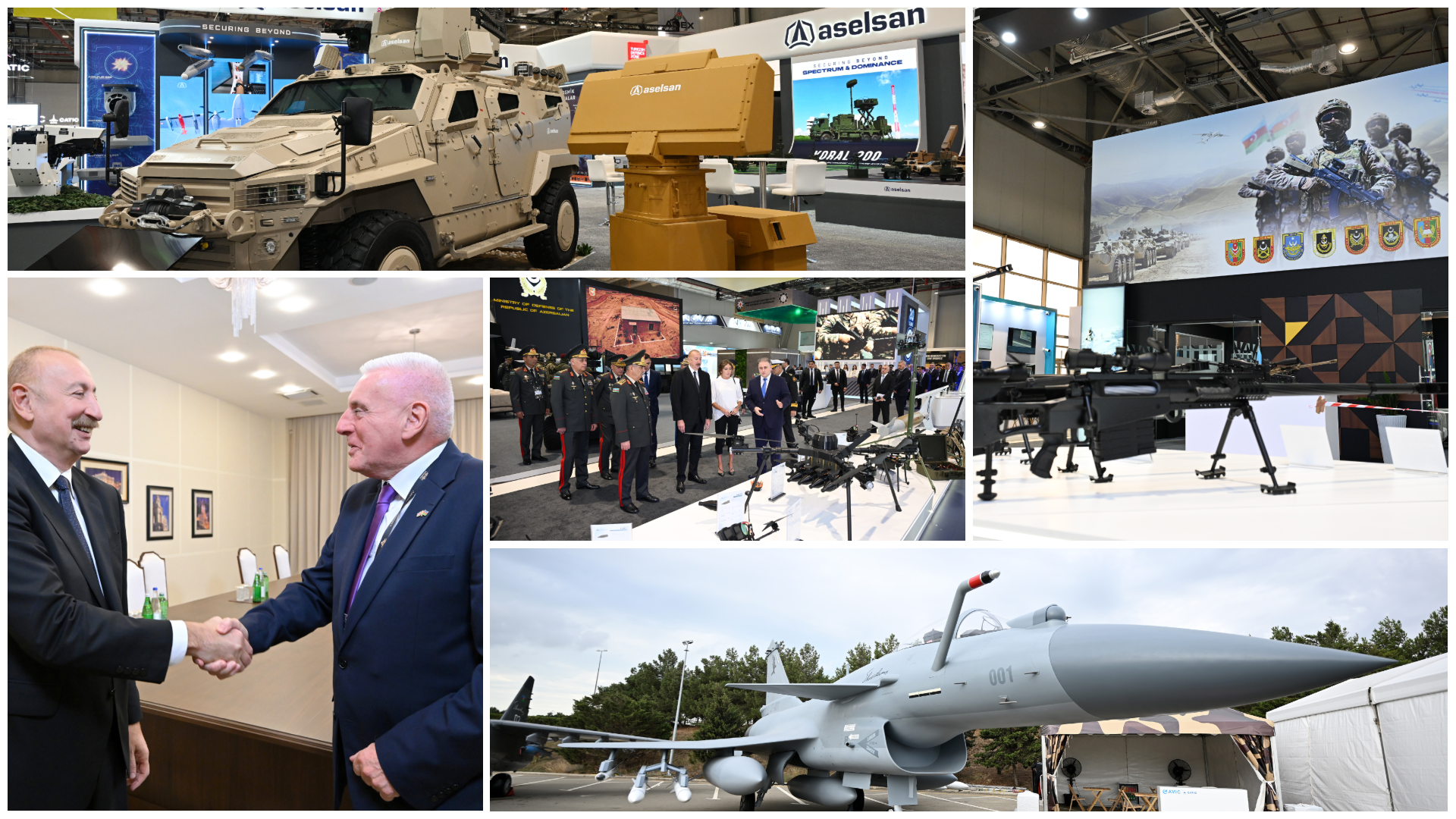
Read moreWalk the halls of the Baku Expo Center this week and you could, in theory, outfit a small army, tanks from China, loitering munitions from Israel, anti-drone systems from the UAE, and the ammunition to keep them all firing from half a dozen countries besides - that was my impression in my first thirty minutes at the venue. That, more or less, was the point of ADEX 2026, the sixth Azerbaijan International Defence Exhibition, which opened alongside its sister event Securex Caspian on September 30th with President Ilham Aliyev and First Lady Mehriban Aliyeva touring the stands. The main story this time, per se, was that Azerbaijan was the one selling.
The sheer size of the event already set it apart from other editions of ADEX. Organisers even had to put up an additional pavilion at the Expo Center in order to accommodate all the exhibitors, and for the first time ever, a special hall was dedicated exclusively to hosting a national exhibition of domestically manufactured weapons and military equipment. Numbers bear witness to the expansion as well: in total, 277 companies from 30 countries participated in both events, with 59 foreign delegations from 39 countries registering and 14 national pavilions being hosted. The largest group of exhibitors came from Türkiye, which is not surprising in light of the "one nation, two states" defence cooperation model established between Baku and Ankara after the Karabakh conflict in 2020. For the first time in history, some major American defence contractors also showed up at ADEX, which Azerbaijani representatives were eager to emphasize, one of them being Lockheed Martin.
The exhibitors list was like a roll call of the biggest names in the international arms trade. Turkish aircraft manufacturer Baykar, builder of the TB2 drone, which has customers in over 30 countries, had its jet-engined Kizilelma unmanned combat air vehicle together with the carrier variant TB3. Turkish electronics firm Aselsan, placed among the top 50 defence manufacturers in the world, exhibited radar and electronic warfare systems. The United Arab Emirates' EDGE Group, formed in 2019 through a merger of over 25 companies and now ranking in the top 25 worldwide, had precision-guided munitions on display. Israeli defence industry included IAI, Rafael and Elbit Systems - producers, respectively, of the loitering munition Harop, the anti-missile system Iron Dome and the Hermes series. Chinese aerospace and armoured vehicle industries were represented by China National Aviation Industry Corporation International and China North Industries Corporation, a stone's throw away from German company Rheinmetall and British BAE Systems, Europe's largest defence corporation. Even Russia's Rosoboronexport had a presence, a reminder that Baku's defence diplomacy runs through Moscow as readily as through Washington or Ankara.
From buyer to builder, Azerbaijan aims high
What has genuinely changed since Azerbaijan's earlier defence fairs, though, is the weight given to the host country's own industry. Azersilah, the Defence Industry Holding President Aliyev created by decree in 2023, anchored the national pavilion, showing artillery components, unmanned systems and the kind of hardware that, a decade ago, Azerbaijan would simply have imported. The holding's remit, consolidating what had been scattered, ministry-run factories into a single entity capable of forming joint ventures and courting foreign investment, reflects a deliberate industrial-policy choice rather than mere showmanship. Officials say the country now manufactures more than 1,000 types of military-purpose products domestically and exports them to over 30 countries, a claim that would have sounded implausible before the 2020 war, when Azerbaijan's defence sector was still overwhelmingly an importer's operation built on Israeli and Turkish hardware, Soviet legacy stocks, and comparatively little of its own design work.
Perhaps the most conspicuous object on the floor, however, did not originate in Azerbaijan. A full-scale replica of the J-10CE – the export version of the "Vigorous Dragon" Chinese fighter – was presented by AVIC, complete with Azerbaijani Air Force insignia and the serial number 27-001 – a degree of branding specificity that far exceeds the usual marketing approach at the trade shows. Azerbaijan's air force chief inspected the same aircraft at the Zhuhai Airshow back in 2024, and Baku has since inducted Chinese-Pakistani JF-17 Block III jets, suggesting China's fighter export push is finding more traction here than it has with the dozen-odd other countries AVIC has pitched the J-10CE to over the years. Pakistan remains, for now, the only confirmed foreign operator, alongside Uzbekistan's recently delivered order. Nothing in Baku or Beijing's public statements confirms an actual purchase agreement, and a livery-marked replica is a sales pitch, not a signed contract. This is based solely on my personal observations. But it is a considerably more pointed pitch than AVIC tends to make, and if it does convert into an order, it would mark China's most significant fighter-jet inroad yet.
And indeed, this change is owed to the lessons Azerbaijan learned on the battlefield itself. The 44-day war showed what types of military technology mattered most: precision-guided munitions, loitering drone technology, electronic warfare capabilities, and the resulting product line is an obvious answer: the native-built Tufan mine-resistant vehicle, designed in just six months and on its way towards mass production; the ITX-15 and ITX-20 armored personnel carriers, introduced at the last ADEX; and the Fireforce, the first-ever locally made laser weapon. None of this is to say that Azerbaijan can yet be considered a leading military exporter, like Türkiye or Israel. But this is clearly a real change in direction from a nation where its defence budget – some 6.66 billion manats, or roughly $3.9 billion, allocated for defence and security in 2025, almost 17% of state budget expenditure- was almost entirely devoted to exports, to a country that is starting to keep much more of both at home.
The clearest sign of Baku's next steps in this relationship came not on the exhibition floor, but in a separate meeting that day, when President Ilham Aliyev met with Lord Vernon Coaker, the United Kingdom's defence minister of state. The British delegation to ADEX, including BAE Systems and a 14-company delegation from the Cambridge Chamber of Commerce, represented a substantial expression of interest, given Britain’s traditionally smaller defence footprint in the South Caucasus region. During the course of the meeting, the president stated that “defence industrial cooperation is a new chapter” of the relationship between Britain and Azerbaijan, talking about potential joint ventures and production lines rather than just armaments.
Conclusively, take the tour through the exhibition hall, and the point will be hard to miss: Americans who are new to the field next to Chinese state suppliers, Israeli missile manufacturers beside a UK government booth, Turkish UAV makers in proximity to Russia’s own weapons sales representative. No one manufacturer gets to feel indispensable at this expo, and that is the whole idea. Thirty years of Azerbaijani experience has taught the country what happens when one is too reliant on another. ADEX 2026 was proof of that lesson being learned.
Here we are to serve you with news right now. It does not cost much, but worth your attention.
Choose to support open, independent, quality journalism and subscribe on a monthly basis.
By subscribing to our online newspaper, you can have full digital access to all news, analysis, and much more.
You can also follow AzerNEWS on Twitter @AzerNewsAz or Facebook @AzerNewsNewspaper
Thank you!