
Azerbaijan's debt reduction reinforces long-term fiscal resilience

Qabil Ashirov
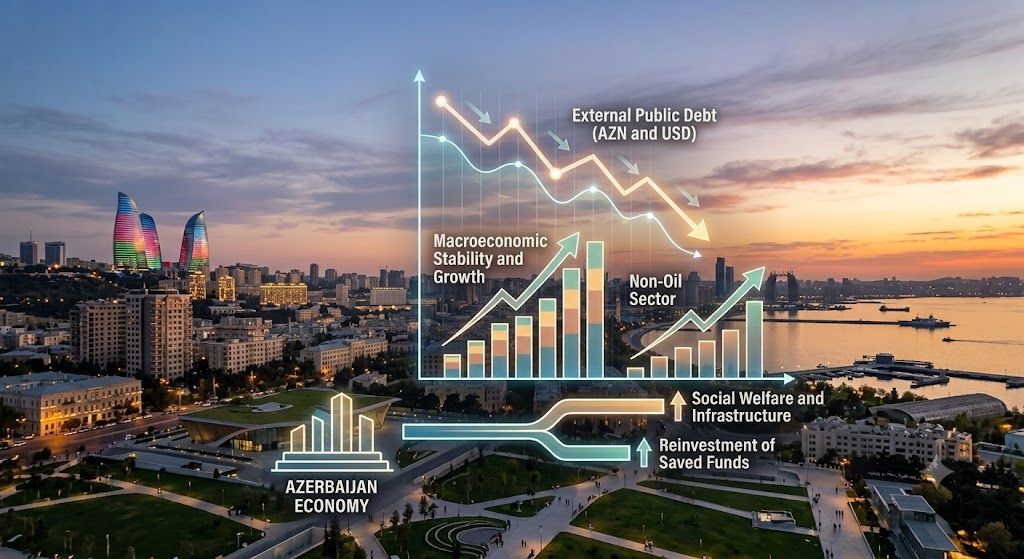
Read moreFor emerging economies, particularly those structurally tied to energy exports, the management of external liabilities serves as a primary litmus test for long-term fiscal sustainability. It is within this context that Azerbaijan’s recent fiscal trajectory demands careful analysis. As reported by the State Statistics Committee, Azerbaijan's external public debt descended to $4.6168 billion as of July 1, 2026. This reflects a commendable 7.9% year-on-year decline, down from approximately $5.0128 billion twelve months prior. By systematically retiring nearly $396 million in foreign liabilities over a single year, the Azerbaijani government is not merely executing a balance-sheet adjustment; it is actively securing a strategic macroeconomic dividend that will resonate across its domestic economy for decades to come.
To truly appreciate the value of this aggressive deleveraging strategy, one must understand the multifaceted vulnerabilities inherent to external debt. When a nation borrows extensively in foreign currencies, such as the United States dollar or the Euro, it exposes its structural integrity to external shocks beyond its control. Fluctuations in international interest rates, tightening global liquidity, and domestic currency depreciation can exponentially inflate the real cost of servicing foreign debt. By aggressively driving down its absolute debt stock, Azerbaijan systematically immunizes its public finances against these external systemic contagions. This proactive reduction in foreign currency liabilities provides a formidable buffer, ensuring that national financial planning remains driven by domestic developmental priorities rather than volatile international debt obligations.
Furthermore, the most immediate and quantifiable consequence of this debt reduction is the dramatic optimization of state budgetary allocations. Every dollar that is borrowed externally carries an ongoing price tag in the form of interest payments. For many developing nations, debt servicing functions as a persistent fiscal drain, cannibalizing vital capital that could otherwise fund domestic growth. As Azerbaijan minimizes its external obligations, it simultaneously curtails the volume of capital leaking out of the country to foreign creditors. The financial capital preserved through lowered interest obligations transforms directly into a fiscal surplus that can be productively reinvested at home. These freed-up public funds can be strategically deployed into high-yield domestic sectors: upgrading transport infrastructure, modernizing the healthcare framework, funding advanced education, and strengthening the social safety net. In essence, paying off foreign lenders today directly expands the economic sovereignty and financial capacity of the state tomorrow.
Beyond immediate budgetary relief, the systematic contraction of external debt acts as a powerful catalyst for institutional investor confidence and sovereign prestige. Global capital markets and credit rating agencies closely monitor a nation’s debt-to-GDP ratio and its trajectory of external liabilities. Azerbaijan’s consistent commitment to lowering its debt profile sends an unambiguous signal to international markets regarding its fiscal discipline and macroeconomic maturity. This deliberate deleveraging bolsters the country's sovereign credit ratings, positioning it as an island of stability in a turbulent regional environment. Higher creditworthiness reduces the cost of capital across the entire economy. Should the government or prominent domestic enterprises require external financing in the future for large-scale industrial or green-energy transitions, they will be able to secure these funds at significantly more favorable interest rates. Thus, reducing debt today establishes a foundation for cheaper, more sustainable financing in the future.
Simultaneously, this fiscal policy acts as a crucial anchor for domestic monetary stability, specifically supporting the stability of the national currency, the Azerbaijani Manat. Servicing external debt requires the steady outflow of foreign exchange reserves. When external debt pressures are high, a central bank faces constant pressure to liquidate foreign assets to meet these obligations, which can imperil the domestic currency’s exchange rate. Azerbaijan's strategy reduces this structural demand for foreign currency, allowing the Central Bank to preserve and accumulate robust foreign exchange reserves. A heavily fortified reserve position enhances the central bank’s capacity to absorb speculative shocks, maintain exchange rate predictability, and anchor domestic inflation. For businesses and consumers alike, a stable currency mitigates transaction risks, stimulates domestic demand, and fosters a predictable environment conducive to long-term private capital investments.
Finally, the philosophical dimension of Azerbaijan’s fiscal strategy centers on intergenerational equity and sustainable diversification. Over-reliance on foreign debt often shifts the economic burden of contemporary spending onto future generations of taxpayers. By aggressively retiring debt during periods of fiscal viability, the current administration ensures that future generations inherit a lean, agile, and unburdened sovereign balance sheet. This structural agility is vital as Azerbaijan aggressively pursues its non-oil economic diversification strategy. An unburdened economy possesses the fiscal space required to experiment, innovate, and subsidize emerging sectors like digital technology, logistics, and agriculture without the constant fear of a debt crisis.
In conclusion, the marginal slowing of the debt reduction pace by a fraction of a percentage point between June and July 2026 does nothing to obscure the grander narrative. The overriding trajectory remains clear, purposeful, and profoundly beneficial. Azerbaijan’s systematic dismantling of its external public debt represents a masterclass in forward-thinking macroeconomic stewardship. By insulating the nation from currency risks, optimizing the national budget for internal development, lowering the cost of future capital, and securing intergenerational equity, this strategy does not merely protect existing wealth—it builds a bulletproof foundation for the country’s future prosperity.
Here we are to serve you with news right now. It does not cost much, but worth your attention.
Choose to support open, independent, quality journalism and subscribe on a monthly basis.
By subscribing to our online newspaper, you can have full digital access to all news, analysis, and much more.
You can also follow AzerNEWS on Twitter @AzerNewsAz or Facebook @AzerNewsNewspaper
Thank you!