
Why Alat Free Economic Zone emerging as Eurasia's next manufacturing hub

Qabil Ashirov
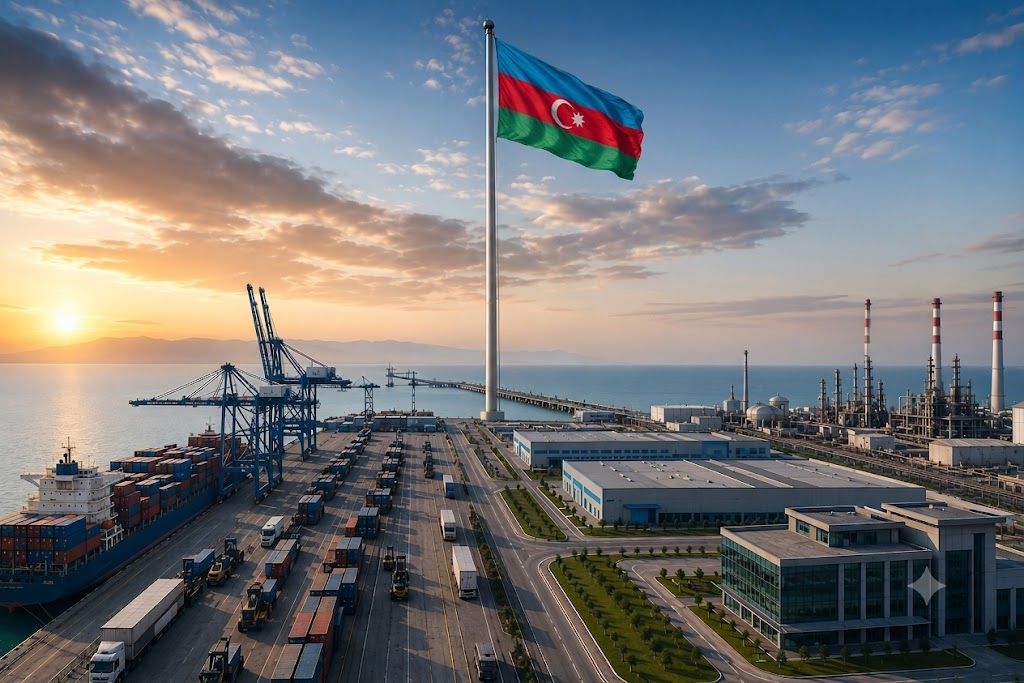
Read moreThe structural evolution of regional trade corridors has entered a transformative phase, driven by the global competition for supply chain resilience and near-shoring advantages. Within this context, the recent legislative amendment granting a fifteen-year customs duty exemption for goods produced within the Alat Free Economic Zone represents a calculated shift in state-directed economic architecture. By decreeing that entities exporting at least half of their manufactured output can access the domestic market completely tariff-free, policymakers are shifting from a traditional oil-funded model toward an integrated, export-led industrial strategy. This structural adjustment is not merely a localized regulatory update; it is a sophisticated geoeconomic maneuver designed to transition a strategic transit country into a dominant regional production and processing hub at the crossroads of Eurasia.
For decades, midstream transport corridors across central Eurasia operated primarily as passive transit pipelines, capturing minimal domestic value-add from the massive volumes of cargo moving between East Asian manufacturing centers and European consumer markets. The introduction of this specific fiscal mechanism directly challenges that historical model. By linking domestic market access to international export performance, the legislative framework effectively incentivizes multinational corporations to anchor their manufacturing, assembly, and high-tech processing units physically within the free zone. This strategy addresses a structural challenge that often plagues emerging special economic zones: the tendency for isolated industrial enclaves to remain disconnected from the broader domestic economy. Under the new protocol, the internal market acts as an intentional financial catalyst, utilizing its consumer demand to absorb the remaining portion of a firm’s production and bolster the commercial viability of large-scale manufacturing.
Furthermore, the operational architecture of this policy reflects an acute understanding of institutional predictability and investor risk mitigation. In the capital-intensive sectors of advanced manufacturing and industrial processing, where long-term amortization schedules dictate investment decisions, a guaranteed fifteen-year regulatory window is essential. This statutory longevity protects foreign direct investment from the unpredictable shifts of short-term fiscal policy, providing the long-horizon stability necessary to commit substantial capital to fixed assets and specialized supply networks. By formalizing this commitment well in advance of its scheduled implementation at the start of the upcoming fiscal year, the state is signaling its readiness to compete directly with established global logistics hubs for high-value manufacturing projects.
Crucially, the success of this integration model depends on the meticulous execution of rules of origin and regulatory compliance within the zone. Managing a dual-destination trade framework—where an industrial asset must satisfy external export quotas before gaining access to domestic consumer markets—requires transparent, friction-free customs administration. The institutional framework must ensure that processing activities within the zone reflect genuine industrial transformation rather than superficial re-packaging designed to bypass standard tariff regimes. If executed with high regulatory clarity, this system will incentivize the development of localized supply chains, encouraging international operators to source raw materials and intermediate inputs from domestic suppliers to satisfy local content requirements and optimize their cost structures.
Ultimately, this targeted tariff concession serves notice to the international community that the Caspian’s central maritime hub is shifting from a passive transshipment point to an active, value-generating economic center. For global logistics networks and manufacturing conglomerates seeking long-term structural alternatives to traditional, vulnerable maritime supply lines, an institutionalized free economic zone tied to a major port infrastructure offers a highly compelling strategic anchor. By directly aligning fiscal incentives with global export metrics, the state is moving beyond the simple collection of transit fees, ensuring that the wealth generated along regional trade corridors is captured to drive domestic industrial diversification and human capital development. As this legal framework comes into full effect, it will establish a new geoeconomic reality, demonstrating how calculated trade policy can transform geographic positioning into a sustainable driver of structural economic growth.
Here we are to serve you with news right now. It does not cost much, but worth your attention.
Choose to support open, independent, quality journalism and subscribe on a monthly basis.
By subscribing to our online newspaper, you can have full digital access to all news, analysis, and much more.
You can also follow AzerNEWS on Twitter @AzerNewsAz or Facebook @AzerNewsNewspaper
Thank you!