
How Azerbaijan, EU built pragmatic and energy-driven partnership

Ulviyya Poladova
Read moreThe European Union's relationship with Azerbaijan has long followed a pragmatic, interest-driven path rather than a transformative integration model. At the center of this relationship stands the Partnership and Cooperation Agreement (PCA), signed in 1999, which created the legal and political framework for bilateral engagement. Unlike the EU's relations with candidate countries or states more closely tied to the European Neighborhood Policy's normative ambitions, cooperation with Azerbaijan has been shaped less by the goal of institutional convergence and more by mutual strategic benefit.
Following its independence, Azerbaijan placed significant emphasis on establishing strong ties with the European Union. Under the leadership of National Leader Heydar Aliyev, cooperation with European institutions was identified as one of the key priorities of the country’s foreign policy. This strategic orientation reflected Azerbaijan’s aim to integrate into global economic and political systems while maintaining balanced relations with various international actors.
A major milestone in EU-Azerbaijan relations came in 2009 with Azerbaijan’s participation in the Eastern Partnership (EaP) initiative. The EaP provides a structured platform for cooperation between the EU and six Eastern European and South Caucasus countries. For Azerbaijan, this framework has enabled both bilateral engagement with the EU and participation in multilateral dialogue on issues such as economic development, governance, energy security, and regional connectivity.
While bilateral relations remain the cornerstone of cooperation, the Eastern Partnership complements this by facilitating policy dialogue and exchange of best practices. It also allows Azerbaijan to promote its national interests in a broader regional context while engaging with European partners on shared challenges.
The European Union is Azerbaijan’s largest trading partner, playing a central role in the country’s external economic relations. It is also Azerbaijan’s primary export destination and one of its most significant sources of imports. This trade structure is largely driven by energy exports, particularly oil and gas, which constitute a major share of Azerbaijan’s export revenues.
Beyond energy, bilateral trade includes machinery, industrial goods, and agricultural products. The EU’s role as a key economic partner has also contributed to Azerbaijan’s efforts to diversify its economy, attract foreign investment, and develop non-oil sectors. European companies have been actively involved in infrastructure, transport, and energy projects within Azerbaijan.
Energy cooperation represents the most strategically important dimension of EU–Azerbaijan relations. The European Union is a major consumer of Azerbaijani oil and natural gas, much of which is transported via pipelines crossing Azerbaijan and neighboring countries.
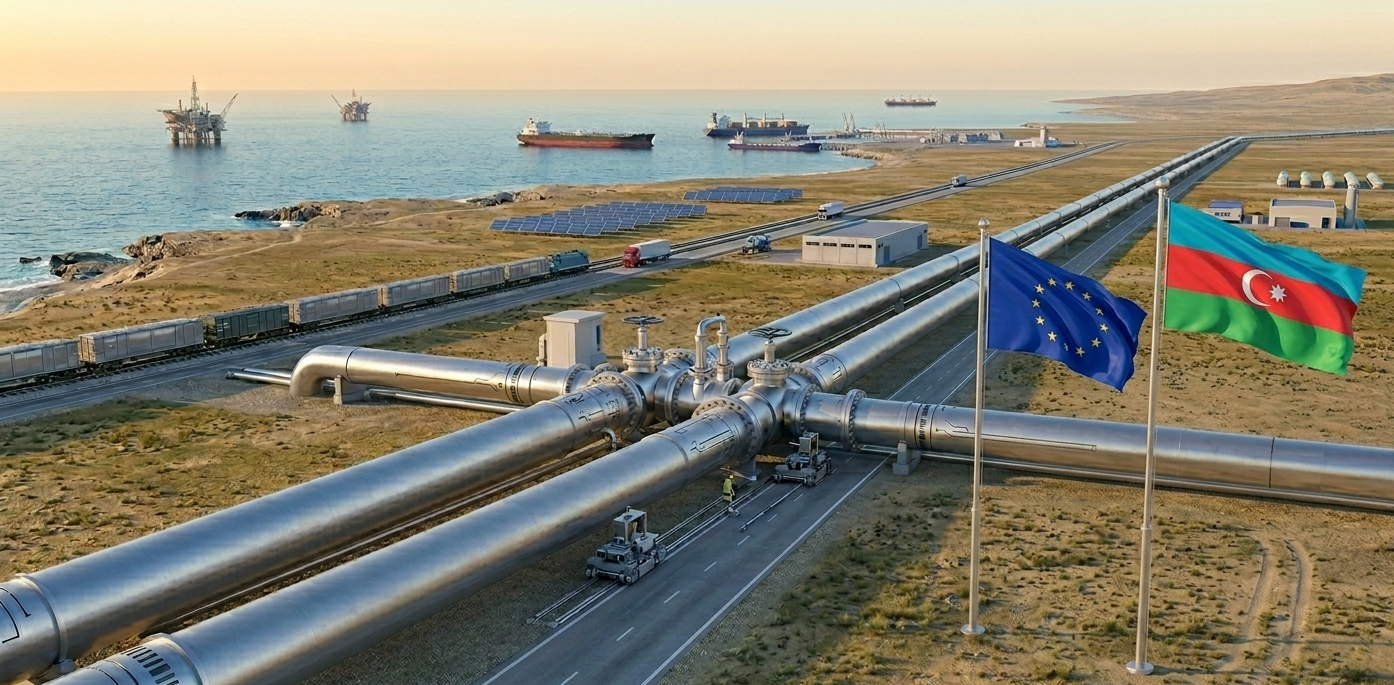
A cornerstone of this cooperation is the Southern Gas Corridor, a large-scale infrastructure project designed to transport natural gas from the Caspian Sea region to European markets. The project is widely regarded as one of the EU’s key initiatives aimed at diversifying energy supply sources and enhancing energy security.
The Southern Gas Corridor consists of several interconnected pipeline systems. The Trans-Anatolian Natural Gas Pipeline (TANAP) runs through Türkiye, linking Georgia to Europe, while the Trans Adriatic Pipeline (TAP) transports gas from the Turkish-Greek border through Greece and Albania, ultimately delivering it to Italy. Together, these pipelines provide a direct route for Caspian gas to reach European consumers, reducing dependence on traditional supply routes.
Azerbaijan’s role in the EU’s energy supply has expanded further in recent years. In particular, the energy dialogue between Baku and Brussels intensified against the backdrop of the EU’s efforts to reduce its dependence on Russian gas following the Russian-Ukrainian war of 2022. In July 2022, a new Memorandum of Understanding on energy cooperation was signed between the EU and Azerbaijan, setting the goal of roughly doubling gas supplies from Azerbaijan to the EU by 2027. By 2024, the annual volume of gas exported to the EU had already increased significantly compared to a decade earlier.
Energy cooperation is not limited to fossil fuels. The EU and Azerbaijan are exploring partnership opportunities in renewable energy and the "green economy." Given Azerbaijan’s strong wind and solar potential, the country is cooperating with several European companies on the development of wind power plants and digital energy solutions. In 2022, the leaders of Azerbaijan, Georgia, Romania, and Hungary signed an agreement on constructing an undersea electric cable across the Black Sea. This project may enable the export of renewable electricity generated in Azerbaijan’s Caspian coastal regions to EU countries in the future. Thus, Azerbaijan intends to contribute to Europe’s long-term energy security not only through oil and gas but also through alternative energy sources.
The country also occupies a crucial place as a geopolitical and transit hub. Located at the crossroads of East-West and North-South routes, Azerbaijan links the Caspian region with Europe and serves as a corridor for trade, energy, and transport flows. This makes it increasingly relevant to EU efforts to diversify not only energy routes but also commercial and logistical networks. In an era of shifting global supply chains and heightened geopolitical fragmentation, transit connectivity has become an asset of strategic value. Azerbaijan's ports, rail links, and overland corridors enhance its appeal as a partner beyond the energy sector.
This brings into focus a central characteristic of the relationship: its bilateral rather than integration-oriented nature. The EU's partnerships with some neighboring countries often involve conditionality, approximation to EU law, and long-term institutional harmonization. In Azerbaijan's case, however, cooperation has generally been pursued on a more sovereign and transactional basis. Baku has consistently favored a model that protects national decision-making and avoids commitments that could be interpreted as steps toward political integration. The EU, for its part, has adapted to this reality by emphasizing functional cooperation where interests overlap.
This model has advantages. İt allows both sides to cooperate without forcing unrealistic expectations. Azerbaijan can maintain a multi-vector foreign policy, balancing ties with the EU, Türkiye, USA, Russia, and other regional actors. The EU can secure access to energy resources, transport corridors, and political dialogue without overcommitting to a difficult integration process.
Azerbaijan’s cooperation with Europe is not limited to relations with the European Union as an institution. Alongside EU–Azerbaijan frameworks, Baku has developed strong bilateral ties with individual European countries.
The relationship between Azerbaijan and the European Union demonstrates how a non-EU country can maintain deep and strategic cooperation with a major international organization without formal integration. Through structured agreements, energy partnerships, and participation in regional initiatives, Azerbaijan has developed a stable and pragmatic relationship with the EU.
Here we are to serve you with news right now. It does not cost much, but worth your attention.
Choose to support open, independent, quality journalism and subscribe on a monthly basis.
By subscribing to our online newspaper, you can have full digital access to all news, analysis, and much more.
You can also follow AzerNEWS on Twitter @AzerNewsAz or Facebook @AzerNewsNewspaper
Thank you!